
What Football Locker Rooms Can Teach Us About Race

My sophomore year of college, I rented a two-bedroom apartment for the school year. Right before the year started, I had a roommate back out on me. I went to my football coaches and asked if they knew anybody who needed a room because I couldn’t afford the apartment on my own. They hooked me up with a new kid on our football team.
Menyada was a black fullback from California. He had long dreadlocks, was as dark as any human I had ever met, and was 240 pounds. Menyada was not the roommate I thought I was looking for, but he ended up being the one I needed. Since I was not in a position to be choosy, I was happy to say yes.
He was a tremendous roommate and we had some interesting conversations about race. I think about these late-night, college conversations whenever I see the race issue pop up in our world, like it has this week in Minnesota and eventually around the nation.
Menyada played his first college football season in Tennessee, at the University of Tennessee-Martin. That was much bigger football than Southern Oregon, so one of our first conversations started there. It was the beginning of a race discussion that was disguised as a football discussion. I joke with my students that I don’t know much outside of football, so everything I know is somehow tied back to sports. There is a lot of truth to this joke.
I learned quickly that growing up as a black person was different than growing up as a white person. Not better, not worse, but different.
“That was a new concept to me — that racism was a spectrum.”
Menyada had left Tennessee because the racism was so different than it was in California, where he had lived his whole life. That was a new concept to me — that racism was a spectrum. As a white kid growing up, I had not considered that racism had gradients. I assumed it was a Yes or No thing. There was racism or there wasn’t. Menyada taught me that there are differences in everything, and some differences he just couldn’t take.
Menyada talked about being called the N-Word by whites at the mall in California and about being stopped by white cops for driving after dark. He talked about these racial incidents as “normal” or “okay.” They bothered him, but since this was his normal and that’s how he grew up, he expected them.
One of my first lessons about taking grades seriously in college was given to me by my defensive coordinator, Jeff Olson. I didn’t know it at the time, but this would also be a lesson on racism. Coach Oly suggested to us freshman that we should communicate with our professors, during office hours, early in the semester, that we were on the football team and would miss a couple of Friday classes. He suggested that we should be proactive and explain the situation before it happened and make a plan for getting the work and staying caught up.
This lesson worked awesome for me. I will never forget the pride that I felt when teachers reacted positively to me and how I felt like a real college student-athlete, taking control of my education. That one lesson was so empowering to me — to learn how to be an advocate for my education and to make the system work for me. As a high school teacher, I strive to teach this lesson to student-athletes.
“I don’t let niggers in my office. You make it stink so wait outside.”
However, Menyada talked about going to a Tennessee professor’s office hours and explaining to the professor that he was on the football team and would miss some Friday classes. He said as he entered the office, the prof was on the phone. Without even looking at him or glancing up, the professor stated “I don’t let niggers in my office. You make it stink so wait outside.” Menyada said he staggered back into the hallway, more out of shock that he was spoken to that way than compliance. He said as he waited, his ears burned with anger but he wanted to do the right thing.
Menyada waited for a considerable amount of time before the professor came out of his office. When the door opened, Menyada again tried to introduce himself and why he was there and was quickly cut-off.
“Frankly, no nigger football player has ever passed my class and I don’t intend for it to happen now. Your best bet is to drop this course.”
This was in the early 1990s, mind you, not the 1960s. As a teacher myself since the late 1990s, I can’t comprehend how one would speak to a student that way. I can’t comprehend how this is even possible, but it happened to Menyada and I saw the pain in his eyes when he told me about it. I saw a proud, tough dude, who could have torn that professor to shreds (and definitely wanted to) and his resignation to the entire situation.
That interaction is why Menyada left Tennessee. It was just too much for him.
This overt racism, this in-your-face-ness, was new to Menyada. He said it isn’t like that in California or Oregon, so after redshirting at Tennessee-Martin, he looked for a place closer to home, which is how he ended up at Southern Oregon.
It has always struck me that the same powerful, positive lesson I learned during my first semester in college could be such a negative for Menyada. Talking to adults and advocating for yourself is supposed to be a positive. I believe in this lesson so strongly, I try to teach it to every student I can. The juxtaposition of the two experiences has never made sense in my brain. I don’t know how the same lesson could go so well for me and so poorly for him, except for the obvious — that I’m white and he’s black.
Since I was from a small town with zero diversity, everyone assumed I was racist.
Other players on the football team thought it was funny that Menyada and I lived together — the little, white defensive back from Canyonville, Oregon, and the big, black running back from Riverside, California. Since I was from a small town, everyone assumed I was racist and assumed that Menyada would beat my ass at some point.
This wasn’t the case at all. I loved living with Menyada and he loved living with me. I learned about racism from him. I think he learned a lot from me, too. Since we both had such different backgrounds, and we were teammates and trusted each other, we were able to ask each other questions that we didn’t understand. We were each other’s museum pieces because our backgrounds were both so foreign to each other.
We were able to have true, authentic discussions and learn. I explained to him that it wasn’t that I didn’t like black people, but I had no experience with black people. There simply was no diversity where I grew up. I had never spent time with a colored person until I went to college. He had never met a white redneck from a logging town. It was a match made in heaven.
Again, Menyada and I were able to talk about issues without classifying each other as right or wrong, but different. Where I grew up was very different than where he grew up. Growing up white was very different than growing up black. Again, not right, not wrong, just different. However, since we had a football brotherhood, we both knew the other was coming from a place of honesty, not judgment.
Football is the ultimate classroom
Our world would be so much better if it was like a football locker room. When I played high school and college football, I didn’t care if you were florescent green — if you could help our team win, you were my teammate. The color of skin was far less important than the color of the jersey you wore on Friday or Saturday and far less important than your overall attitude and commitment to the team.
Menyada, and other black teammates I had in college, helped me learn this athletic lesson on a broader scale. I had little in common with some players and lots in common with others. However, what we all had in common was a burning desire to win. What mattered most was how much effort and efficacy you brought to the table in the way you trained, the way you lifted, the way you practiced, and the way you played.
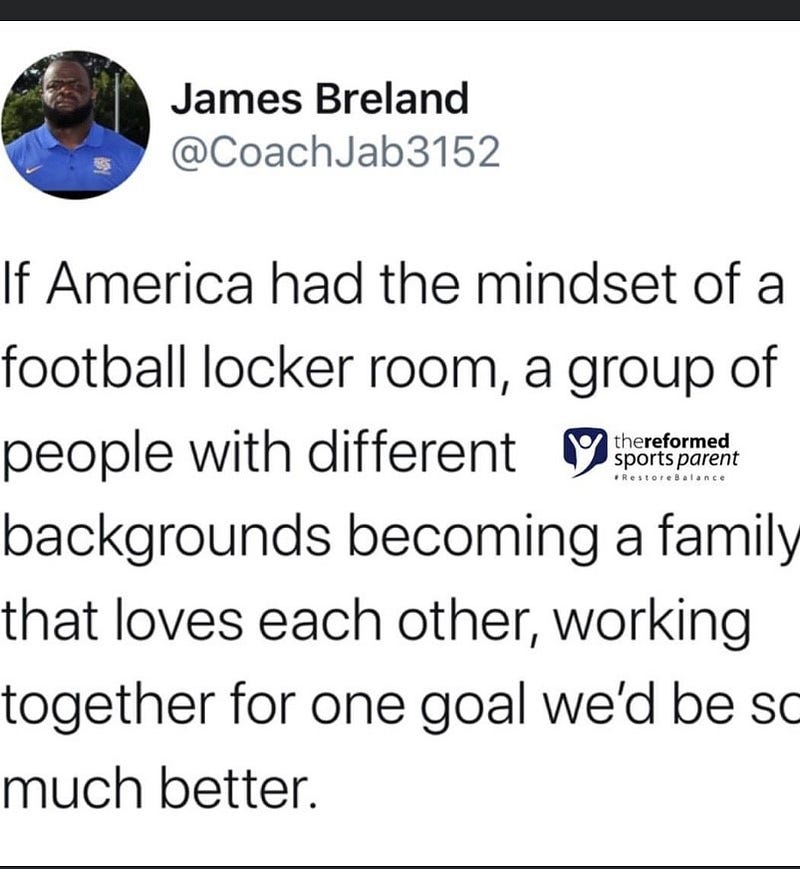
This is the lesson that America is missing right now. According to James Breland, “if America had the mindset of a football locker room, a group of people with different backgrounds becoming a family that loves each other, working together for one goal — we’d be so much better.” If we could understand that we are all different, and put our differences aside and understand that we are working towards a larger goal, America would be a better place.
Southern Oregon Football has an abbreviation it bases a core belief around: FAMILY — Forget About Me, I Love You. What a great lesson.
I see this lesson from the coaching side now. As a coach, I don’t care if a kid is florescent pink if they can throw the ball, catch the ball, defend the ball, or block for the ball. I don’t care if they grew up rich or poor. I don’t care if they are from Canyonville or Riverside — I care that they can produce and that they buy into our team.
I wish our world was able to judge people based on their ability to produce and their ability to buy into a Team-First mentality instead of their background and ethnicity.
“Alice, that’s my brother. Can’t you see the resemblance?”
As clique as it is, everyone needs to rewatch Remember The Titans. In one of the final scenes, after the racial lines had been breached and the team was in the state championship game, the black defensive end came to visit the white linebacker in the hospital. The nurse wouldn’t allow Julius into the hospital room, and the white erstwhile racist looked at her and said, “Alice, that’s my brother. Can’t you see the resemblance?” My eyes tear up as I remember the scene.
Because of their bond, they were brothers. Because of their shared struggles and goals, they were brothers. Because the football locker room had forged them into brotherhood, those players, like most football players, were linked forever.
This is what happens when people put similarities before differences.
Teaching The Adventures of Huckleberry Finn as a white teacher
I’m not sure why I am even writing this. I am not protesting but I am thinking a lot. I am appalled at the death of George Floyd. I watched 16 Shots yesterday, which is the documentary of a black man shot by the police, and was appalled by it. I have all this racial stuff on my mind and I just wish everybody played football and hung out with people from different backgrounds in a locker room. 2020 has been rough and people need each other more than ever.
I don’t know if it is racist that I write this. There is that possibility, because I am not black. I teach The Adventures of Huckleberry Finn every year in a very non-diverse classroom and it always opens discussions and doors to racial conversations.
I state the following rules for students and it hasn’t let me down yet in having productive, spicy conversations. First, I tell students that I am not black and can’t pretend to know what it is like to be black. Second, I tell students that even though I’m not black, I can talk about and think about issues from a sympathetic/understanding standpoint and that even though I’m not black, I can listen to and read from people who are and it can lead to productive conversations. Third, I tell them that most of them aren’t black so refer to Number 1 and Number 2 before speaking. Keep everything with a tone of respect and understanding.
I have found that if I can sell my classroom on this bigger picture, then we can discuss and learn from the literature, the current events, and the world. We can discuss issues and concepts with a bigger picture in mind, instead of letting it boil down to differences only. In my 20 years as an English teacher, this racial question never seems to be solved. Every year, there is another Minnesota to discuss as current events to the backdrop of Huck Finn going down the Mississippi. I wish it wasn’t true, but it is.
“The color of the jersey that unites us is greater than the color of the skin that divides us”
This selling the classroom on a bigger picture is just like what happens in a locker room. If people could buy into something greater than themselves, and sacrifice a part of themselves for the greater good, we would have less problems in our world.
If people could take pride and have a sense of belonging in being a Lancer, or a Raider, or a Mustang, or an American, then they could stop being hung up on their own issues. When people figure out that the color of the jersey that unites us is greater than the color of the skin that divides us, then we can live in the country that Menyada and I were able to create in a two-bedroom apartment while talking and learning from each other.
https://coachwhite17.com


