
What “Follow-For-Follow” Really Is
And why making it against the rules is a bad move

As you may know, I’ve been working with Jennifer Barrios Tettay recently to prepare the October interview. (Thank you so much, btw!) While finalizing things for the full interview to be posted on Patreon, she sent me a somewhat alarming response from Tony Stubblebine on Vritant Kumar’s March article on “follow-for-follow:”
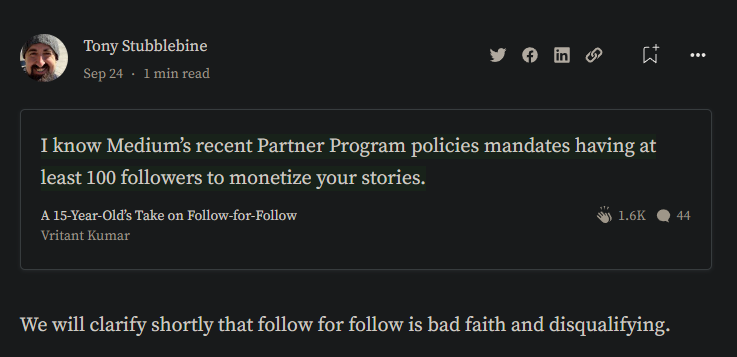
My Initial Response
I’m somewhat of an idiot. I knew Ev Williams had stepped down and a new CEO was going to take his place, but I forgot the guy’s name. So when I saw this comment, I assumed it was another writer threatening people again.
It’s happened to me before.
And since that previous interaction led to me directly confronting Medium about whether I was doing something wrong or if this writer had gone off the rails, I felt pretty confident that this Tony guy was all talk.
Sigh.
Well, you probably already know, but clearly Tony’s the new CEO. Which means it’s not a threat; it’s a promise.
And that’s exactly why I felt this article needed to be written: I’ve got some things to address about this upcoming clarification.
What Is F4f?
It’s a method, plain and simple. However, it’s not ONE method. It’s like a calorie restriction diet — there are multiple ways to do it, and some ways are better than others.
And rightly so, some ways should be against the rules.
But using the f4f blanket to make ALL of them bad isn’t a good idea, because there are ways to use the method that are actually really beneficial to the entire Medium community.
So please, read on — give me the benefit of the doubt for a few minutes.
The Wrong Ways
Let’s start with the wrong ways to do f4f. I don’t have any personal bad vibes against people who have done this, but I recognize that these practices aren’t effective for those using it or appealing for the others involved.
- Demanding follows
- Copy/pasting responses (otherwise known as response spam)
- Malicious unfollows (because they didn’t follow you back)
- Refusing to follow unless followed
- Automating a program to follow for you
These things are bad. There’s no question about it: they just don’t feel right to do or have done to you. If you don’t feel that yourself, that’s something to discuss with your therapist — but we’re not going to fight for you here.
By all means, make (or keep) these things against the rules. Nobody needs this.
The Other Ways
The above only describe maybe 15% of f4f users in my experience. The other 85% use different tactics that are still considered under the f4f umbrella (and are worth fighting for).
Asking for a follow politely (on a follower-themed article)
This way is neutral in my opinion. I get that it can be annoying if it’s done just anywhere, but when it’s on a follower-themed article it makes sense. I appreciate these, because I know how hard it is for people to reach out and ask for help; they’re literally requesting encouragement at the lowest possible level I could give.
Asking is different from demanding — it implies a choice, not a requirement. I don’t think I’ve ever personally asked but those that do are usually at the end of their rope, and just trying whatever they can to be heard.
I want them to be free to ask. Because I want to be free to respond with my follow. Silencing them feels oppressing to me, as I know very intimately what it feels like to be in that position myself.
Letting them ask doesn’t take away my freedom to choose to not follow them, and it doesn’t mar the experience for anyone as long as it’s kept as genuine (non-spam) replies on appropriately themed articles.
Following Broadly
This is what I’ll call what I do. Out of thousands of people, only 2 have had a problem with it; and I’m not sure they actually read to fully understand.
So, here’s the very short version:
- Find someone active
- Choose a recent story
- Read, clap, comment (something meaningful)
- Follow
And at the end, know that your comment puts you in front of their face. Chances are, they will check out your profile. If they like your stories, or generally want to reciprocate the encouragement, they will follow you back.
Over time, I’ve learned to really depend on the algorithm to track what stories I tend to click on to bring me stories from those people I might enjoy; and it’s done a really good job of it, despite the extreme variety of follows I keep feeding it.
I have faith in the algorithm. Both ways, too.
My method of f4f is probably the most common from what I’ve seen. It’s the kind most people are comfortable with, and doesn’t tend to rub anyone the wrong way.
It connects people, encourages writers to encourage each other, and helps build communities within the Medium platform.
The Narrow Follow
There’s another 10% or so on the far end that will only follow people that at a glance seem to be in their select range of preferred topics. Sometimes that’s a nutrition writer following only writers that focus on health, or a general blogger following people that write entertaining stories.
There’s nothing wrong with this method, but it differs from mine due to its more selective nature. There’s less encouragement and support in general, but the support they can provide does tend to be deeper and stronger.
The Follower-Follow
I’ve never done this, but it’s a pretty smart move in many ways. This kind of f4f seeks out writers to follow their follows.
So basically, you find someone you like and decide to blindly follow all the people they’ve followed. It assumes that because they decided to follow and support those people, you will too.
What I like about this one is that it really fights against the echo chamber effect. This can really mix up your feed — for better and worse at the start — and let the algorithm bring you things that you may not know you even like until it’s right in front of you.
This one relies solely on people noticing you’ve followed them and being curious. There’s no commenting to request or demand anything, and no other engagement (unless you actually want to read a story that pops up).
Words Are Important
If Medium comes out and firmly states that “follow-for-follow is against the rules,” it’s not just taking a stand against those in the first group; it will be felt through all of them. Every one of these other groups believe they are practicing f4f, and will immediately believe they have to stop for fear of losing their account.
I don’t think that’s the message Medium is trying to send.
This is why I believe it’s a bad idea to make f4f against the rules. Because it hurts more of the good than it does the bad. The method of f4f isn’t just the spam or malicious unfollows, it’s also the genuine engagements encouraged by the desire to promote one’s work on the platform.
It attacks the already challenging perspective of self-promotion through engaging with others as being a punishable offense. More people will stay isolated, preferring to not engage “just to be safe.”
I know this, because I’ve seen people do it.
During the great f4f debate of March and April, that’s exactly what many writers did. They holed up and stopped interacting unless someone interacted with them first. Some of them lasted through to June and gained the courage to try out “f4f” in one of the more acceptable, comfortable methods.
Many of them gave up.
That entire saga is why Follower To Follower exists. I couldn’t stand to see so many people giving up because they were afraid to promote themselves in the wrong way and get banned.
They were afraid they’d be practicing f4f, and writers assured them that was against the rules.
Not For Me, For Them
I know my services of F2F and the other things I do here are limited. Whether Medium makes those endeavors obsolete by improving their search function or making what I do against the rules is irrelevant to me; I won’t be doing this forever.
And thank God, because I wouldn’t want to.
So I’m not writing this for the right to continue what I’m doing, because I don’t do this to keep doing it. I do it to support other writers.
F2F, the directory, and even this article are all out of a desire to help others here to grow, thrive, and gain the fullest enjoyment from the Medium experience they possibly can.
(Yes, I am doing things to also profit here and there. But it’s not the driving force; that’s more an experiment to see if anything sticks — and to gain information to help others with if I learn anything through it.)
If shutting down the Monster Family would keep f4f as generally compliant with Medium’s rules, let me know and I will do it today.
Just say the word, Tony. I believe that strongly in the good side of f4f.
Or, you know, maybe at least when you take that official stand, you are incredibly clear about what is and isn’t against the rules. So that people don’t stop connecting out of fear.
Because I know that’s what Medium is all about — connecting people and ideas.
A Note About Unfollowing
I believe in unfollowing. I do. But not maliciously. Sometimes you need to unfollow, and there’s no way around it. Maybe they changed their tone to something you just don’t agree with, or you thought they were someone they never were and it took awhile to realize it. Whatever the case, you just can’t in good conscience keep following them.
There’s also times when they just publish so often their stories fill up your feed — but that’s a good place to use “mute author.” I didn’t know about this one until after I’d unfollowed a few people to clean up my feed.
Oops.
But it’s important to me that you all know it’s not horrible to unfollow. It’s ok — as long as it’s not in the hopes that it will control someone’s actions. That’s when it’s malicious and bad; though there’s nothing in the rules preventing you from doing it, that’s definitely in bad faith.
To date, I think I’ve only unfollowed someone once as TAM. Maybe. Not counting the one block I’ve done, which also unfollows. And my feed is full of articles that make sense. They don’t all interest me enough to click, but they all fit my interests enough that I get why the algorithm would think I’d like them.
And I follow broadly, folks. The algorithm does its job really well if you know what you’re clicking on!
All hail the algorithm! 😉
Until next time, follow each other, follow the dopamine, and follow yourself, always!
Hey, look: a newsletter. And also Twitter. And Facebook.
Support writers, read without limits, and be part of the community — all for $5.