
What does ‘Unity in Diversity’ actually mean for India?
The evolution of language and culture
Growing up in India during the ’80s and ’90s one could not have escaped the message of Unity in Diversity. The official national integration song Mile Sur Mera Tumhaara would be played daily on Doordarshan, India’s state-run National TV channel. The musical animation Ek Anek Aur Ekta still brings a lump to my throat.
In the mid-’90s Cable TV arrived on the scene, killed National TV in the metro cities, and created an early version of “filter bubbles’’. Then came 24-hour news channels and social media to erode an already shrinking common ground.
What does Unity In Diversity mean in the context of India? How did we come to be so diverse in our languages, food habits, clothing, festivals, and customs? What does this astonishing diversity reveal about our past going back 2000 years?
DNA Doesn’t Lie
The story of our deep past is etched into our DNA but Science has only recently learned how to read it. David Reich, one of the pioneers of ancient DNA analysis, has been able to piece together the major human migrations that have occurred since Homo Sapiens came out of Africa. The findings are presented in his 2018 book Who We Are And How We Got Here. Reich’s comments on the present-day population of India are revealing —
People tend to think of India with its more than 1.3 billion people as having a tremendously large population, and indeed many Indians as well as foreigners see it this way. But genetically, this is an incorrect way to view the situation. The Han Chinese are truly a large population. They have been mixing freely for thousands of years. In contrast, there are few if any Indian groups that are demographically very large, and the degree of genetic differentiation among Indian ‘jati’ groups living side by side in the same village is typically two or three times higher than the genetic differentiation between northern and southern Europeans. The truth is that India is composed of a large number of small populations.
How could this much genetic differentiation persist in a population which has been occupying the same geographical area for more than 2000 years? Centuries of strict endogamy must account for it. Within the same village, this would manifest in the caste system¹, of which prohibition on inter-marrying is a central tenet.
Strict endogamy is anything but natural. Historically, whenever two populations have encountered each other there has been extensive mixing. Endogamy then must be enforced through threats of violence, actual violence, social boycott, emotional blackmail, and other subtle means. Which is why in India 90% of marriages are arranged, popular cinema continues to repeat the Romeo & Juliet theme, and the latest case of “honour killing” evokes only a mild sense of shock. And this despite the heightened risk of disorders linked to rare recessive genes, that comes with marrying one’s kin.
But what has all this got to do with the linguistic and cultural diversity that we see across India? Like genetic differentiation, could it result from the social isolation of populations over centuries?
Is diversity born of segregation?
Darwin’s Curious Parallel
It turns out that segregation at the local level does account for caste-based dialects that are phonetically distinct and not merely “accents”. There are noticeable differences between the way Marathi (or Malayalam) is spoken by the Brahmins and by the lower castes. But of course, the differences between upper and lower caste Marathi dialects are minute compared to the differences between Marathi and Malayalam. So where did Marathi and Malayalam come from? Modern linguistics² employs a Darwinian framework to answer this question.
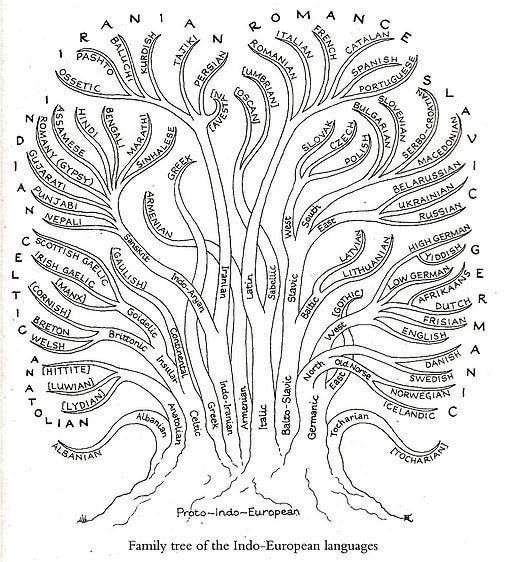
There are some striking parallels between the evolution of new species and that of new languages. Present-day languages are thought to have descended from ancestral languages just as modern species have evolved from ancestral species. That means we can construct a “tree” of languages representing ancestral relationships similar to the way species are mapped onto a phylogenetic tree.
Languages that share a more recent common ancestor tend to be more similar (Spanish and Italian) than languages that split earlier (German and Italian). This is analogous to how species that have a more recent common ancestor³ (fox and wolf) tend to be more similar than species that split earlier (bear and wolf). These patterns did not escape the attention of Charles Darwin, who noted in The Descent of Man —
The formation of different languages and of distinct species, and the proofs that both have been developed through a gradual process, are curiously parallel… We find in distinct languages striking homologies due to community of descent… Dominant languages and dialects spread widely, and lead to the gradual extinction of other tongues. A language, like a species, when extinct never reappears.
Morphological and grammatical similarities between the 7000-odd languages of the world have allowed linguists to group them into families. These language families tend to mirror the haplogroups defined by geneticists to capture ancestral relationships between populations. Which should come as no surprise because parents pass on genes and language to their children. On the other hand, it would be a problem for scientists trying to trace the history of human migrations if they got very different answers from genetics and linguistics!
The Evolution of Language
So how would a new language evolve? Imagine a population in which all individuals speak the same language. This population splits, for whatever reason, into two groups that become socially isolated from each other. Random “mutations” start to crop up — mispronounced, distorted, reanalyzed, forgotten words as well as new words and grammatical innovations — which are then “inherited” by the next generation of speakers⁴.
A conscious desire to assert distinct group identities could accelerate this process of divergence, until one day individuals from the two groups are no longer intelligible to each other. At this point, we will say that the groups speak different languages.
Note that in this model there is no objective difference between language and dialect — we speak the language but they speak a dialect. It also makes no sense to talk of an individual or group who is the “creator” of a particular language. That’s just not how natural languages arise. The synthesis of a common “constructed” language for the world has been attempted (like Esperanto) but it has always failed.
Another way for a new language to arise is as a hybrid of two or more languages, in which case it is called a creole. Urdu, spoken exclusively in the Indian subcontinent, started out in this way when native speakers of Khariboli and Persian had to communicate with each other. This is where the analogy with biological evolution breaks down. Two species can never merge into one because individuals of different species cannot, by definition, mate with each other and produce fertile offspring.
The Idea of India
Finally returning to the question we started with, we can now assert the following: the fact that certain groups speak different but related languages must be proof of prolonged social isolation among populations that nonetheless share some biological ancestry. Unity in Diversity may be a modern-day aspiration for India as a nation but it certainly is not a fair description of our past going back 2000 years and beyond. It’s no use inventing utopian pre-histories. It’s no use blaming the British or the Muslims. The fact is, we have always been a divided society.
Notes
¹ The word “caste” is ambiguous as it can refer to varna (four divisions) or jati (hundreds of subdivisions within varna). Reich is referring to the latter. Caste-based endogamy in India is believed to have started around 100 CE.
² Steven Pinker’s 1994 book The Language Instinct is an excellent primer
³ Note that no modern species can be the ancestor of another modern species. Instead, any two modern species must share a common ancestor.
⁴ Read a few lines of English from the time of Chaucer in the 14th Century and you will realize how fast languages mutate


