
What Does it Mean to Be A Good Neighbor?
I will be your neighbor. Will you be mine?
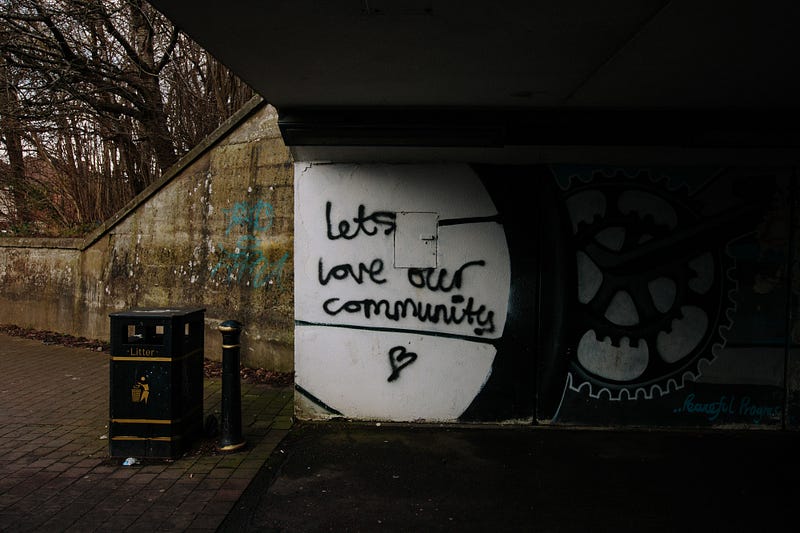
I suppose most of us have written the words “we are living in uncertain times’’ and only to edit around it, trying to escape the cliché. Or we think back to the opening line of A Tale of Two Cities and wonder if dear Charles Dickens was writing more of a prophecy than a reflection. We try to find new words until we are forced to reconcile ourselves with the fact that some things are clichés, not because they are overused or overly romantic in notion, but in fact, because they contain some irrevocable truth and there is no better way to phrase it.
In other words, we are living in uncertain times.
Or as Dickens wrote it:
“It was the best of times, it was the worst of times, it was the age of wisdom, it was the age of foolishness, it was the epoch of belief, it was the epoch of incredulity, it was the season of Light, it was the season of Darkness, it was the spring of hope, it was the winter of despair, we had everything before us, we had nothing before us, we were all going direct to Heaven, we were all going direct the other way — in short, the period was so far like the present period, that some of its noisiest authorities insisted on its being received, for good or for evil, in the superlative degree of comparison only.”
Uncertainty reigns as the world dances between sheer panic and sheer apathy. The difference between the faithful and the faithless do not seem so extreme but the differences between the faithful hang heavy in the air. Our world is on fire. Our schools have closed down. A virus spreads across the earth but not nearly as fast as misinformation across the internet. Many people can’t breathe — either from the virus or their panic. Sometimes both. Often both. Our news is filled with tragedies even Shakespeare could not have dreamt.
My own country faces self-perpetuated and self-induced detriment. Our health care providers are suffering from lack of rest, personal protective equipment, and answers. Our citizens are suffering from a complete lack of leadership. We get caught up in spirals of apathy, panic, and self-preservation, shining a brighter light upon the distance we’ve created from nostalgic-era of front porch networks and the simple act of borrowing sugar from a neighbor.
Simone Weils writes, “The love of our neighbor in all its fullness simply means being able to say, ‘What are you going through?’” Only when we take the time to ask this question and listen to the answer, can we cut through the fog of uncertainty and fear and self-preservation to find a hero. This hero, in all their flawed humanness, restores our faith, however temporarily, in our own humanity.
Take the bus drivers for schools in Appalachia who have teamed up with food banks and the school districts to ensure that their whole community is getting enough to eat. Each day, they provide another a reminder of the power of the front porch network, community, and thinking of others more than ourselves.
Consider the community church in California that has re-routed resources as Christ would have done. They feed the hungry both in body and in spirit.
Individual people are seeking out ways to care for each other too. Some are converting their Free Little Libraries into Free Little Pantries. Others are building gardens for their neighbors to take from.
Surrounded by tragedy, we are turning to our roots, to the power of feeding one another, to the power of the front porch networks. These moments of unexpected heroism remind us that we don’t need to be heroes in the classical sense to be a Good Samaritan. Unfortunately, we see these as anomalies far too often. We celebrate them because we do not recognize them as common, daily acts of care. What would it look like if caring for our neighbor was the norm, not the exception? What could it be like if when we turned to the news, we wouldn’t find relief in these stories because the news is no longer so awful?
In one hand, I feel the weight of catastrophe. In the other, I feel the weightlessness of hope. Sometimes, I think we deserve this. Within it, there is hope, beauty, and the painful yet ever necessary capacity for change.
The world we left behind as we locked down from COVID-19 wasn’t working. We don’t need to see the news or read the statistics to know that. It can be easy to feel helpless as individuals pitted against the machine, the system, the rich, the divides. But this is not the time to fall into the pits of despair. This is our time to turn to our strengths, to choose to be a good neighbor, to take the time to care. As the world begins to open up again, we have a chance to re-create our communities, to become who we want to be.
In The Art of Asking, Amanda Palmer writes,
“American culture, in particular, has instilled in us the bizarre notion that to ask for help amounts to an admission of failure. But some of the most powerful, successful, admired people in the world seem, to me, to have something in common: they ask constantly, creatively, compassionately, and gracefully. And to be sure: when you ask, there’s always the possibility of a no on the other side of the request. If we don’t allow for that no, we’re not actually asking, we’re either begging or demanding. But it is the fear of the no that keeps so many of our mouths sewn tightly shut.”
I am not suggesting we become superman. I’m suggesting we open our hands to offer the sugar our neighbor asks for. I’m suggesting we open our hearts and schedules long enough to hear what they say when you ask them what they’re going through. I’m suggesting we allow ourselves to be vulnerable and strong enough to leave room for being told ‘no’ when we ask for that cup of sugar.
Amanda Palmer also writes,
“From what I’ve seen, it isn’t so much the act of asking that paralyzes us — it’s what lies beneath: the fear of being vulnerable, the fear of rejection, the fear of looking needy or weak. The fear of being seen as a burdensome member of the community instead of a productive one.
It points, fundamentally, to our separation from one another.”
To find the connection we’ve been missing for years and have highlighted amidst a pandemic, we must embrace our humanity. That very force within us is what leads to both love and shame. The force that leads us to fear our own needs and vulnerabilities is the same one that allows us to say “I make mistakes.” Our humanity is what leads us to self-preservation at the expense of others simply because we are afraid of expressing that we need them too. Our humanity is also what allows us to put our own needs aside for the sake of the other. When the community is cared for, the individual is cared for. This is what we forget.
If each of us as individuals viewed our lives as walks down Jericho Road, who would we be? Who do we want to be? What are we willing to do, to sacrifice, to bear the pain of love for, to be that person?
When we can step outside again, when children can play on playgrounds again, when we can breathe without the cloth of a mask in our faces, when we can embrace again, who will you be?
I will hold you. This is my promise. I will break bread with you. I will sit for hours just to hear what you’re going through. I will remind your body what a hug and a kiss on the cheek feels like. I will your neighbor. Will you be mine?