
What Does AI Have To Offer Music Writers?
You’re probably thinking nothing, but there might be more to it.

Putting the generation of images aside, as that’s way too obvious (see above), those who write about music in an experiential nature have little to gain from an interface like ChatGPT. Or do they?
Content and experience — the purpose of this article.
The most engaging part of reading posts about music is tapping into the author’s experience of a particular album or artist, their proximity, and the meaning it has afforded them through that connection.
So unless you’re writing about Excel formulas (Math Metal? The Dillinger Escape Plan, Converge, Meshuggah anyone?), a public interface such as ChatGPT can’t immediately communicate how any particular record has elevated your experience or given you a perspective on it that may be interesting to other readers.
I’ve examined this in detail below, but before we get to that, the core purpose of this piece is to examine the utilitarian nature of Large Language Models (LLMs), the distinction between tools that can assist a writer versus tools employed to do the writing, and whether there’s space or need for music writers to adopt this technology.
But ChatGPT is useful for research?
One of the key limitations of a service like ChatGPT is the impact of the computing concept — garbage in, garbage out. A notion where the quality of the output cannot exceed the standard of the input. In an age of misinformation and disinformation, this isn’t going to be categorically helpful for fact-checking. And due to the natural language processing performance of ChatGPT, which outputs a human-esque, conversational tone, I have observed a number of occasions where people have completely overlooked output that is not only inaccurate but not even remotely moored to reality.
AI tools can improve your writing.
Reiterating that facts and figures compelled from ChatGPT can be flawed, these tools can still help improve our writing. One useful example is active versus passive voice, which our friends at Google elegantly illustrate with the following example:
Active: The Beatles wrote A Hard Day’s Night.
Passive: A Hard Day’s Night was written by the Beatles.
The contention with using a passive voice is that it can seem wordy, inefficient, and indirect. Naturally, a passive writing style may fit within an individual’s identity and preferred approach, but seen as an illustration of the optimal communication method when writing, it’s a fitting example of how a ChatGPT prompt can improve our writing.
This can be applied to a host of different grammatical scenarios, and in the spirit of further developing our technical writing capacities, shouldn’t be overlooked.
But this is where the distinction needs to be made between the technical aspects of writing and the experiential nature of what we’re sharing. If you’re anything like me, you will find yourself primarily reading to capture the insights and perspective of the author; the topic is often secondary.
For example, I’ll read a music auto/biography about most artists; I don’t need to have an affinity for their music. I appreciate the opportunity to be exposed to an artist I’m less aware of, and find the history of most musicians to be unique and their motivations inspiring.
It can be useful for inspiration, though asterisks apply.
This is a personal perspective. I have a decent backlog of ideas. These pop into my head, and I add them to my Notion table to be picked up as the inspiration strikes. I find this process organic and effortless. Whether my ideas resonate is secondary, but my motivation to write about music is for my satisfaction and to share experiences I hope will resonate with others.
It’s abundantly clear to me that the more you write, the more ideas you generate.
But! The point of this section was about inspiration and idea generation. ChatGPT or any AI-enabled interface — Notion, for example — can punch out a bunch of copy about a particular artist, but as you can see from the example below, it’s fairly neutral, work it out for yourself position. I’m reading because I’m interested in the author’s perspective. I don’t have the same expectation of a Wikipedia article.
By way of illustration, let’s ask a question as old as (Hardcore) music itself.
In the never-ending debate as to who was Black Flag’s greatest singer, ChatGPT has to say the following:
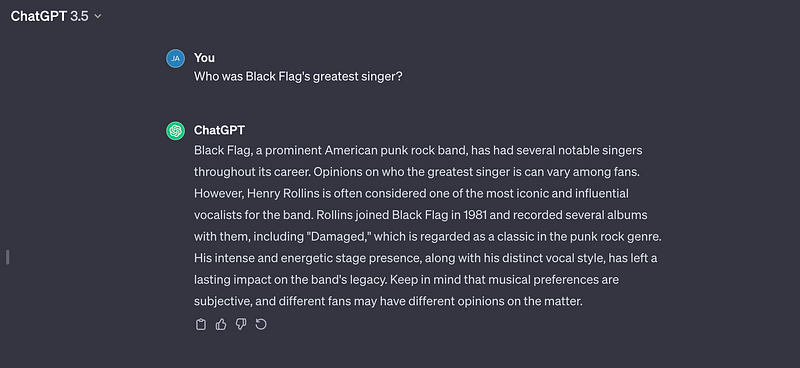
The response is technically correct. Black Flag did have several singers, and each of them was noteworthy. I appreciate the note of caution at the end about music being subjective, but this sort of insight, if shared via a music writer, isn’t interesting. It’s a Wikipedia article bereft of any conviction.
What makes good reading is something with teeth. Someone making the case for why Black Flag’s 1982 Demos represent their creative pinnacle. For those who understand authentic and authoritative writing and even some basics about Black Flag, there’s nothing verifiable about the following, which is rife with errors. It’s a wishy-washy, generic narrative. Demos are raw because the production effort isn’t of an album quality. This isn’t specific to Black Flag — the demos of virtually every single band in existence are rawer than the album that followed.
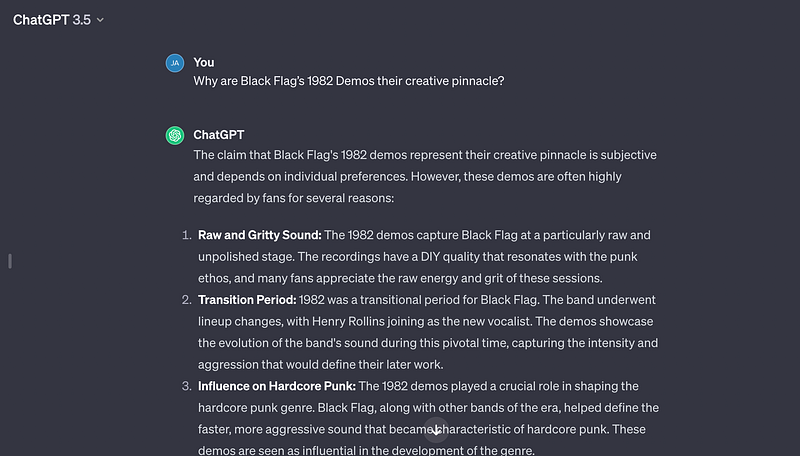
Prompting ChatGPT with a more topical query is conducive to specific insights. I may never have thought about writing about Black Flag’s role in setting up those DIY touring pathways across the US or a piece on Raymond Pettibon’s artwork and how that extended to other acts such as Sonic Youth. And provided I can go deeper on those subjects offer something unique to my experience of those concepts, I may have something worth reading.
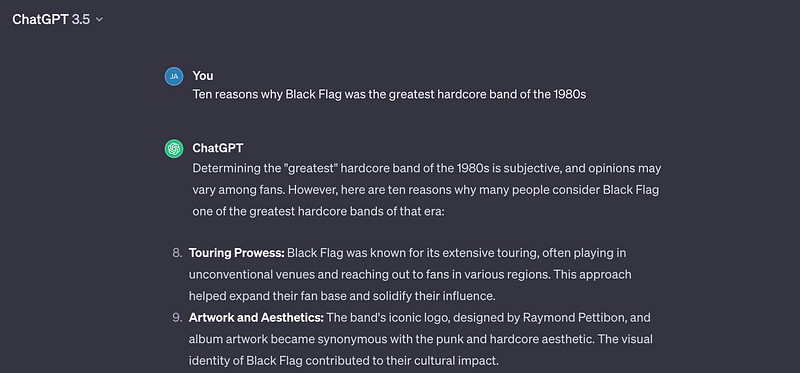
The most convincing arguments come from an individual’s beliefs and judgment. This method may help unlock something in the recesses of your mind but is secondary to heart-felt and dogmatic beliefs. An article about Black Flag’s role in establishing the DIY touring routes in the USA is infinitely less interesting (read: less Wikipedia-esque) than a humorous exploration of the number of times Henry Rollins broke his hand during his tenure in Black Flag. He writes about this in Get In The Van, his Black Flag tour journal compendium.
Plagiarism.
This is a complicated area for a number of reasons.
- The information output from our prompts to ChatGPT is an assemblage of information that exists on the public internet or has been fed into the algorithm by other means. In other words, the output comprises ideas or IP conceived by other people. This is where the delineation between inspiration and output is reinforced. Are we envisioning or regurgitating?
- It means that depending on where we publish, our ideas and perspectives are being accessed by AI algorithms and feeding the assemblage.
- Google’s position on this matter is ambiguous, but from an SEO perspective, there is a risk that content produced using AI will be cited as not human, which may determine that content as not useful and not worth ranking. The science isn’t exact, but if you want to see an example of what comes back, this tool is quite good at detecting AI writing.
SEO.
SEO is an odd concept when it comes to Medium articles. On the one hand, Medium content is gated, so why factor SEO when writing for this channel? Having said that, it’s a pathway to new subscribers to the channel, which we’re all motivated by increasing, whether we benefit directly or indirectly. If Google’s basic position is that useful and unique content is prioritised in search results, this ought to serve as a basic consideration when deciding if AI-written content is something you want to lean into beyond the inspiration frame.
It’s worth noting that SEO content that reads like SEO content is not what’s being recommended here. There is an art to writing in that capacity and questioning the merit of AI direction is mandatory.
Conclusion and takeaways
- Language models like ChatGPT can be helpful for writers, but mostly where technical aspects of writing are concerned.
- Readers are interested in your perspective and experience. A service like ChatGPT can’t describe how you feel or what you have experienced.
- Just because it’s written well doesn’t make it compelling, noting that you can use an AI service to make your writing sound better, but I’d argue that a more satisfying outcome is developing your own voice.
- As a fact-checking tool, these are highly dangerous and often inaccurate, introducing convincing commentary about things that are plainly false. Credible sources still need to be referenced.
- Music writing should be inspirational, characterised by you, the author. LLMs have no authority that Wikipedia doesn’t.
What do you think? Is there space for AI within music writing?
Disclaimer: None of my Medium articles have utilised ChatGPT (or an equivalent LLM). I have employed image generation services for a number of pieces and expect that to be self-evident. While not ruling out the possibility, please consider my personal position that my own writing remains AI-free.


