
Future of science
Neither Fiction nor Non-Fiction: Or How a Cat Sparked Speculations on Quantum Physics
When design fiction and an experiment with a storied history in physics meet, what fictional realities could emerge?

This article is adapted from a research of long-term interest to me, but updated with more recent insights. The historical insights were taken from research I conducted between 2016 and 2017.
Design fiction, or speculative design, is currently a popular method in academia and industry to encourage participatory deliberation and model future scenarios. The participant of a speculative design enterprise is promised an immersive experience with instructive value. Design fiction sees direct and indirect counterparts in creative science fiction prototyping, the studio laboratory, critical design, and adversarial design. Mutual collision and entanglement take place when both the object and subject of research, are
In this article, I am experimenting with design fiction as a fictional physicist to generate my versions of a famous physics thought experiment that could either anger professional physicists or bowl them over.
Science fiction and design fiction: so what would that mean for a physics thought experiment?
Although this claim would likely breed a chorus of disapproval from reviewers of academic journals, I believe that there is still a difference between science fiction and design fiction, that being the design of intentionality. For science fiction, the narrative within the story is the authorial intention whereas in design fiction, it is merely a process toward an endgame of a product or service realization (with potential for profit-making). Moreover, design fiction is focused on creating provocations aimed at soliciting active interventions from the target user/audience. The exploratory informs the ultimate goal of design fiction: to develop an iteration of prototypes through experimentation until one settles on a final list of candidates.
Rather than speaking in abstraction, I will present the case of how the quantum interference experiment, with a rich history predating quantum theory, could be used to demonstrate the indistinguishability of made-up scenarios in science and other plausible but not scientifically acknowledged theories. I have actually coined a name for this no-man’s land between science theories and fictional theories that had emerged from fictional world-building, but I will not reveal that here yet.
Why this experiment, the reader asks? Well, firstly this experiment straddles classical and quantum physics, creating a metaphorical wave even as it transacts from a classical way of thinking about physics (you can think Galileo, Newton, and even Einstein’s original special relativity theory) and quantum physics (yes the world of subatomic particles with a logic that makes little sense to our mundane way of existing). If you have even heard the eponymous phrase Schrödinger Cat without knowing the deal about it, then you already know how the quantum interference experiment is media popular (even if how it became a meme is not yet well understood). However, I believe what I am about to do here has potential for participatory science communication. If you are a philosopher (or someone who reads philosophy), you might have followed discussions on thought experiments that emphasize the latter’s embodiment as fiction in assessing the value of the thought experiment’s fictional content. If you would like me to write another article on thought experiments and design fiction, you can leave a note below.
Now, I am going go lay out the original routed before going design fiction with quantum-scale possibilities.
Quantum Entanglement – Route 1

The quantum interference experiment is a favourite philosophical example on the paradox of dualism in physics, making it such a useful example for thinking about that intersection between science and fiction (or design, if you will). Allow me to summarize this seminal paper by Einstein, Podolsky and Rosenberg paper (famously known as the EPR paper), “Can Quantum-Mechanical Description of Physical Reality Be Considered Complete.”
The two main statements of the abovementioned paper drive the debate: 1) “every element of physical reality must have a counterpart in physical theory,” and 2), “if, without in any way disturbing a system, we can predict with certainty (i.e. with probability equal to unity) the value of a physical quantity, then there exists an element of physical reality corresponding to this physical quantity.” From these two statements, a claim is made regarding how the quantum mechanical description of particle is ambivalent due to lack of certainty over whether the two physical quantities, each with its own definite quantifiable value, could possess a simultaneous reality.
Following that line of reasoning, it is stated that if the first system (a state represented mathematically as a wave), after interacting with a second system (which contains an outcome subsequent to interaction with the first state), produces physical qualities (i.e. momentum and position, or, wave and particle) that co-exist, then quantum mechanics is said to provide a complete description of our physical reality, since the problem of dualist contradictions will then have to be explained away. These dualist contradictions underpin the discussion of quantum interference.
Quantum Superpositions – Route 2

Bohr discusses Heisenberg’s general principle governing commutation relations between conjugate variables (such as position and momentum; basically, the Uncertainty Principle that undergirds the problem of dualism in quantum mechanics), and what Bohr refers to as the problem of “atomic processes.” According to Heisenberg, quantum mechanics as a term appeared for the first time in a 1924 report by Max Born that described the properties of atoms such as transition frequencies. The same report discusses the dispersion theorem that characterizes ‘fuzziness’ of uncertainty relation in the expectation value of a physical reality. Heisenberg recognized that the physical problem espoused in quantum physics could never be mathematically satisfied, since a shift in thinking is required for breaking out of the status quo. As he puts it,
Through Heisenberg’s personal account, we could trace the intellectual development that produced the work inspiring the EPR-Bohr debate; of course, the inspiration for Heisenberg had also been the work of Bohr and Einstein.
Heisenberg was invested in developing the physical content of the theory he was working on (together with Born and Pascual Jordan) whereas Born considered mathematical formalism as primary. As far as Heisenberg was concerned, the problem of physical content versus mathematical form was unresolved; the mathematics provided descriptive potential but not prescriptive prowess — in other words, the math cannot tell you what to do. It was through his study of the path of the electron in the cloud chamber that Heisenberg realized that the concept of path could only be deployed with any degree of inexactness due to the Uncertainty Principle, as long as the electron path is not smaller than Planck’s quantum of action (the product of energy and time that cannot exceed Planck’s constant of h).
Even as Heisenberg was developing the Uncertainty Principle, Schrödinger was looking into the development of wave mechanics that would eliminate the ‘quantum jumps’ from Planck’s law of thermal radiation, by studying the wave function represented as 𝛹 (psi). The classically anomalous ‘jumps’ occur when one could no longer sharply delineate the moment of separation between two-point masses in an oscillating atomic system. This lack of sharp delineation is responsible for the break, or a ‘jump,’ when going from a classical state that is determined, to a quantum state that is indetermined and where fuzziness dominates. The desire to avoid quantum jumps was a culmination of his evaluation of a statistical formulation of quantum mechanics.
Schrödinger’s central argument on quantum mechanics is that the latter takes its inspiration from the classical mechanical model; an understanding of quantum mechanics’ dissimilarity from classical mechanics requires comprehending the rationale driving classical mechanics’ description of a physical state. Schrödinger points to the determination of reality espoused through the psi-function; in the story of a cat, a closed container, Geiger counter, and canister of hydrocyanic acid, the psi-function contains information of the dead-and-alive cat. What is essential for the physicist is what could be observed; in the case of classical physics, this is easily resolved, but not so for quantum physics. To return again to two instances of the determination of states within a classical model, but with stakes in quantum physics, Schrödinger proposes two theorems pertaining to how a quantum world is represented by the statement content of the psi-function, exemplified by the aforementioned cat.
According to Schrödinger’s biographer Walter Moore, there was a discussion in that cat paradox article into how the problem of entanglement could be resolved through the theorem of the non-invariance of inferred state description, which is that the measurement on either of the first or second system could break apart entanglement and restore the distinctive and individual quality of each of the system. Just as Bohr had argued in his rebuttal of the EPR arguments, a suitable arrangement would allow one to infer the state of the first system without disturbing it — Schrödinger goes a step further by showing that the state of the first system could also be inferred as a result of the actions on the second system. The cat paradox is the most publicly known face of the interference/dualism problem that has inspired multitudes of science fiction stories.
From Schrödinger’s Cat to Quantum. Revolution/Technologies 1.0

The Schrödinger’s cat trope provides a bridge into the quantum interference phenomenon represented by the superposition of waves as carriers of fundamental information about nature, one underpinning the core discussion of quantum decoherence, caused by interactions that alter the original state of the quantized object. That thought-experiment presumes, in the case of superposition regarding the state of aliveness or deadness of Schrödinger’s cat, that the reality of the condition of the ‘smeared’ cat is not determinable because in the Copenhagen interpretation, any attempt to peek at the cat would lead to the collapse of its wave function, and therefore, the indeterminacy of ascertaining the precise condition of its condition of being dead or alive.
All the interference experiments, from the double-slit to the interferometry experiments, are part of the quantum mechanical postulates on the aforementioned indeterminacy of simultaneous measurement of position and momentum. Philosopher of physics Klaas Landsman discusses the ambivalent relations between classical and quantum physics through his example on Bohr’s use of the classic double slit experiment to critique the latter’s assumption of completeness in the Copenhagen interpretation. At the same time, Landsman provides a detailed discussion of the Heisenberg cut as another example marshaled by Bohr (and Heisenberg) for thinking about complementarity.
The Heisenberg cut is a counterpart to the Schrödinger’s cat thought experiment (and a seed of an idea regarding quantum indeterminism that could be exploited within the development of design fiction), as each reacts differently to classical and quantum interpretations of the interaction between an atomic object and its apparatus. Philosopher Van Dyck points to Heisenberg’s intentional use of classical explanation to a quantum mechanical problem in his choice of thought experiments to create contradictions important for highlighting ambiguities and demonstrating the underdetermination of facts. This ambiguity means that there is no easy way of knowing the values of both position and momentum within the present and in the prediction of their values in relation to each other in the future. However, the thought experiment allows for some form of narrative coherence to this inter-scale disjunction, therefore giving interpretable kinematical feature to a quantum-level paradox. Further, the thought experiment of Heisenberg is meant to highlight the issue of causality in the real world by disturbing the inscrutability of quantum indeterminacy.
The paradoxical appearance of the double-slit experiment concerns the conception of the materiality of the atom. Here is what a general set-up of the double-slit experiment looks like: consider a beam of electrons that is directed through two narrow slits before reaching a backstop/screen to produce varying patterns of intensities, similar to the setup used by Tonomura et al in the 1982 demonstration of the Aharonov-Bohm effect, an effect produced by a change in the wave function of a charged particle going through a negligible magnetic field. These patterns produce variations of ordered intensities, a fringe of light and shadow that presupposes wave-like interferences. However, the wavelength of the light could potentially interfere with the electrons, depending on the length and phases of the photons in relation to the electrons, so the possibility for indeterminism remains open.
There are two crucial epistemological demonstrations of the double-slit experiment. In the first instance, the double-slit experiment can be used to demonstrate the qualities of electromagnetic force by illustrating field-like and particle-like qualities of both electrons and photons, or at the very least, a representation of such possibilities. In a version described by Feynman, he explains how one counts the probabilistic distribution of electrons arriving at the backstop (that functions as a detector), as the electrons enter either the first slit with the second slit stopped up, or vice versa. He found that the probabilistic sum of either an open and stopped-up slit (regardless of which might be the case) does not equal the sum of the probabilistic distribution when both slits remain open. Therefore, if the observer desires to ‘watch’ the electrons, a photonic light-source of pre-determined wavelength is brought over to create a deterministic condition that allows for more precise prediction of the momentum and position of the electrons passing through the slits towards the detectors. However, the wavelength of the light could potentially interfere with the electrons, depending on the length and phases of the photons in relation to the electrons. Hence, the possibility of indeterminism remains open. In the second instance, the double-slit experiment can be used to demonstrate quantum entanglement.
Anton Zeilinger (of the Nobel Prize 2022 fame) proposed a thought-experiment involving a neutron and probe particle — the probe particles arescattered by the neutrons upon passing through the slits. The state of the particles passing through either the first or second slit are entangled; if two probe particles are orthogonal to each other, interference will not happen between the neutrons as the neutrons will be similarly orthogonal. But if the probe particle cannot reveal any information about the neutron, then interference is purported to have taken place between the neutrons. Incidentally, this work is part of his series of experiments around the quantum interference phenomenon that had won him and his colleagues the Nobel Prize.
Were one to employ two strongly-correlated particles and place detectors along their paths, one will find that interference is no longer possible because we already know the ‘which path’ that the particles are taking due to their entangled states. Even when we do not know the ‘which-path’ of the particles, we know that our knowledge or ignorance of the first particle’s choice of pathways will condition our perception of the second particle entangled to the first particle because the behaviour of one particle will register the other. Nonetheless, the use of the quantum eraser can remove information path recognition through a readjustment of the original experimental setup.
The neutron interferometry experiment, which complements the experiment described by Zeilinger, rehabilitates the original classical interference experiments with light optics to provide the most direct verification of the wave-like quality of a quantum entity. The interferometer is a
Build your own interference experiment (design fiction returns!)

Now, my design is a theory-fiction composite picture of variants within the interference experiments I have just laid out in two exhaustive sections!
A special-order double-barrelled rifle is modified for releasing beams rather than bullets. The rifle can release both electron (the target particle) and photon beams (the probe for the target particle) simultaneously (one beam at a time), or phase-shift and time-release each of the beams so that photons from the first beam entering one slit could be followed closely by electrons from the second beam. The rifle allows manipulation of timing t and the particular slit the photons enter (which-way experiment) by creating a condition of superposition between the electrons from the same beam, or allowing the natural ‘randomization’ of path choices. In addition, one could also suppress the potential for interference through another built-in function of the gun, with the photons standing in for the ‘environment’ that the ‘systems’ (the electrons) interact with.
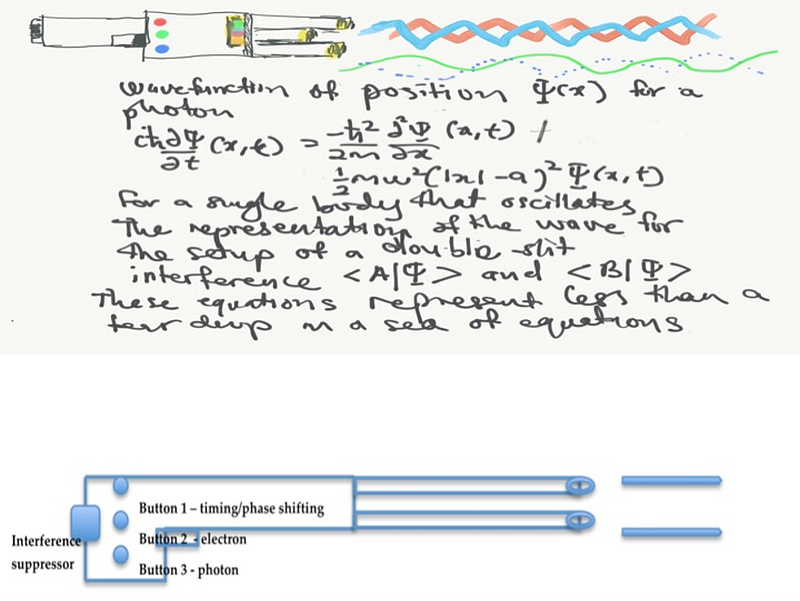
Suppose that the rifle is able to produce three versions of outcomes from the three initial states of the beams.[1] In the first version, the electron beam passes through the slits as usual (the choice to turn on the photonic beams is optional) — this is not dissimilar from the aforementioned Feynman thought experiment. In the second version, the function for interference suppression will be turned on to prevent an observer, such as myself, from being able to track when the beam was released by creating a quantum eraser; information on the electron beam is suppressed once the electrons pass through the slits (this could potentially be applied to discerning the finer points of quantum measurements and the interaction between the two quantum systems). The third version is a composite of the first and second versions intentionally made to be entirely fictional just to push the boundary of the possible.[2] One can also add another parametric function to the rifle: it is capable of adjusting the frequency and intensity of the beams released. So, when this function is activated, together with the phase-shifter (one that changes the wave function of the particle emitted), we could generate a multitude of phase-shifting waves that are superposed. After an elapse in time, we can also release the photonic beams, with even more functions turned on. If desired, further parameters could be added, or complexified, to demonstrate the interference experiment into one illustrating a connection to higher energy physics to demonstrate how a low level/data volume experiment correlates to a high level/volume data experiment.
What I have not included into this picture is an extended demonstration of mathematical narrative (that is another project in itself) for showing how mathematical formalism is connected concretely to physical manifestations so that one could then produce mathematical fictions of the physical materiality that spans different levels of fundamentality in terms of the particles involved. The development of such a narrative would require genealogical development of the dualism paradox that could converge in physical and formal visualizations of connecting ideas, and the divisibility between a macroscopic and a microscopic world.
Wrapping up this experiment (without ending it)
In returning to the three scenarios, I could imagine the outcomes of this fictional proposition with a few reality checks built in. The imagined scenarios are beginning hypotheses where even a misguided start contains the potential for producing an outcome with realizable properties. The first version is a classic, unmodified thought experiment that acts as a control. The versions that came after are products of enhancements, and explorations into the what-ifs that have been tacked onto the original thought experiment. The second version represents points of decoherence when the interactions of the delocalized states of electrons and photons are intentionally suppressed. The third version represents an output that is a combination of the observer’s state of consciousness and perception of the measurement made (at varying states of collapse), a variation to the Schrödinger’s cat thought experiment.
I decided to see how to track all these diagrammatically. See the blue shapes below.
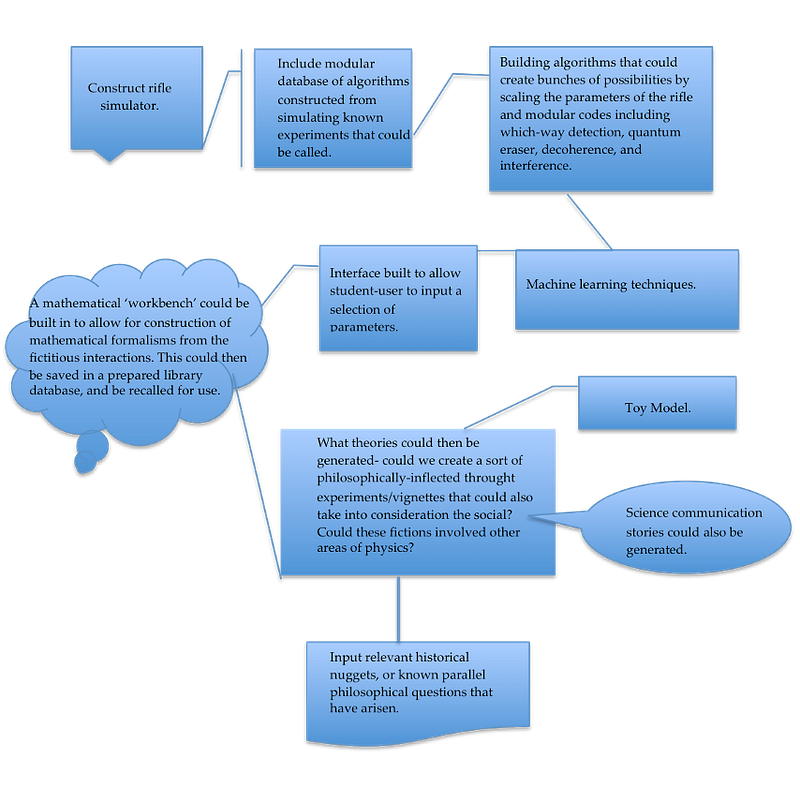
One could also complicate the mix by adding in the omniscient observer, who I will introduce as Wigner’s friend; such an observer would have the equivalent of what amounts to information on whether that dratted cat is dead or alive. The double-slit experiment, and its exposure of the ‘underbelly’ of quantum physics, have indirect implications on the development of a pragmatic aspect of quantum physics, such as technological advancements of areas where quantum effects matter, i.e. quantum systems and computing. Although I am limiting my exploration to a single fictional case of a very particular area of physics, I argue for the possibility of redeploying the motivating factor of this design fiction into other areas of boundary sciences, thereby deploying fiction to think speculatively yet rigorously about the science, especially of emergent sciences perched at the intersection of multiple, possible pathways. Lofty ideals aside, one could underestimate the possibility of deploying design fiction to the more dry-and-cut everyday science, since novel ideas have been known to emerge from unlikely sources.
Little Notes on the Side
[1] These are not the only interactions that our fictional rifle is capable of producing, but these are the only ones discussed in this essay.
[2] One could also create a third version demonstrating decoherence through a composite profile of all existing interpretations of quantum mechanical theories, and further versions that could involve major and minor tweaks. The point is not to quibble about the veracity of such fictions, but rather, to see what new ideas could be generated from the creation of such fictions.