
Do You Really Need A Website?
A closer look at websites and why having your own website matters

Recently, my friend Jason wrote a post for this publication questioning if writers still need a blog. It’s a good read. He concluded you do likely not need a blog at all. However, I respectfully disagree with Jason’s conclusion on this topic and this post is why.
If you want to be a writer, you definitely want to have a website.
Why? I’ll dive into that in a brief moment. First, a super quick illustration.
You have car insurance, right? Why?
You might say you do because it’s required by law. Fine. Let’s say it’s not required by law. Would you still have car insurance for a new car?
Sure you would. Why? Because your car is valuable. You don’t want to lose your car if it’s stolen or something happens to it.
The same thing goes for your brand online. While I enjoy using Medium and social media, these platforms come and go. AOL was once the king of the internet, then Myspace. Currently, Facebook is huge. And Medium is growing too.
However, Medium changed the rules, and these changes greatly affect writers. More on this here.
We don’t know the future of Medium. In a few years, the site might look very different. Medium.com may not even exist. The only certainty is change. Things keep changing every day.
You need something you can control during uncertain times where constant change is the norm. What can you do?
You can have your own website. When you put your content on the websites of others, you’re building a house on rented land. It’s just a matter of time until things end badly. But when you have your own website, it’s like having your own little space of the internet that’s all yours.
What Is a Website Really?
I know it’s really easy to view a website as a blog. That’s fine, because that’s often the case for many writers. However, I think that the definition of a website is very short-sighted. Instead, I view a website as a central hub. A connection point that leads a visitor to where they want to go.

A website can be much, much more than a blog. I actually build websites for businesses, and each business has a goal in mind when they craft a website.
For many businesses, the goal is getting people to sign up for an email list. Or maybe it’s selling a product or service. That’s really clear. You can see if a website is working well or not when you have a specific goal in mind.
But a website can also exist as a portfolio, an information page — or a media hub — for a podcast or YouTube channel or many other things.
Let’s look at a few examples.
A Connection Hub Example
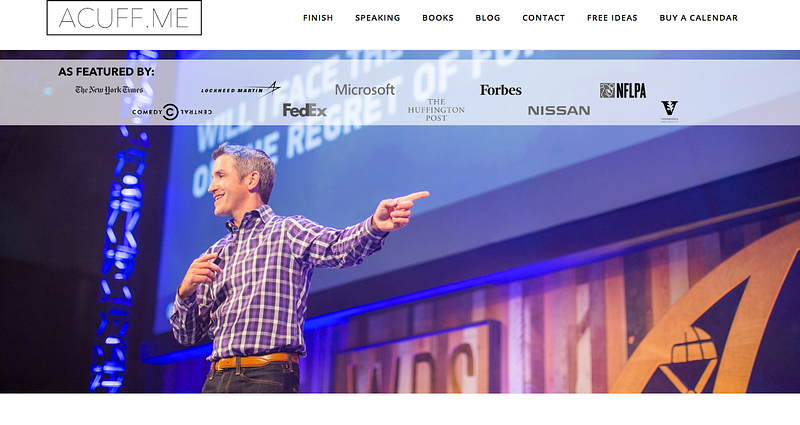
My friend and client Jon Acuff has a really nice website. Let’s glance at it for a moment.
If you scroll down a little further on Jon’s site, you’ll see this.

Look at that. His website is a hub for info about his books, booking Jon to speak, his podcast, and his blog. Even if Jon doesn’t get an immediate speaking engagement through his own website, it gives information and background about Jon’s speaking.
Although books are first on this website, I’d argue that a picture is worth a thousand words. Jon is speaking on stage, smiling as he just told the audience something exciting.
The end-user might not see this at first, but when she sees the word “speaking” on the website, her brain will immediately connect the dots.
Another Great Example to Consider
Here’s a great website from Sean McCabe. Take a look. It’s clear, it’s simple and it easily passes the “what’s in it for me” test.
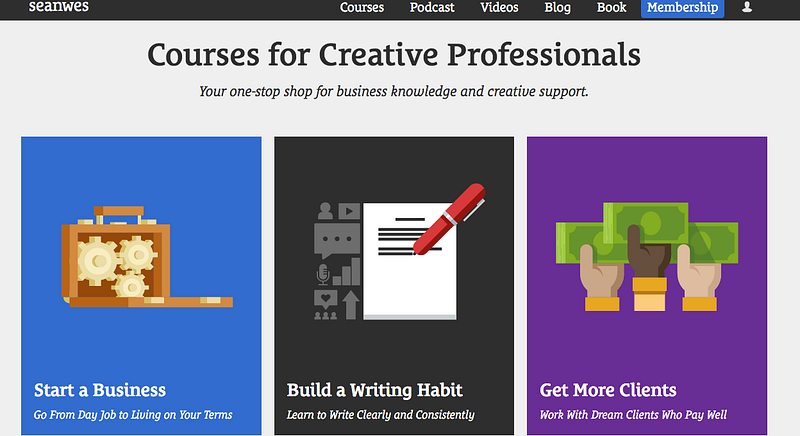
I’ve taken a few of Sean’s courses mostly because of the clarity on his website. Look at the tagline: “Your one-stop shop for business knowledge and creative support.” This phrasing is fantastic. You don’t come up with a great tagline like that without having a lot of clarity. I love it. This website is actually a community filled with courses and helpful content such as podcasts, videos, and blog posts.
One Last Example
Here’s a final example for you. November was National Novel Writing Month, aka NaNoWriMo. Here’s the official website.
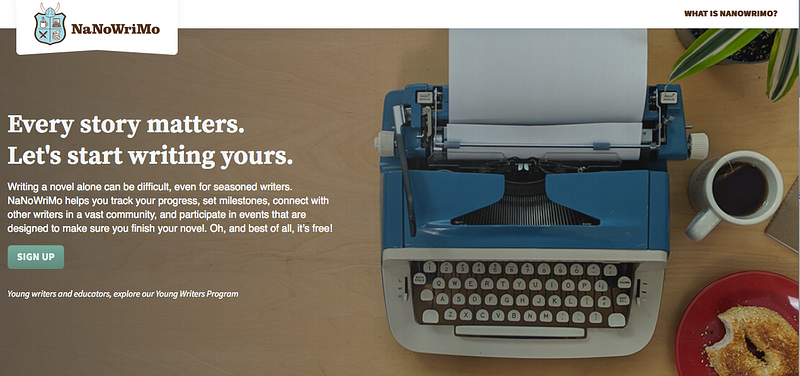
It’s so clear and well done. What’s the website about? Helping you write a novel. I really love this website. The photo is very appealing too. What’s the next step for this website? That’s right, it’s signing up. So simple.
The Problem Most of Us Face
Most people don’t have a goal in mind for their website other than “getting more traffic.” That’s not good enough. That’s not clear. Web traffic alone does not matter. What kind of web traffic you want is much more important.
People go to websites for solutions. Even boredom is a problem that is often solved by Facebook, Twitter, Reddit, or YouTube.
If you’re not solving problems, that is likely why your website is not getting any traction.
So what can you do? You need to realize that for years marketers have had it wrong. Content creators are not the hero. The hero is the end-user.
A Shift of Sorts
Keeping in mind that the end-user is the hero, you become the guide offering answers. We all need some guidance from time to time, right? Scroll back up for a quick second to the NaNoWriMo website above. It does a great job of being the guide to the end-user.
Your website is your chance to guide the hero to achieve victory. It’s your chance to enter the end user's story. Nothing matters more to the end-user than her story. You need to help her accomplish her goals.
A Final Thought
Remember, your website is also the only thing you have complete and total control over. Medium could end tomorrow. Your website’s end date is totally up to you.
Don’t delay. Your website is a valuable investment in your online presence. Start working on it today, even if it’s just brainstorming ideas on a piece of paper. I’ve made a simple cheat sheet for you here about the three things your website should have. I hope you enjoy it.


