avatarPrateek Dasgupta

Free AI web copilot to create summaries, insights and extended knowledge, download it at here

4405

Abstract

Seti I </b>seized the city for the Egyptians, defeating a small Hittite force. But happy with his victory, Seti made no plans to defend it, and the Hittites retook Kadesh.</p><p id="9943">This set the stage for his legendary successor Pharoah <b>Ramses II</b> to confront the Hittites at Kadesh.</p><h1 id="a50d">The battle of Kadesh.</h1><figure id="12da"><img src="https://cdn-images-1.readmedium.com/v2/resize:fit:800/1*Cmhvfa0YZK0hAYe_uXX3ew.jpeg"><figcaption>Relief from Abu Simel showing Ramses II slaying an enemy. at Kadesh. Image source: <a href="https://en.wikipedia.org/wiki/Battle_of_Kadesh#/media/File:Egypt_Abou_Simbel6.jpg">Wikimedia Commons.</a></figcaption></figure><p id="6c8b">The growing tensions between Hittites and Egyptians eventually lead to an epic showdown outside Kadesh.</p><p id="152e">A young Ramses II was eager to prove a point to the Hittite upstarts and rushed into battle confident of victory. He marched onto Kadesh with 20,000 men and 2,000 chariots. The Egyptian army had four divisions: Amun, Ra, Set, and Ptah, named after their gods.</p><p id="26f3">Egyptian chariots were light, fast, and built for two men. The Hittite chariots, on the other hand, were larger, slower, and had a three-man unit.</p><p id="6c48">Ramses caught two Bedouin spies, who informed him that the Hittites were far away from Kadesh. Sensing an easy victory, Ramses stormed ahead of his army and headed towards the city.</p><p id="142d">But little did he know he was in for a rude shock.</p><p id="4974"><b>Muwatalli II,</b> the Hittite ruler, planted the spies. He was waiting outside Kadesh with 3,500 chariots and a 37,000 strong infantry.</p><p id="ec03">Ramses, meanwhile, caught two Hittite soldiers who confessed the truth when threatened with torture. They said that Muwatalli was waiting to ambush the Egyptians with a large army. Realizing the danger, Ramses sent messengers to his other divisions.</p><figure id="302b"><img src="https://cdn-images-1.readmedium.com/v2/resize:fit:800/1*2Y3BQJ8iTCqYvGb0U_TT_A.png"><figcaption>Initial Hittite charge on the Egyptians at Kadesh. Image source: <a href="https://en.wikipedia.org/wiki/Battle_of_Kadesh#/media/File:Battle_of_Kadesh_I.png">Wikimedia Commons.</a></figcaption></figure><p id="2bec">The Hittite chariots charged into Ramses’ forces outside Kadesh, destroying them. The situation looked hopeless for Ramses. According to his own account:</p><blockquote id="3117"><p>Not one of my princes, of my chief men and my great, was with me, not a captain, not a knight; For my warriors and chariots had left me to my fate, Not one was there to take his part in fight…Here I stand, All alone; There is no one at my side, My warriors and chariots afeared, Have deserted me, none heard My voice, when to the cravens I, their king, for succor, cried. But I find that <b>Amun</b>’s grace Is better far to me than a million fighting men and ten thousand chariots be.</p></blockquote><p id="48f1">While Egyptian generals abandoned Ramses, <a href="https://historyofyesterday.com/5-bizarre-uses-of-animals-as-weapons-in-war-by-armies-7a57108afcb">his lions held their ground.</a> Despite their bravery, the Hittites had the upper hand.</p><p id="95e5">All Muwatalli had to do was march his infantry into Egypt’s rapidly dwindling forces and seize the day. But, for unknown reasons, he did not press his advantage and instead held back his reserve forces.</p><figure id="7b49"><img src="https://cdn-images-1.readmedium.com/v2/resize:fit:800/1*I-pENl2LAcsEQ2AR2XK65Q.png"><figcaption>Egyptian counterattack at Kadesh. Image source: <a href="https://en.wikipedia.org/wiki/Battle_of_Kadesh#/media/File:Battle_of_Kadesh_II.png">Wikimedia Commons.</a></figcaption></figure><p id="bf3d">Because of this delay by the Hittites, the Ptah division came to the battlefield just in time to prevent a rout and the capture of Ramses.</p><p id="b92e">The Hittites started plundering Egyptian camps as they thought victory was inevitable. This made them vulnerable to the Egyptian counterattack.</p><p id="9c28">We get a one-sided narrative of this battle from the Egyptian accounts, which claim that Hittites fled the battlefield, after the Egyptian counter. They mention most of the Hittite army drowned in the rivers.</p><p id="a1c5">Ramses declared victory over the Hittites.</p><p id="3c24">But according to Hittite records, they won because they prev

Options

ented Ramses from taking over Kadesh. Ramses had indeed failed in his goal.</p><p id="37f5">Because of these contradicting accounts, current experts conclude the battle was a draw. We may not know the exact outcome of the battle, but we know what followed.</p><h1 id="efb1">The world’s first peace treaty.</h1><p id="7c73">Despite Ramses’ exaggerated claims of victory, he knew it was wise to work with the Hittites than fight them. Both had valuable trading goods and technologies which could complement each other.</p><p id="0e12">Muwatalli died two years after his defense of Kadesh in 1272 B.C. and was succeeded by his brother <b>Hattusili III.</b></p><p id="f938">Hattusili and a more mature Ramses welcomed the idea of ceasing hostilities between the two sides. In 1258 B.C., both parties sued for peace and we have the first recorded peace treaty in the world.</p><p id="e67f">Part of the agreement read:</p><blockquote id="a345"><p><b>Ramesses</b>, the great king, the king of the country of Egypt, shall never attack the country of <b>Hatti</b> to take possession of a part (of this country). And <b>Hattusili</b>, the great king, the king of the country of Hatti, shall never attack the country of Egypt to take possession of a part (of that country).</p></blockquote><p id="25eb">Both civilizations realized they were matched in terms of military strength and resources, hence, it was pointless to continue fighting each other. Peace would help their people carry out trade and exchange knowledge.</p><p id="65c2">The Hittites were expert metallurgists who shared advanced toolmaking technology with the Egyptians.</p><p id="d0f8">The Egyptians had superior agriculture and shared farming techniques with the Hittites. This improved the Anatolian civilization’s grain output.</p><p id="3a2a">There were no further conflicts between the two Bronze Age superpowers.</p><p id="c7db">Egypt and the Hittite Empire thrived for a few more decades, but they were now facing external threats. Around 1200 B.C., both empires faced a <a href="https://readmedium.com/who-were-the-mysterious-sea-peoples-blamed-for-the-bronze-age-collapse-ef42bf46ddec?source=collection_home---4------2-----------------------">wave of invaders known as the Sea Peoples</a> who destroyed many sophisticated cities and razed them to the ground.</p><p id="bd9f">The Hittite Empire collapsed. Egypt fared better, managing to defeat the Sea Peoples. But it was a pale shadow of its former self.</p><p id="8e90">The world quickly descended into darkness, with writing systems disappearing in Greece, Anatolia, and the Levant. The affluent urbane life was abandoned in favor of a more primitive lifestyle.</p><p id="a90a">If you want to learn more about the world after the collapse of the Bronze Age civilizations, read the story below.</p><div id="c087" class="link-block"> <a href="https://historyofyesterday.com/the-lesser-known-dark-ages-which-you-have-probably-never-heard-of-100e2713e493"> <div> <div> <h2>The Lesser-Known Dark Ages Which You Have Probably Never Heard Of</h2> <div><h3>The Late Bronze Age collapse lead to a period of darkness in history.</h3></div> <div><p>historyofyesterday.com</p></div> </div> <div> <div style="background-image: url(https://miro.readmedium.com/v2/resize:fit:320/1*JmKWQvR-oX28ng_MH-3sRQ.jpeg)"></div> </div> </div> </a> </div><p id="59b3"><i>Enjoy reading tales of the past? Please support my work by <a href="https://prateekdasgupta1.medium.com/membership">subscribing to Medium using my referral link</a> and gain unlimited access to thousands of stories.</i></p><h1 id="ad12">References.</h1><ol><li>Healy, Mark (1993). <i>Qadesh 1300 B.C, Clash of the Warrior Kings</i>. Osprey Publishing; Osprey Campaign Series</li><li><a href="http://www.thebritishmuseum.ac.uk/research/publications/bmsaes/issue_6/bryce.aspx">The Eternal treaty from the Hittite perspective</a>, British Museum</li><li>Cline, Eric H. (2014). <i>1177 B.C.: The Year Civilization Collapsed</i>. Princeton, New Jersey: Princeton University Press.</li><li>Bryce, Trevor (2005). <i>The Kingdom of the Hittites</i>.</li><li>Shaw, Ian (2003). <i>The Oxford History of Ancient Egypt</i>. Oxford: Oxford University Press.</li></ol></article></body>

What Do We Know About the First Peace Treaty in Human History?

The first known peace treaty, signed in 1258 B.C., ended hostilities between two Bronze Age superpowers.
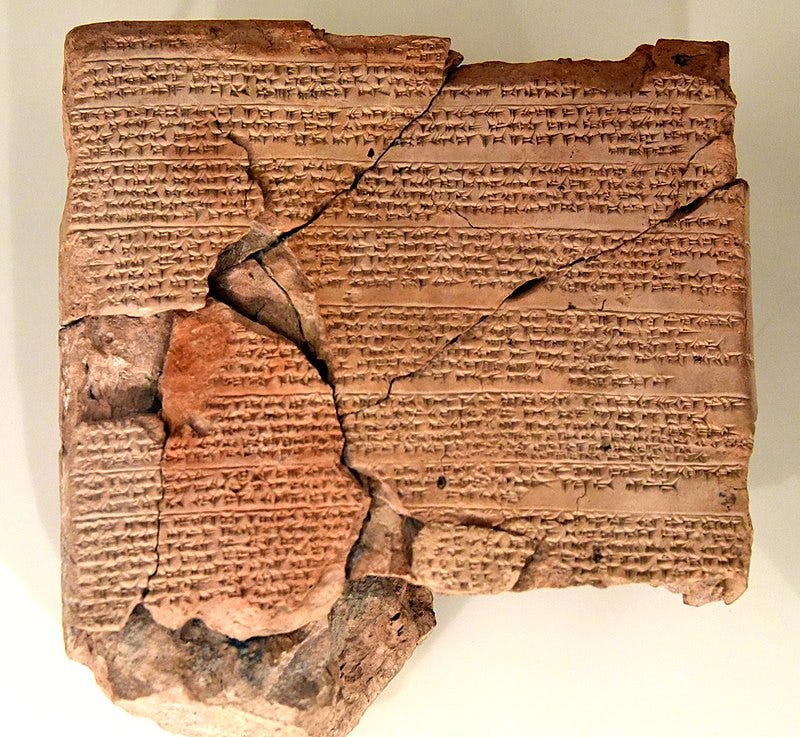
The Egyptian-Hittite peace treaty, the world’s first known peace pact signed in 1258 B.C. Image source: Wikimedia Commons.

When discussing history, it is unavoidable to bring up wars. Thankfully, human history is known not only for its conflicts but also for periods of peace that resulted in enormous progress for our species.

The earliest human peace treaty may have been a handshake between two rival clans. But we don’t know where or when it happened.

There is more evidence for the first recorded peace pact, between two Bronze Age superpowers, the Egyptians and the Hittites, in 1258 B.C.

During the Bronze Age, as technology advanced and international trade flourished, Egypt in North Africa and the Hittites in Anatolia spread their influence.

As both competed for control of the lucrative trade routes of the era, fighting was unavoidable. Following a series of minor skirmishes, the stage was set for an epic clash in the city of Kadesh, in present-day Syria-Lebanon border.

Background.
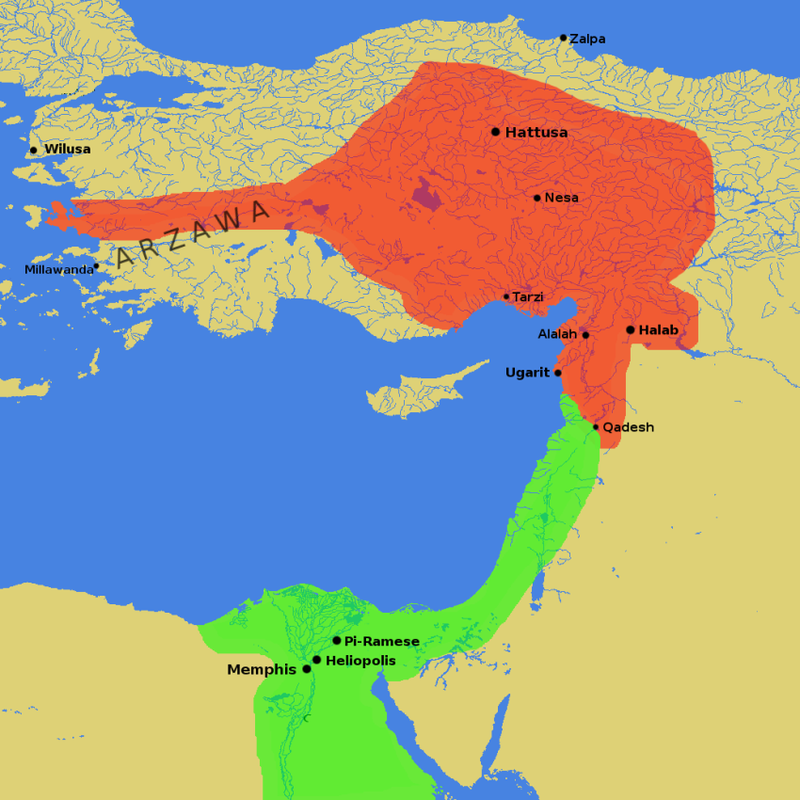
Egypt (green) and Hittite Empire (red), before the Battle of Kadesh in 1274 B.C. Image source: Wikimedia Commons.

Before diving into the conflict between the Hittites and the Egyptians, it’s important to know these Bronze Age civilizations and what brought them to a showdown at Kadesh.

Birth of the New Kingdom and the rise of Egypt’s power.

The Hyksos, a Levantine people, ruled Egypt during the start of the 16th century B.C. The Levant is the region that includes modern-day Israel, Lebanon, and Syria.

Pharoah Ahmose I defeated and evicted the Hyksos from Egypt around 1570 B.C., ushering the “New Kingdom” era.

The expulsion of Hyksos may have inspired the biblical tale of the exodus of the Jews from Egypt.

To prevent future invasions, Egypt extended its borders up to the Levant. By the reign of Thutmose III, Egypt was at the peak of its power. Thutmose was also the first person titled the “Pharoah”, and all Egyptian rulers thereafter used that title.

The New Kingdom Pharaohs re-started the grand Egyptian tradition of building magnificent monuments. The most well-known of these was the temple of Luxor, built by Amenhotep III.

But Egypt was lowering its guard on its North-Eastern frontiers in the Levant. This allowed a new rising power from Anatolia to seize lands at a rapid pace.

The rise of the Hittites.

The Hittites were an Anatolian people, who rose to power almost at the same time as Egypt’s New Kingdom. They ruled from Hattusa, in present-day Turkey.

The Hittites were well-known metalworkers. They had access to crucial copper mines, tin supply, and meteoritic iron. This enabled them to develop superior tools and weaponry, allowing them to make quick progress in farming, construction, and military operations.

Hittites defeated the Mittani kingdom, based in present-day Syria and Iraq. But their greatest display of strength was when the Hittite king Mursili I invaded and sacked the magnificent city of Babylon.

The Hittites switched their attention to the Levant and began pushing their way into Egyptian territory. The strategic city of Kadesh, an important commercial center, aroused the Hittites’ interest.

Pharaoh Seti I seized the city for the Egyptians, defeating a small Hittite force. But happy with his victory, Seti made no plans to defend it, and the Hittites retook Kadesh.

This set the stage for his legendary successor Pharoah Ramses II to confront the Hittites at Kadesh.

The battle of Kadesh.
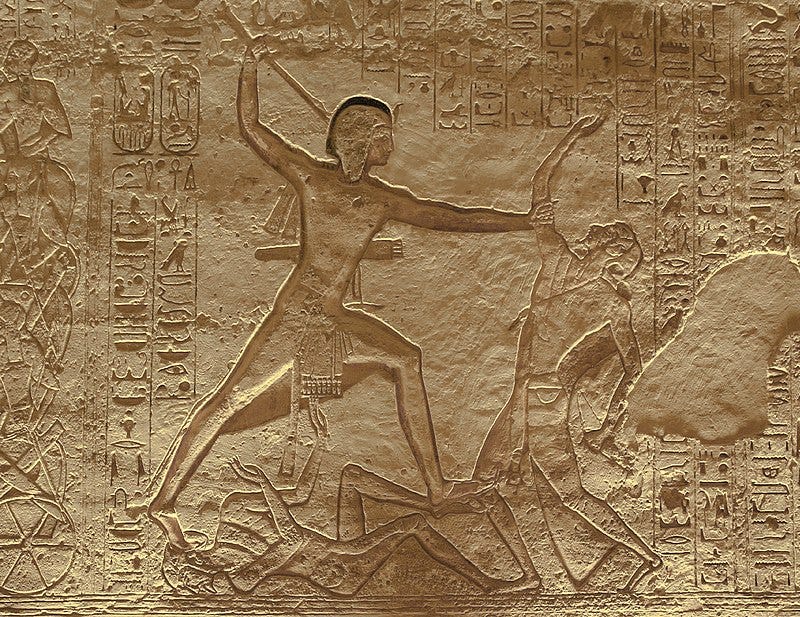
Relief from Abu Simel showing Ramses II slaying an enemy. at Kadesh. Image source: Wikimedia Commons.

The growing tensions between Hittites and Egyptians eventually lead to an epic showdown outside Kadesh.

A young Ramses II was eager to prove a point to the Hittite upstarts and rushed into battle confident of victory. He marched onto Kadesh with 20,000 men and 2,000 chariots. The Egyptian army had four divisions: Amun, Ra, Set, and Ptah, named after their gods.

Egyptian chariots were light, fast, and built for two men. The Hittite chariots, on the other hand, were larger, slower, and had a three-man unit.

Ramses caught two Bedouin spies, who informed him that the Hittites were far away from Kadesh. Sensing an easy victory, Ramses stormed ahead of his army and headed towards the city.

But little did he know he was in for a rude shock.

Muwatalli II, the Hittite ruler, planted the spies. He was waiting outside Kadesh with 3,500 chariots and a 37,000 strong infantry.

Ramses, meanwhile, caught two Hittite soldiers who confessed the truth when threatened with torture. They said that Muwatalli was waiting to ambush the Egyptians with a large army. Realizing the danger, Ramses sent messengers to his other divisions.
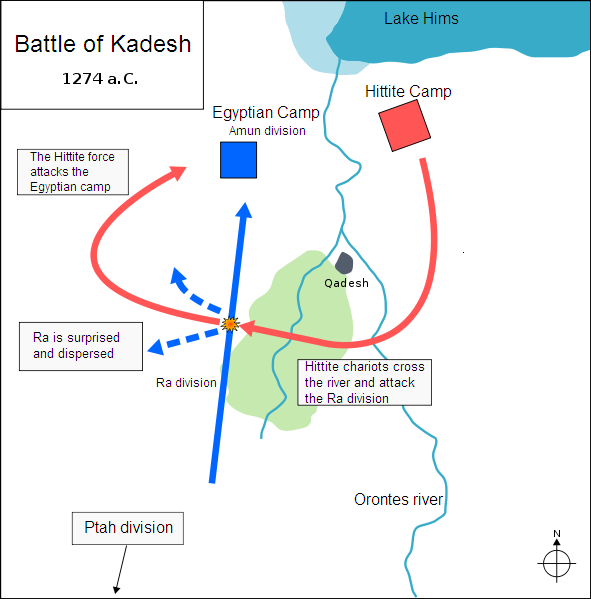
Initial Hittite charge on the Egyptians at Kadesh. Image source: Wikimedia Commons.

The Hittite chariots charged into Ramses’ forces outside Kadesh, destroying them. The situation looked hopeless for Ramses. According to his own account:

Not one of my princes, of my chief men and my great, was with me, not a captain, not a knight; For my warriors and chariots had left me to my fate, Not one was there to take his part in fight…Here I stand, All alone; There is no one at my side, My warriors and chariots afeared, Have deserted me, none heard My voice, when to the cravens I, their king, for succor, cried. But I find that Amun’s grace Is better far to me than a million fighting men and ten thousand chariots be.

While Egyptian generals abandoned Ramses, his lions held their ground. Despite their bravery, the Hittites had the upper hand.

All Muwatalli had to do was march his infantry into Egypt’s rapidly dwindling forces and seize the day. But, for unknown reasons, he did not press his advantage and instead held back his reserve forces.
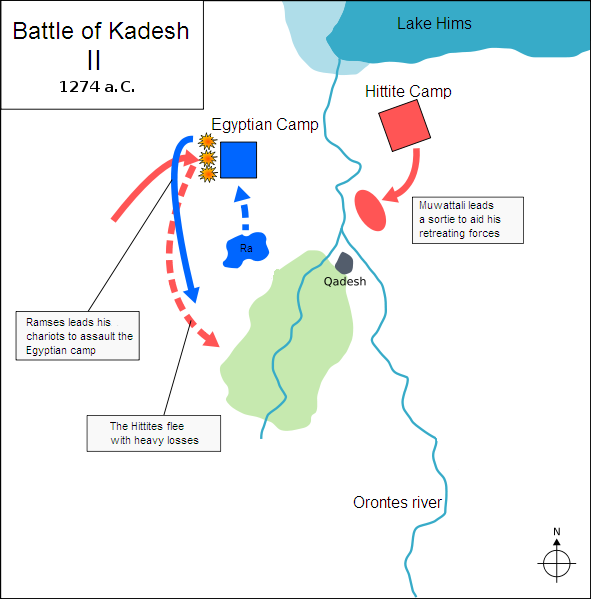
Egyptian counterattack at Kadesh. Image source: Wikimedia Commons.

Because of this delay by the Hittites, the Ptah division came to the battlefield just in time to prevent a rout and the capture of Ramses.

The Hittites started plundering Egyptian camps as they thought victory was inevitable. This made them vulnerable to the Egyptian counterattack.

We get a one-sided narrative of this battle from the Egyptian accounts, which claim that Hittites fled the battlefield, after the Egyptian counter. They mention most of the Hittite army drowned in the rivers.

Ramses declared victory over the Hittites.

But according to Hittite records, they won because they prevented Ramses from taking over Kadesh. Ramses had indeed failed in his goal.

Because of these contradicting accounts, current experts conclude the battle was a draw. We may not know the exact outcome of the battle, but we know what followed.

The world’s first peace treaty.

Despite Ramses’ exaggerated claims of victory, he knew it was wise to work with the Hittites than fight them. Both had valuable trading goods and technologies which could complement each other.

Muwatalli died two years after his defense of Kadesh in 1272 B.C. and was succeeded by his brother Hattusili III.

Hattusili and a more mature Ramses welcomed the idea of ceasing hostilities between the two sides. In 1258 B.C., both parties sued for peace and we have the first recorded peace treaty in the world.

Part of the agreement read:

Ramesses, the great king, the king of the country of Egypt, shall never attack the country of Hatti to take possession of a part (of this country). And Hattusili, the great king, the king of the country of Hatti, shall never attack the country of Egypt to take possession of a part (of that country).

Both civilizations realized they were matched in terms of military strength and resources, hence, it was pointless to continue fighting each other. Peace would help their people carry out trade and exchange knowledge.

The Hittites were expert metallurgists who shared advanced toolmaking technology with the Egyptians.

The Egyptians had superior agriculture and shared farming techniques with the Hittites. This improved the Anatolian civilization’s grain output.

There were no further conflicts between the two Bronze Age superpowers.

Egypt and the Hittite Empire thrived for a few more decades, but they were now facing external threats. Around 1200 B.C., both empires faced a wave of invaders known as the Sea Peoples who destroyed many sophisticated cities and razed them to the ground.

The Hittite Empire collapsed. Egypt fared better, managing to defeat the Sea Peoples. But it was a pale shadow of its former self.

The world quickly descended into darkness, with writing systems disappearing in Greece, Anatolia, and the Levant. The affluent urbane life was abandoned in favor of a more primitive lifestyle.

If you want to learn more about the world after the collapse of the Bronze Age civilizations, read the story below.

Enjoy reading tales of the past? Please support my work by subscribing to Medium using my referral link and gain unlimited access to thousands of stories.

References.

  1. Healy, Mark (1993). Qadesh 1300 B.C, Clash of the Warrior Kings. Osprey Publishing; Osprey Campaign Series
  2. The Eternal treaty from the Hittite perspective, British Museum
  3. Cline, Eric H. (2014). 1177 B.C.: The Year Civilization Collapsed. Princeton, New Jersey: Princeton University Press.
  4. Bryce, Trevor (2005). The Kingdom of the Hittites.
  5. Shaw, Ian (2003). The Oxford History of Ancient Egypt. Oxford: Oxford University Press.
History
Peace
World
Education
War
Recommended from ReadMedium