
What do people really think about Religious objections to vaccines?

To answer the question in the title we can of course speculate, offer an opinion, or even try a straw poll of our own. None of that is necessary now because, on March 31, 2022, Pew published a national poll that gives us a fascinating insight.
The title gives the game away, it is “Americans skeptical about religious objections to COVID-19 vaccines, but oppose employer mandates“
What are the numbers and what do they really reveal?
There are a few surprise here.
Let’s take a closer look.
What do most think about those that have a religious objection to having a vaccine?
Below are the Pew statistics …
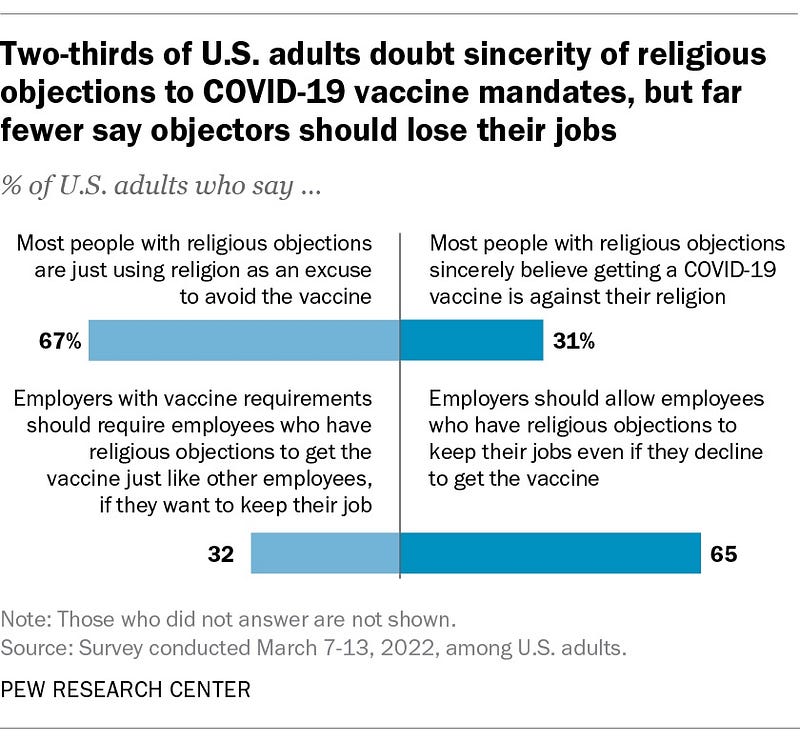
We all know that the COVID vaccine has become a deeply politicized issue.
Related to this are three foundational facts …
- COVID is real — yes there are some who deny it exists and claim, on the basis of no evidence at all, that it is a hoax. That is a fringe view. Most agree it is real.
- The deep impact of COVID is a statistical fact — beyond the number of deaths, close to 1 million in the US, more than half of those that get COVID still have lingering symptoms six months later.
- There are multiple vaccines that have been demonstrated to be effective
Knowing the above, you might think that common sense dictates that most people would consider it to be a rather good idea to get the vaccine and thus greatly reduce personal risk. You might also think that having vaccine requirements is a sensible idea, especially for those that come into contact with vulnerable people, such as within a healthcare context or those that care for high-risk people such as the elderly.
Apparently not.
Under normal circumstances, you would be right, most would indeed agree with you.
Sadly, as you can see from the Pew statistics, there are rather large numbers of people who clearly reject what is obvious common sense.
Pew simply reports the numbers …
Two-thirds of U.S. adults say most people who claim religious objections to a COVID-19 vaccine “are just using religion as an excuse to avoid the vaccine,” while about a third (31%) say they think the objectors “sincerely believe getting a COVID-19 vaccine is against their religion.”
At the same time, most Americans do not think those with religious objections to the COVID-19 vaccine — regardless of the sincerity of their beliefs — should lose their jobs. A majority of adults (65%) say employers that require coronavirus vaccinations should “allow employees who have religious objections to keep their jobs even if they decline to get the vaccine.” Around a third (32%) disagree, saying the employers should “require employees who have religious objections to get the vaccine just like other employees, if they want to keep their job.”
What they don’t do is dig into why it is like this.
OK, let’s go there.
Why is it like this?
This next bit is not a surprise, but for completeness, here it is.
Pew doesn’t just ask a question in isolation, they also gather other details. It is those other details that can reveal insights.
It enables them to break down the opinions expressed by politics and also religion.
Here is how the answers the the questions fan out across the divides …
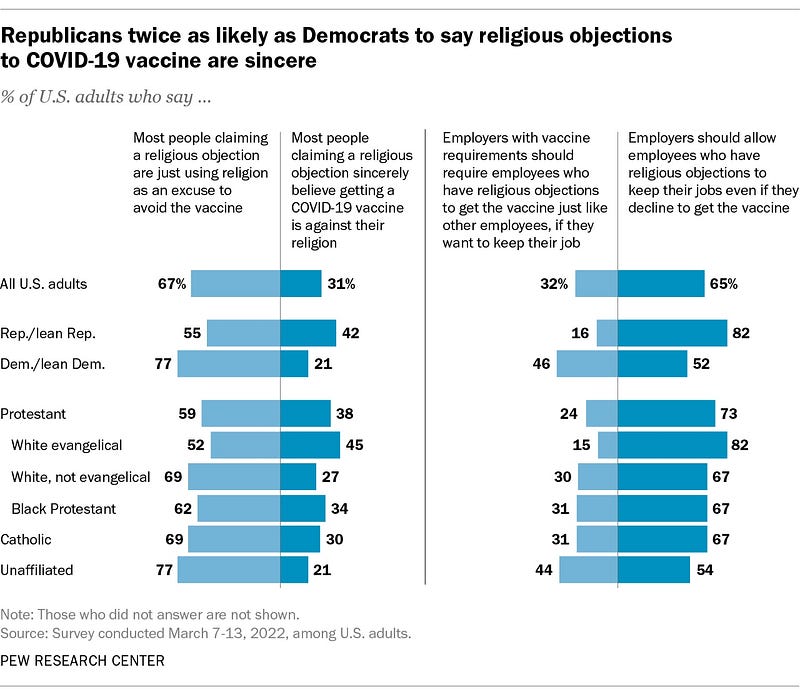
For the first on the left there is a spectrum of opinion. We have White Evangelicals at one end, and the religiously unaffiliated at the other end. You can of course also see the political split there as well.
What is abundantly clear, no matter how you slice it is this …
- The majority can see thought the religious exemption charade and label it correctly as an excuse.
But wait, there is also this …
- Surprise-1: A majority of evangelicals, even 52% of the white ones, say that they agree that religious excemptions are just an excuse
- Supprise-2: The majority of Republicians, 55%, also agree that religious exemptions are just an excuse
Even the most potentially contentious justification, the supposed creation of vaccines via cell lines that came via an aborted fetus, is revealed to be religious cosplay. The most vocal staunch anti-abortion religious group, Catholicism, the church with the longest and deepest anti-abortion history, takes the stance that Catholics have … “a prima facie duty to be vaccinated, not only for the sake of their own health but also out of solidarity with others, especially the most vulnerable“.
The Catholic church does not duck the issue, but instead tackles it head-on like this …
‘all clinically recommended vaccinations can be used with a clear conscience and that the use of such vaccines does not signify some sort of cooperation with voluntary abortion
OK, let’s move on to the other big-ticket item — vaccine mandates.
What about those that refuse a vaccine and then get fired for refusing it?
Everything appears to have flipped the other way. On the surface, this feels very odd.
Nobody, no single grouping, political or religious, has a majority that thinks you should be fired if you refuse a vaccine.
If you refuse the vaccine and then go to work in … let’s pick an example … a care home looking after the very elderly, and you then bring COVID in and it kills many, should there not be consequences for that?
Don’t those that run care homes have a duty of care ? Should they have vaccine mandates for staff?
OK, hold that thought and consider this. One of the key pillars of medical ethics is that a patient has the ultimate decision-making responsibility for their own treatment. If a patient refuses treatment, even if it is for bad reasons, then ethically they have that right.
This does not need to be a reason for them to be fired.
There is a middle ground here. The options most commonly available are these …
- You either have the vaccine, or you agree to regular tests to verify that you can safely interact with those at risk.
The availability of that alternative is why most probably do not think that refusing a vaccine should get you fired.
What is clear is that political/religious tribalism is very much in play.
Normally most would get the vaccine without too much bother. Hint: Smallpox is gone.
However, if the tribe you are associated with has embraced anti-vaccine as part of that identity, then you will adopt the same stance. If asked why, you will most probably cite “reasons” without really giving them much thought.
We humans can be like this. Often we will drift into things for emotional reasons. Later we will justify it to ourselves and others by having official “reasons”. If you then proceed to demolish the stated “reasons”, you will be astonished to observe that the stance remains intact and apparently immune to not just criticism of the claimed “reasons”, but the complete obliteration of the stated “reasons”.
This is because the cited reasons are not the actual foundation at all, we tend to simply tack those on later.
In summary: Yes, people cite religious concerns for refusing vaccines. Most can see through that charade. Even if it is a sincerely cited reason, it is still an act and is not what is really going on.
We consume ideas by putting on a specific religious/political identity. We then lie to ourselves and others about why we believe what we claim to believe.
Understanding this opens a door to having more meaningful productive conversations.


