
What Do I Do with the Love Letters Dad Wrote to Mom?
A dilemma I didn’t anticipate
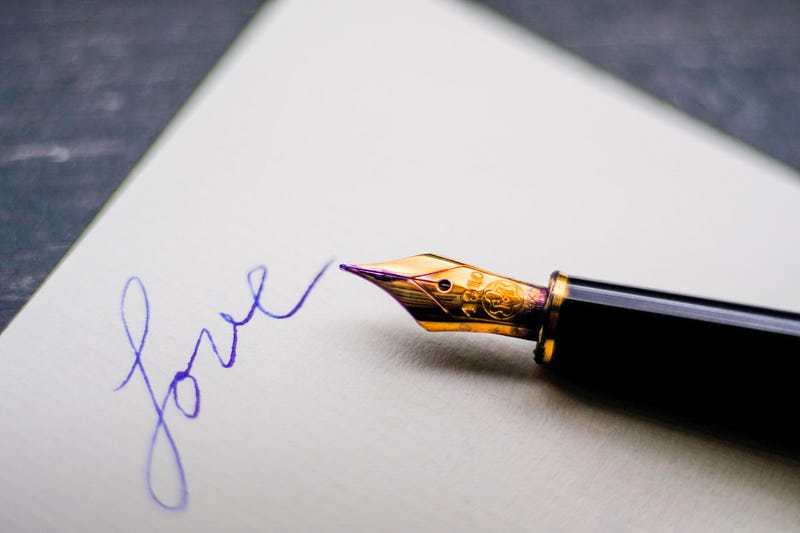
“What’s that?” I asked my mom as I pointed to a large pile of envelopes gathered by a thick rubber band.
We were cleaning her dresser, getting her ready to move in with us after Dad died, when I stumbled on this collection with a return address of The Windsor Hotel.
“Oh, those are letters your father wrote to me when he worked at the mountains,” she explained.
I looked at her in disbelief. So many thoughts were running through my mind. My father was an incredible man with many gifts and skills but writing was not one of his talents. As a matter of fact, writing and reading were always laborious and tedious for him. Yet, sitting before me were 78 letters and one postcard, all handwritten by him.
Seeing his cursive handwriting on the top envelope of the stack jogged a myriad of memories for me.
“Can I read them, Mom?” I wanted to respect her privacy but, frankly, was dying to read them.
“Of course you can, but you are going to be disappointed. They all say the same thing,” she cautioned. She discounted them as “no big deal” and something about the way she said that did not ring true.
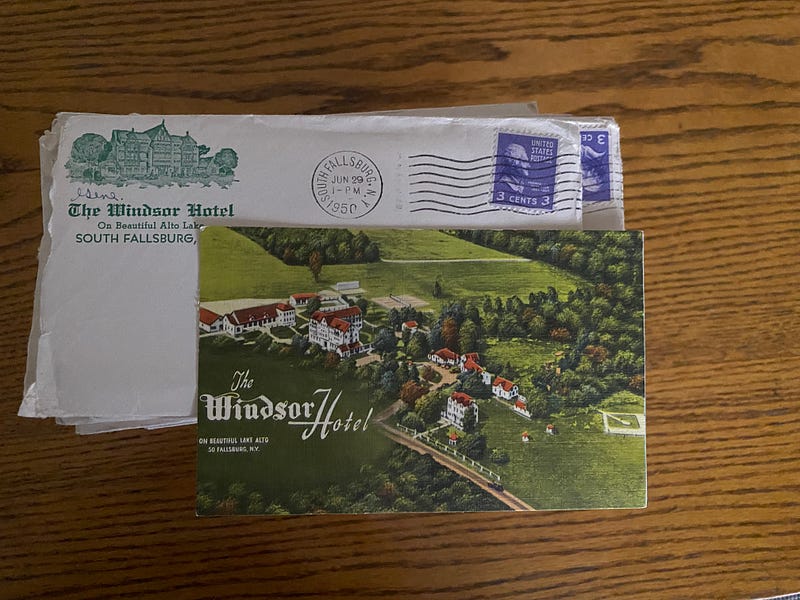
The year was 1950. Dad took a job as a baker in a summer resort in the Catskill Mountains. He and Mom were engaged to be married in September and both of them were trying to save as much money as possible.
The Windsor was located in South Fallsburg, New York and it offered vacationers the use of a beautiful pool and many sports and activities like handball, basketball, golf, tennis, horseback riding and lawn games. Boating was available at a lovely lake bordering the property.
The Catskills, known to many as “the mountains,” was a celebrated Jewish resort area. The Catskill Institute describes how in the 1950s, “a half-million people each year inhabited the ‘summer world’ of bungalow colonies, summer camps and small hotels. These institutions shaped American Jewish culture, enabling Jews to become more American while at the same time introducing the American public to immigrant Jewish culture. Home-grown Borscht Belt entertainment provided America with a rich supply of comedians, musicians and performers.”
For my Dad and others like him, the summer resorts of the Catskills offered steady employment where they could earn money if they worked hard. Additionally, Dad felt he could pick up some new skills.
He worked there from March of 1950 to the end of September 1950, one week and six days before their wedding. He visited home, which was 90 minutes south, once every other week on his one day off. When he couldn’t visit, he wrote Mom letters. Love letters.
When he applied for a job, he had the opportunity to choose what he wanted to do. He could be a groundskeeper, or a server in the dining hall. Neither of those jobs appealed to him. There was one slot open in the bakery. He knew nothing about baking and convinced his boss that he was a quick study who was willing to learn. He wanted to learn how to bake.
Life as a baker in a summer resort in the Catskills was labor intensive. He got up at 4:00 am to start the bread, kneading and proving dough for hours for challah, rye, pumpernickel and sourdough bread. When that was completed, he started to make the sweets for the day. He made apricot and walnut rugelach, blueberry and sour cherry blintzes, chocolate babka, cheese Danish and honey cake. Lucky for us, we got to try all of these when he and Mom baked them in years to come.
Though it was difficult work, he never complained. He particularly enjoyed working with people from a variety of cultural backgrounds. In his small town, he saw others with the same ethnicity, primarily Eastern European. The workers in “the mountains” were a melting pot from a variety of places and backgrounds and he loved making friends with them. He often wrote about sharing meals in the kitchen with the staff. Since they shared cooking their meals, he got to sample ethnic meals that were “homemade” and totally new to him.
Every day when he baked, he jotted down recipes on notecards and mailed them to Mom. All of the recipes were designed to feed large groups of people and years later I remember both of them reducing proportions to make some utterly delicious baked goods. When baking was completed, he was sent either to the kitchen to do prep work or to the grounds crew to help with outside work.
Days were long, beginning at 4:00 am and ending at 8:00 or 9:00 pm. The work was steady and intense, but I remember Dad feeling grateful for those days because what he earned gave them a financial start for their lives together.
Reading the letters offers a peek into a young man’s life in 1950. Money was tight. Dad mailed cash inside each letter to Mom. Some letters explained that $5.00 or $10.00 was included and others had as much as $30.00. He excitedly told her to bank whatever it was and wrote a lot about saving for their future.
In one letter, he was apologetic about spending $6.50 for a pair of men’s dress shoes for the wedding. Considering what he was making, this was a significant amount. Throughout my life, Dad always bought Mom whatever she wanted but rarely, if ever, spent any money on himself. In a few letters, he reminds her that they will spend “cash only, no credit” and that now is the time to put money away for a house.
There are 3-cent stamps on each letter. I became acutely aware of how little they had when I read about the wedding preparations. They decided they wanted to have as many people as possible, so they planned a reception in the backyard of a relative’s house after the church wedding.
They accommodated 200 guests and served sopersata sandwiches on homemade rolls, several hams, potato salad and trays of cheese and fruit. This was a grand splurge. They had beer, wine and soda for all and a four-tiered wedding cake that Dad made and decorated. They both saved everything they could to make this happen. While Dad was at “the mountains” working, Mom worked long hours in a garment factory. That is a story for another day.
The letters are filled with endearments like “Dearest Sweetheart,” My Love” and “Dearest Hon.” Each is signed “with love and kisses” or “from your lover.” I wish I had the companion letters from Mom, but I do not. He references her letters frequently and, in one letter mentions the poetry she wrote for him! That she wrote poetry was a big surprise.
But, for me, the most poignant part of the letters is when Dad wonders about what the future holds. He articulates his fears and reassures her after he voices each fear. He tells her that they will make it through anything because their love is true. He tells her as long as they are together, they can weather any difficulty.
“I’ll love you til I die,” he writes. And so, he did. They were married for over 68 years and he was in love with her until the very end.
My childhood and my adulthood are filled with memories of my Dad telling my Mom how much he loved her. His affection was demonstrative and steady, as was hers in return. Though our family life was not perfect, that love was a foundation of security that never faltered. Each of us benefited from the strength of their love for one another.
Still, I struggle with knowing what to do with these letters. I recognize that the letters are valuable on many fronts. I could see them being woven together to create a narrative of sorts, but that feels wrong to me.
Am I invading what is private space that existed only between the two of them?
There is an innocence to them that feels so different from today. If I am not going to share them publicly, to whom do I give them to pass them on? Should they be divided between grandchildren and great-grandchildren? Or, should they remain together?
While he was working as a baker, he was approached by a man who offered him training to become a PP&L lineman. He jumped at the chance. For the rest of his life he baked only at home for holidays.
There are times as we grow up — and grow older — when we come to appreciate our parents in new ways. We come to understand that they were not always as clear and certain as they appeared to be and that they took risks and set out on their adventures with excitement and hope. Reading Dad’s love letters gave me a chance to see him as a young man of 21 in love, long before I was a twinkle in his eye. It gave me the opportunity to understand why Mom was so taken with him.
When we leave a legacy for our children and grandchildren, we hope that they know us well and respect our efforts to give them the best life possible. This fully human picture helped me love them both even more, and inspired me to begin sharing even more with my children and grandchildren.
After all, it is in ordinary living where we find the extraordinary.