
Three Case Studies in Changing Your Mind When Writing
The rewrites of Beauty and the Beast, Hamilton, and Frozen
I can tell you that when I write, the foundations often look nothing like the final product. But you have no real reason to care about that, or evidence that the changes I talk about made the story better.
So let’s look at three examples of blockbuster stories whose foundational layers ended up being nothing like the final production.
Beauty and the Beast
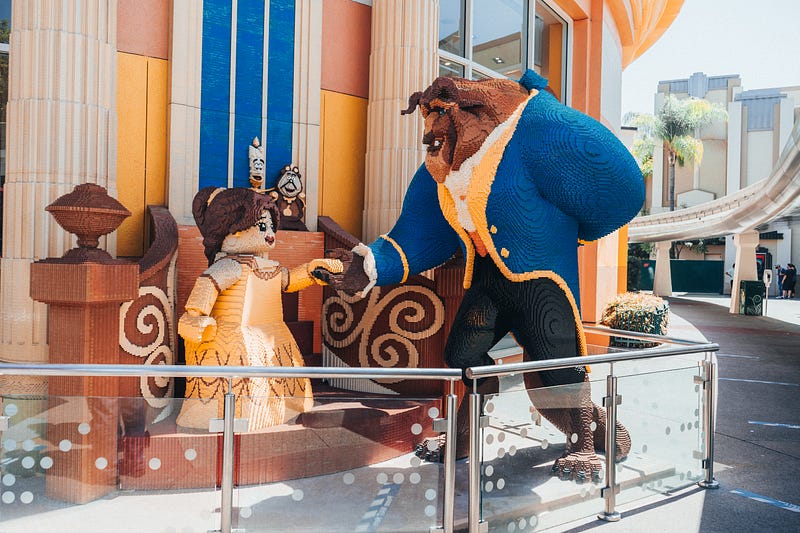
The first of these is Disney’s Beauty and the Beast. Besides featuring my favorite Disney princess for reasons that should be clear, Beauty and the Beast is a wonderfully crafted story. It uses a structure called chiasm beautifully: mirroring the first half in the second half, beat for beat, showing how the characters change within that. The color scheme, the animation, the music… everything about this early Disney Renaissance film is iconic.
But it didn’t start that way. The whole story of how Beauty and the Beast came to exist is worth looking into, but what’s most relevant here is its foundation: the first storyboard laid down for that movie. On that storyboard, artwork and costumes were truer to the pre–French Revolution era, Belle had sisters, we knew more of the origin story for how they got into a small town, “Be Our Guest” was sung to Maurice when he arrives instead of Belle… it’s a completely different take.
To be fair, it’s also much closer to the original fairy tale, but that doesn’t mean it was right for the late 1980s when this story was being developed. In fact, production came grinding to a halt several times early in the process because it wasn’t clicking, wasn’t getting greenlit, and no one was particularly happy with how it looked.
Let’s say the Disney writers looked at their foundation at this point and gave up on retelling this story, because it clearly wasn’t working, and then no Disney movie came out in 1991. Maybe they decided The Little Mermaid was a fluke and gave up on their return to retelling fairy tales. Without this renewed focus on retellings, there might have been no Aladdin, no Hunchback of Notre Dame, no Hercules. Maybe they decided that since they put all this work into this foundation, it was what they would use, with no changes. Maybe it flopped and we still didn’t get Aladdin or The Lion King or the rest of the Renaissance.
Instead, they accepted that while they had the start of something, it wasn’t the right start yet. They fired the team that made that version, brought on women to write the story and the screenplay, and tried again, using that foundation as a jumping-off point, the cement under the building, rather than a finished product. They decided that Belle should be the protagonist, and “Be Our Guest” should be a showstopper saved for her, not sung to Maurice as it had originally been. They decided the animation style needed to change with the times — allowing them to blend animated and computer-animated styles for the first time in history for the iconic dancing scene during the title song.
Disney wouldn’t have had their renaissance without Beauty and the Beast, and they wouldn’t have gotten this version without their foundation — or without deciding that foundation was incomplete and needed reworked.
Hamilton
The second blockbuster I want to examine is the hit Broadway musical Hamilton. Lin-Manuel Miranda, wonderful person that he is, decided to drop Hamilton covers, medleys, and unreleased songs once a month for an entire year back in 2018. It was a fantastic year for musical theater buffs who wanted more from LMM, myself included. But from a craft standpoint, the highlight of the project was his release of what he called “First Burn,” his first attempt at writing the song that became “Burn.”
What made that release so fascinating was how amazingly good that song is. Some lines were clunky, sure, in ways that got revised — that’s what happens between drafts and finals — but one stanza of the original sent the internet in a flurry. That stanza of “First Burn” has lines that are inarguably better than some of the lines that made the final cut. The rhyming scheme, the words that Eliza screams at Hamilton that are, well, a sick burn: It’s brilliant.
Heaven forbid someone whisper “He’s part of some scheme” Your enemy whispers So you have to scream I know about whispers I see how you look at my sister
So a bunch of people tweeted to Lin-Manuel Miranda, asking about the change from these lines. He explained in a Twitter thread (that I’ve since lost; if you find it, link me!) how, during revisions, he thought about the character Eliza and what he needed her to feel in that moment — and the anger she throws at Hamilton was wrong for the scene.
So he kept the foundation he built in the first version of that song. Then he cut some of the best lines, lyrically but not in relationship to the character, from it. The final song is emotionally poignant instead of angry, fitting to what Eliza does in that moment and afterward.
What if he hadn’t, though? Maybe he kept it because he enjoyed the rhymes and the banter in the original too much to let it go, to kill his darlings. It’s hard to say what would have happened to Hamilton. Maybe it still would have been a great success. But maybe Eliza’s arc would have been missing a nameless something that kept people from connecting emotionally to her.
Her knowing her husband had been flirting with her sister might have come off as weakening her character, and maybe it wouldn’t have become quite the success it is today. It’s hard to say. But LMM knew even good foundations mustn’t be held onto too tightly, not when they stop serving the narrative.
That is, it was a beautiful foundation, but it was a foundation for the wrong house. So he killed his darlings, redrafted, and let it go.
Frozen
Speaking of letting it go… let’s study an example that, despite its commercial success, didn’t follow through as thoroughly as it could have on rebuilding from a foundation. We’re back to Disney, fast-forwarded about 25 years from the development of Beauty and the Beast. I’m talking, of course, about Frozen. Based on a Hans Christian Andersen story called “The Snow Queen,” the story was supposed to follow a princess out to tackle an evil snow queen and save her kingdom from an eternal winter. Animating this fairy tale had been on Disney’s to-do list for literally decades, with no success in getting from foundation to final product.
This time around, early drafts had Elsa as the unequivocal, two-dimensional antagonist and Anna the plucky protagonist. Songwriting was handled by husband-wife duo Kristen Anderson Lopez and Robert Lopez, who drafted “Let It Go” as the popular-in-Disney-movies Villain Song. Needless to say, it’s a bop. And the Powers That Be decided it was too good of a song to give to a villain. Elsa, somehow, needed redeemed.
With less than a year until the film’s release, the writers set to work finding a new plot, one with deeper character dynamics, a complex motivation for Elsa’s actions, and ultimately, the triumph of sisterhood.
What resulted, probably due to the tightened schedule, was a film in which it’s hard to track the plot, the character arcs, the theme, and…pretty much everything else. Elsa ends up with a much larger role, to the point where Anna’s actions as protagonist get convoluted.
As the YouTube channel Screen Junkies says in their “Honest Trailer” about Frozen, “Watch Anna save the day by teaming up with her sister, a merchant, a hot guy, and a snowman to defeat villains like her sister, a merchant, a hot guy, and a snowman.” While only “her sister” is the same character in these descriptions, Elsa’s unclear role — how she morphed from antagonist to co-protagonist between drafts — is evident in what became the final picture.
As much as I find Frozen endearing, and there are certainly reasons it’s become a modern favorite, I firmly believe it could have used an extra year in development, solidifying Elsa’s role and working on thematic cohesion.
I also think Disney figured this out, because Frozen 2 is one of the most thematically cohesive Disney movies made recently, and its own story to production involved a similar turn around a song and plot point that needed defined. The “Into the Unknown” documentary on Disney+ shows that the plot point of who or what the voice that’s been calling to Elsa is wasn’t settled until very late in the writing process, much like Elsa’s role was unclear for much of the writing of Frozen.
“Let It Go” was a revelation about the story that crumbled the plot like a house of cards, and the rebuilt structure felt equally flimsy. When “Show Yourself” was finally finished, the last piece of the puzzle didn’t crumble anything, but completed it. The whole film tied together quickly once that final missing piece fell into place, and with a few revisions to foreshadow the moment, Frozen 2 became the beautiful, resonant movie that Frozen could only hope to be.

If you like my work and would like to read more of it, consider joining Medium with my referral link to get full access to every article on Medium. Using my referral link doesn’t cost you anything, but half of the fee goes directly to supporting me each month.