
What did I Learn From Over 10,000 Minutes of Meditation?
Nothing, but that’s the point?
It is a counter-intuitive idea when we really think about it. A common principle in meditation is that for attaining mental clarity, you have to realize that it is there all along. As Andy (Headspace founder) likes to say simply noticing that you are distracted, brings you back to focus. The simplest things are the hardest precisely because they are simple. All we need to do is realize we are one breath away from full consciousness. Yet, so far away.
We all have to start somewhere
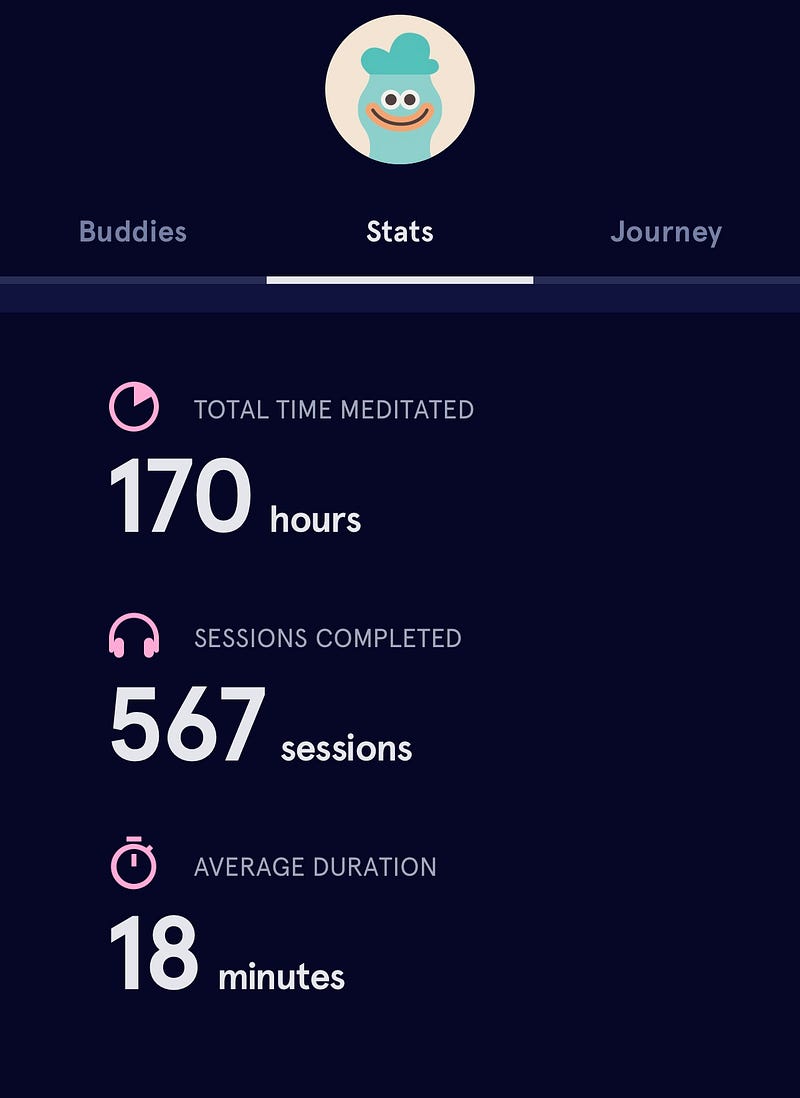
And, we all have to start at some point in time. For me, meditation with any sense of continuity started with Headspace. Over the past couple of years, I have continued to build sessions and arrived at more than 10,000 minutes of meditation time. It has not become a rigorous habit but fairly consistent practice.
What I have captured in this article is a series of observations that I have not seen being discussed much.
Training your mind’s director
Your brain runs on glucose. To dominate an entire planet is no easy task and the human brain has managed that in a relatively short time. In order to achieve this feat, consumes a ton of energy. You have probably observed that when you start to lose focus, a shot of glucose in the bloodstream perks you up quickly.

A few years ago, I had read a book on the new research in Neuroscience (’12 Brain rules’?). One of the analogies given in that book is that your mind’s focus is like a well-lit stage. Each idea or thought you have is like an actor on the stage. In order to keep multiple actors on the stage can easily tire, distract and cause chaos.
This is the main reason why multi-tasking is such a bad idea. Switching between tasks is like moving around actors unnecessarily. It wastes a lot of your brain’s energy, literally. Back to the play analogy, in order to manage the actors on stage and keep it from getting crowded, you need a competent director. That’s where meditation comes in. It is a training program for your mind so it can be a good director to stay focused.
A window into the shutting down of the mind’s processes
I had a short glimpse into the connection of the body’s well-being to the mind. A few months prior to Covid, I found myself suddenly in the ER. My platelet count had plummeted to 700 (because of a viral infection that I picked up on my recent trip to India, more on that later).
The low platelet count had a dramatic impact on reducing my energy levels. I noticed my thoughts were turning inwards and I experienced an overall reduction in the number of thoughts. I could feel the energy it took to even hold any thoughts so my mind would just give up thoughts altogether. It was a feeling that I want to hold on to.
The silent observer that doesn’t speak any language
A weird sensation occurred during one of the meditation sessions. I came across an ‘observer’ in the mind which seemed completely silent. I am not sure if it’s a fabrication of the mind but it was an interesting experience.

There is surely a ‘pop science’ explanation of different types of conscious and subconscious minds that play out. Maybe the silent observer is where we experience the subconscious mind because it’s not accessible through thoughts articulated as words.
Another interesting experience is that while observing your own breathing — you start to get these wisps of thoughts that are not fully formed yet. It takes a few seconds before you catch on that your mind has added more details that make up the full thought. It’s pretty cool. According to research in neuroscience, it takes thought about ten seconds since conception to your conscious mind realizing it.
After that first time, I haven’t experienced the presence of the silent being but that’s what meditation teaches. You cannot crave experiences.
Mostly a nap time
I have to be honest though. Many of the meditation sessions were post-lunch. And, we all know what that means. Within the first few minutes of the session, Andy’s voice would knock me out. The phrase “I am not sleeping but I am meditating” is perfect for capturing the moment. Nap times are the best.

Closure
The good part of meditation is that it lets you play with one of the most sophisticated machines known to us — our minds. The tools to do that are simple and accessible to us all. You don’t have to take anyone’s word but you can just observe your own experiences, patterns.
Though meditation is supposed to train you to recognize your reactionary response to nervous situations, I haven’t experienced that part yet. Eckhart Tolle’s book was a lot more influential on my mind in trying to stave off reactionary responses rather than my meditation practice.
After spending 10,000 minutes on meditation, I have arrived at a part where I enjoy the experience. There are still some days, where I find it difficult to sit still (especially, when a loved one is sick). I have to treat those challenging days as opportunities (to practice) but I am not there yet.


