
The Roots of Secrecy
Why UFOs Were Disavowed
The UAP/UFO coverup was put in place by well-meaning national security leaders, but has it outlived the benefit?

In life, our choices are often made out of the choices of those who came before us.
Withheld information, either by denial, deception or omission, reflects a choice by someone else to refuse us genuine understanding. With this slippery exercise of control, our perception of life is made false. Someone we might never know or identify has taken power over our recognition of experience. Until we discover the means to learn what we were not told, we exist diminished by ignorance. Only the truth, as the ancient adage goes, will set us free.
In ufology there exists a widely repeated, multi-faceted narrative concerning a choice made not to tell people about the existence in the skies, the seas, and maybe even within the Earth of highly advanced intelligent beings who are not human.
Various terms have been applied to this perceived cloaking mechanism. Steve Bassett, a long time Congressional lobbyist on the question, uses the phrase Truth Embargo. Others say simply UFO coverup. The first emphasizes the neutral aspect of withholding, an inoffensive way to navigate toward political change. The second gestures toward an energetically methodical approach to full on manipulation. Coverup implies an aggravated blush of immoral and unethical, if not illegal activity (cross those t’s and dot those i’s). A third option, which tries to synthesize both aspects, is Disavowal.
The people who initiated the Disavowal were far from stupid. They engineered an overarching influence at the highest levels to ensure the secrecy not only of their pursuit of knowledge about unidentified phenomena, but their very own existence. Their sphere appears all encompassing, and they seem to have evolved to hold some command over both the armed services and the spy agencies. Documents revealed over the years allude to the deployment of rapid response forces to ensure management of encounters and the collection of evidence as events occurred. They are always watching.
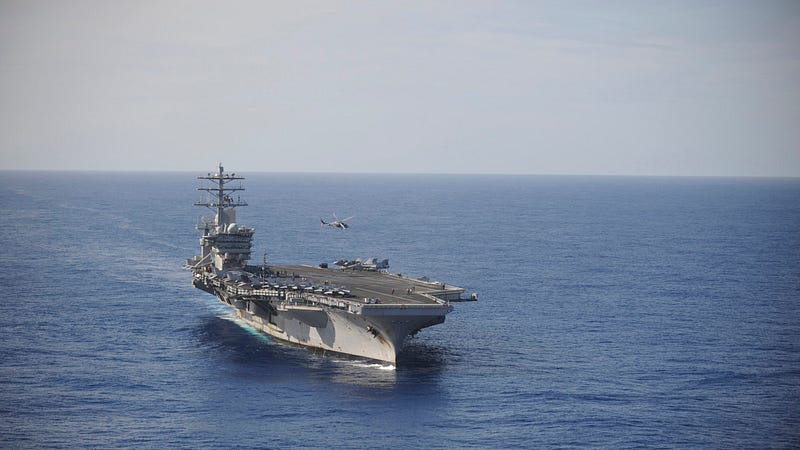
For example, look at how fast agents of the secrecy policy are reported to have arrived on the aircraft carrier U.S.S. Nimitz to seize the data of the famous Tic-Tac incident in 2004. Accounts from sailors involved don’t tell how men in civilian suits got onboard to take the hard drives, but they are said to have been present almost immediately while the ship cruised in naval exercises off the coast of California. That takes real-time sway over many moving parts.
The Disavowal has been powerful, thorough, and long lasting. After nearly eight decades, though, this endeavor now has a visible silhouette. We can discern more readily the existence of a well organized system of concealment, but are still left to wonder about the motivations behind it. While the reasons may have evolved to be many, there are probably two original intentions that are most important.
The first is national security and the second is culture shock.
Reason #1 — National Security
World War 2 had just come to an end. Seventy-five million human beings were dead from the violence, never mind the traumatic damage to civilization and the Earth itself.
During the war Americans had looked at events overseas with constant fear and anxiety. Everyone left standing felt a profound need for recovery from turmoil that had engulfed them relentlessly for five hard years. Victory meant peace. People not only expected to enjoy the afterglow of triumph but were relying it on to restore the world to normalcy so they could get on with their lives. Then came flying saucers.
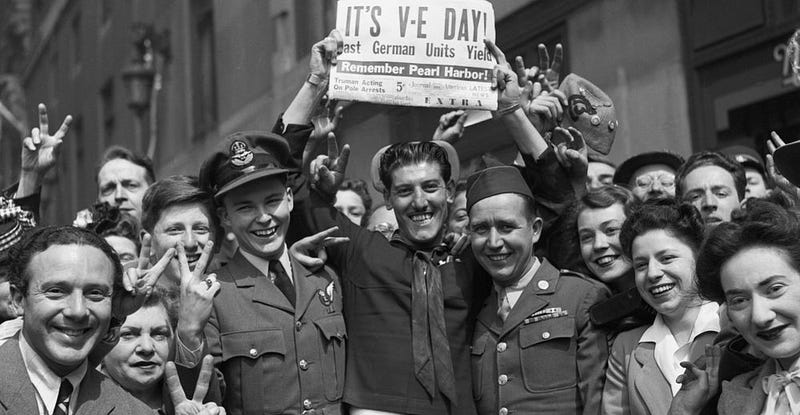
Coupled with the prolific material output of a fully engaged civilian manufacturing base, the U.S. military had been victorious over technologically advanced opponents. The general feeling was that America had saved the world. This was naturally a source of great pride and confidence. The terrible errors of political arrogance like Vietnam were yet in the future. People trusted the proven valor of the armed services. America’s military was the top dog on the planet. Oorah.
Into this jubilant psychological state fell the presence of unknown flying machines and their otherworldly occupants, most notably according to researchers, near Roswell in 1947. Indications exist that crash recoveries were made at as many as six other sites around New Mexico over the next few years. There are speculations that some crashes were induced by high energy radars deployed by the Army. Maybe that was comforting; there was a way to bring these things down. All this activity took place around some of the most sensitive, highly secure scientific research installations in the United States, as well as the only air base supporting U. S. nuclear weapons delivery systems. Not good from a certain perspective.
Threat Analysis
The initial decision to make secret whatever they may have recovered is understandable from the military point of view.
The Pentagon’s job is to keep America safe from foreign threats. What could be more foreign than a completely unknown form of sentient life with technically superior craft that can come and go at will over U.S. air space (how can that thing fly!)? Rest and renewal in society would be harder to come by if the American people had to look up into the skies fearing potential danger much closer to home than Europe or Asia. Bad for reputations all around.
An added factor was that the military did not know whether the same successful outcome they enjoyed against the defeated Axis Powers was guaranteed with potential adversaries about whose numbers and capabilities they knew next to nothing. Besides, the power projection of the Cold War was coming into play. The competition for post war funding was tough enough without confessing that you didn’t know if spending the money would do any good. Comprehensive threat analysis was imperative. Solutions could be proposed later.
Important to consider also was lingering memory of the effects of a pre-war radio broadcast. Presenting a program dramatized in the format of a news report, Orson Welles had triggered mass hysteria over fictional invaders from Mars. H. G. Wells wrote War of the Worlds in the late 19th century, but the adaptation that went out over the air waves in 1938 agitated an astonishingly credulous national audience into believing the end was nigh. Easy to figure the military should not be in the business of spreading news that might be taken by some as announcing that the Martians really had arrived. Duck and cover could go only so far.
Very likely, the Disavowal was started as a means to give people in the know enough time to figure out what was going on, what it all meant, and how to respond.
The results of a few early military studies, Projects Sign and Grudge, antagonized the top brass with a lack of politically acceptable information. Worse, the entire subject was continuing to attract public attention. Acting out of trust, people looked to the military for answers to things they were seeing in the skies and sometimes on the ground. Ordinary honest people like Paul and Evelyn Trent in McMinnville, Oregon, managed to take impressive photographs. Reporters came calling. Something had to be done to quell the nuisance of all this interest.
Sounds of Silence
Lying into a microphone with a sufficient number of stars on your uniform and a condescending smirk on your face was an easy solution.
Yet this was not always convincing with credible experiencers insistent about what they had seen with their own eyes (and Kodaks). Behind the veil of the Disavowal, questions remained more populous than answers. Resolution might take a while. Long term thinking required a long-term management strategy. The question was, how much time to figure this out? Ten or twenty years, thirty, fifty, more? Best to plan ahead as far as possible. Like any show, the Disavowal must go on.
Civilians couldn’t be ordered to keep silent, but they could be intimidated with public ridicule or personal threat. Somewhere by someone a decision was taken to insist that anyone who spoke seriously about flying saucers had questionable reliability, motives, and sanity (jokes are always welcome). If that didn’t do the trick, there were more unpleasant means. With well-staffed departments for this sort of work having skills honed on a massive scale in the recent world war, the military took the naïve American public for a legitimate counter intelligence theater. Humiliation became pest control.
Authorities who had facilitated experimental nuclear strike research by raining down large amounts of radioactive dust on major American cities in order to see which way the wind would blow found no moral hazard in belittling, scaring, or doing harm to citizens who wouldn’t shut up about UFOs. Greater good, needs of the many, and so forth. Best of all, the effects were cumulative and transmissible. The Disavowal became effectively self-perpetuating.
Finally, national security is always on a need to know basis. If they don’t know about something, we don’t need to know that bit, either. Silence is success.
Reason #2 — Culture Shock
The second pressing reason for the Disavowal was probably evident right from the start.
Humans have spent millennia presuming we are at the top of the heap of importance in the universe. Humanity tends to take itself as the sine qua non of significance, with many entrenched ways of thinking about existence to support this self-conception. Right up front in the Judeo-Christian scripture of Genesis, human dominion over every last thing on the Earth is presented like a car title. We are very special; whatever you see belongs to us (why, that’s our Moon!).
Over the past several centuries, the modern world carried this attitude forward with verve. Everything came to be considered within our control. What we want to do we can do because there is no one to stop us, even if that means destroying ourselves (gods were deaccessioned). Consciousness is discounted if not happening in a human brain. Except when it isn’t. When disclosure does come, we might not be able to kid ourselves any longer.
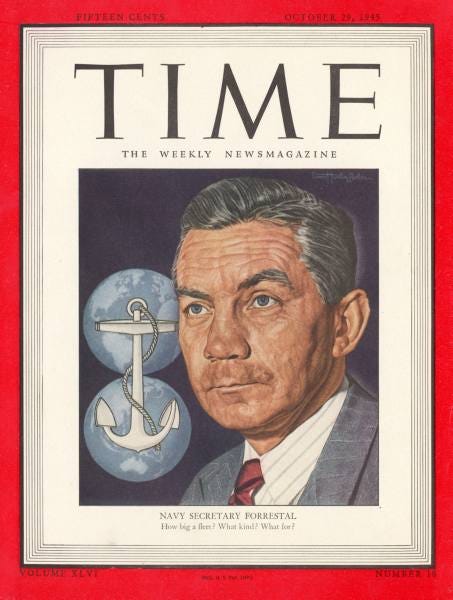
The announcement that the human race is not just not alone, but is also apparently not the sharpest tool in the shed, could be foreseen to have largely predictable but unmanageable results. The fate of a powerful man like James V. Forrestal, the first U.S. Secretary of Defense during the exact years the UFO recoveries are said to have taken place, leaves room for wonder. Did this very capable Ivy League educated and religious man become unhinged upon learning there were intelligent beings not mentioned in any standard text? Or did rank-and-file soldiers tasked with picking up dead alien bodies have nervous breakdowns over an experience from which they wouldn’t ever recover? We may never know, but those managing the Disavowal could go figure.
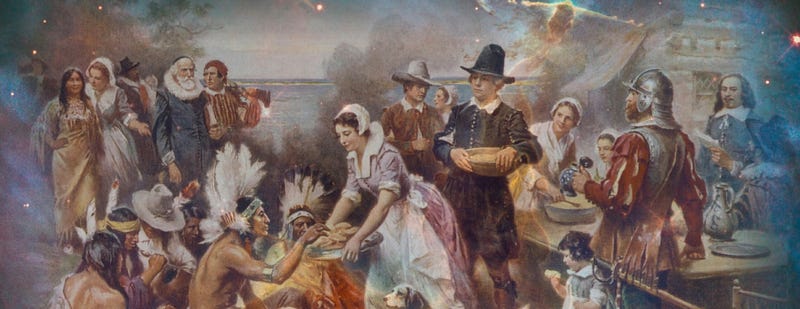
The theological and cultural implications of being a possibly distant number two, three, or more in the scheme of things were studied in reports commissioned discretely from think tanks. Uh-oh. Western civilization might suffer the same ill fortune as the indigenous people of the Americas did when the Europeans arrived. Freed from the imagined constraints of a deity who was apparently not looking over a favored only child all this time, destabilized people might fling dinner on the floor rather than give up their seat at the head of the table (“But you promised!”). Never mind what fashion designers might whip up in silver lamé, overall prospects for social effects didn’t look good.
The Uncertainty Factor
With all this considered, there can be little surprise at a decision made long ago to keep the rest of us out of the loop.
Maybe gatekeepers haven’t kept everything to themselves. We all have smart phones now with global interconnection and nanotechnology can build up the world an atom at a time. Meta materials can make things invisible, so there’s that. Possibly Ronald Reagan was reporting (in 1985!) truthfully by noting in his diary that “our shuttle capacity is such we could orbit 300 people.” There’s so much hidden from us, true, but also our lives are exponentially more empowered with distractions. What’s left to know? What choices are we missing? The Disavowal is probably always working out cost to benefit ratios.
The potential human reaction is all on us. Americans have only recently, and barely, survived an attempted governmental coup. This previously unimaginable event happened due to delusional thinking ginned up by a political party wanting to retain power at any cost. The discontents of ordinary citizens were manipulated through toxic mass media into violence over the way an election went. This is what we do to ourselves with no space aliens in the mix.
Whether ending the Disavowal will bring any good is a legitimate question. Things are pretty bad as they are. Human induced climate change, diminishing natural resources, overpopulation, ongoing military conflicts, and a mass extinction event underway, to mention a few of the day-to-day issues. Our list of self-created woes is extensive. Who’s in charge here?
Perhaps enough cultural indoctrination has taken place over the past 75 years that people won’t lose their continence when faced with the reality we are not the number one and only — and we never were. On the other hand, maybe human beings just need to be embarrassed into behaving better toward the rest of the universe. If the Disavowal has been clear about anything, it is that shaming can work lasting wonders in behavior modification. Whatever happens, those whose minds have been occluded by the Disavowal aren’t the ones who will choose to make the call.
Freedom always come at a price. In the end, we are the ones who have to pick up the check.
Trail of the Saucers focuses on UAP news, history, culture, and analysis. It is published by Stellar Productions and edited by writer/producer Bryce Zabel who also co-hosts the popular new podcast Need to Know with Coulthart and Zabel. Here are several more pieces from the Trail of the Saucers archives —


