
What Constitutes “Viral” on Medium?
Is viral in the eye of the beholder…? Not really…

The phrase “going viral” was first coined by Richard Dawkins in his 1976 book The Selfish Gene, in a context unrelated to technology. There, drawing on Darwinian theory, he posited that ideas replicate in a manner similar to viruses.
It was not until the advent of the internet that we have been able to observe the true pace and scope of the dynamic. An idea goes viral when it is passed exponentially from one person to the next in a rapid fashion. Whereas viral spread of ideas used to take place in town squares, it now happens online at a pace once unimaginable.
It is momentum that most characterizes viral spread. In the last ten years, the viral spread of ideas has toppled governments, saved lives and taken infinitely more.
How do I know if my story is going viral on Medium?
While the scope may be different, the definition of “going viral” on Medium is the same. Your story has gone viral if your reads are organically increasing exponentially. Depending on your reach, a story that skyrockets from 0 -1000 impressions in 24 hours can be considered as having “gone viral,” but more often, viral Medium stories earn more than 20K impressions in a matter of weeks.
Thousands?! I’m grateful when my story earns 100 views
It is a bitter pill for new Medium users to swallow when they learn that for the large majority of content, Medium does not assist with distribution. This statement is true whether or not your material is “selected for distribution.” At the present time, the ratio of new content to readers is such that most work does not get seen, unless you, the writer, share it with folks who want to read your work.
Here’s a sad personal screenshot featuring a well-written, well-titled story distributed by P.S. I Love You (now a full Medium pub), whose exposure has stayed neck-in-neck with a non-distributed, controversially titled piece of the same length that I published the same day. The P.S. I Love You story was distributed at the time of publication. And still, bubkis (= Yiddish slang meaning, nothin’)!
Both sets of numbers are unacceptably low for me, but the point is the same. Even top-line distribution does not guarantee reads.

As you work your way up through the Medium ecosystems, the situation improves, but it’s important to face the fact that in the beginning, if you want your work to be read, the onus is on you to share it.
The keys to non-viral spread of your work on Medium are building a base of true followers, gaining acceptance to wide-distribution publications, and building your personal distribution list and social media following, so that you can directly notify interested readers about your work.
What’s all of this talk of “going viral”?
Most work on Medium does not go viral. But, some does. When it does, it’s distribution curve looks like every viral distribution curve ever, regardless of the platform (ie. straight up!).
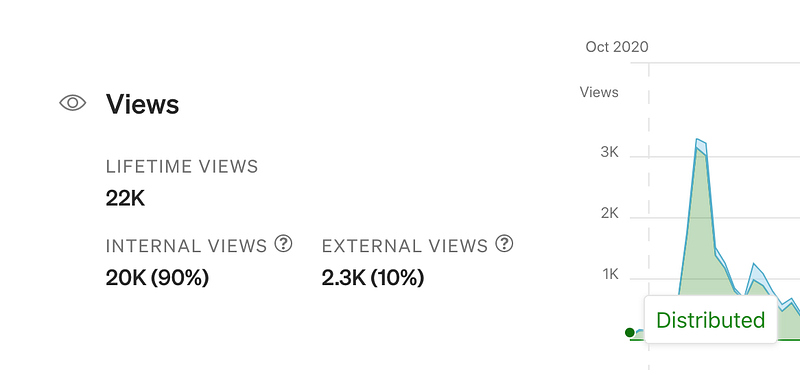
To meet our goal of becoming more successful writers on Medium, I find the shape of this curve less helpful than an analysis of what it feels like when you are an author on the publishing end of a viral piece.
How it feels to go viral (aside from totally awesome!)
- Greater than 40% read ratio: Stories go viral because they are good. If your work is not earning a 40% read ratio in its first 24 hours, it is unlikely to go viral. Make sure that your header and sub-header accurately preview the meat of your story and try improving your opening paragraph to better hook your reader.
- Consistent increase of reads, claps, and comments: When a piece of content is going viral, it sets off a consistent and rhythmic drumbeat of notifications that folks are clapping and commenting on the piece. While these metrics (claps and comments) are no longer a part of the way that Medium calculates compensation for writers, I am convinced that they are the metrics the algorithm is measuring when it is assessing sticky content. 50% is a good measure; on a viral story; about half of your viewers will choose to read, half of those will clap, and half of those will comment.
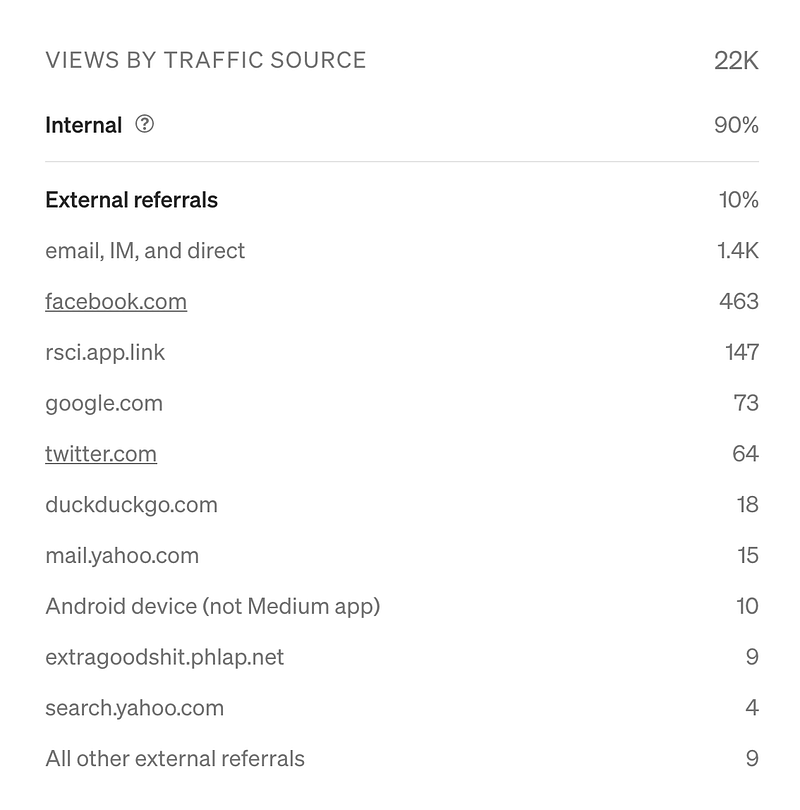
- Email exposure: Stories that begin to gain traction on Medium are emailed out by Medium to our followers. Until you build and manage your own distribution list, earning this type of Medium distribution (this happens even when your story has not been “selected for distribution”) can make or break a story. See the screenshot below for a sense of what I mean.
- Increase in “external views”: All of my Medium articles that have gone viral have broken out of Medium to be shared on other platforms. An early indicator for me is Reddit; if I see it show up as a traffic source, I know that I have a story that is going somewhere. This metric is harder to read for those who regularly rely on their own social profiles to set off the distribution domino effect of your work, because early sharing will generate many non-paying external reads. Still, the bottom line is, viral stories break out of Medium.
The moral of the story
Algorithms like the one that animates Medium are designed to optimize viral content. When your story goes viral, it is because its early reception has set off a digital domino effect, which the algorithm is designed to recognize and amplify.
The source of the domino effect does not matter. It can come from your own social media channels, from lots of great interaction from the Writer’s Communities in which you participate, or from exposure to your Medium followers.
The how is not important.
What is important is the steady, rhythmic 50%/50%/50%/50% metrics that show the algorithm that you’ve written something sticky.
P.S. Going viral is not always immediate, and it does not always happen with your most beloved work.
As I share here, the viral piece screen-shotted above had a different title and as a result, took several days to launch. It only went viral after I made improvements, based on what I learned by watching the behaviors of the first readers who saw it. Use the feedback metrics you receive in the first 24 hours after publication to tweak your story and improve its chances for success.


