What Compassion Has to Do with Having a Growth Mindset
Have you ever wondered if your quest for good habits has a dark side?
This is what we call the “To what end?” question. It’s a practice of looking deeper and developing a more wholesome approach to productivity and self-improvement.
Recently I saw a tweet where someone described being “livid with themselves” over their perceived failure to follow through completely on their journaling habit. And my heart sunk when I saw that. I don’t want to be a part of any habit-building that leads to someone being enraged at themselves. We don’t need that in the world.
Hopefully, that tweet was a bit of hyperbole. But it made me wonder if we need to talk about self-compassion more—or at least do a better job of bringing that question, “To what end?” forward in all that we do.
Building productivity, fitness, eating, and other habits can trigger a very common human flaw: perfectionism. Taken too far, our aspirations tip over into very unhealthy territory where we become our own worst critics.
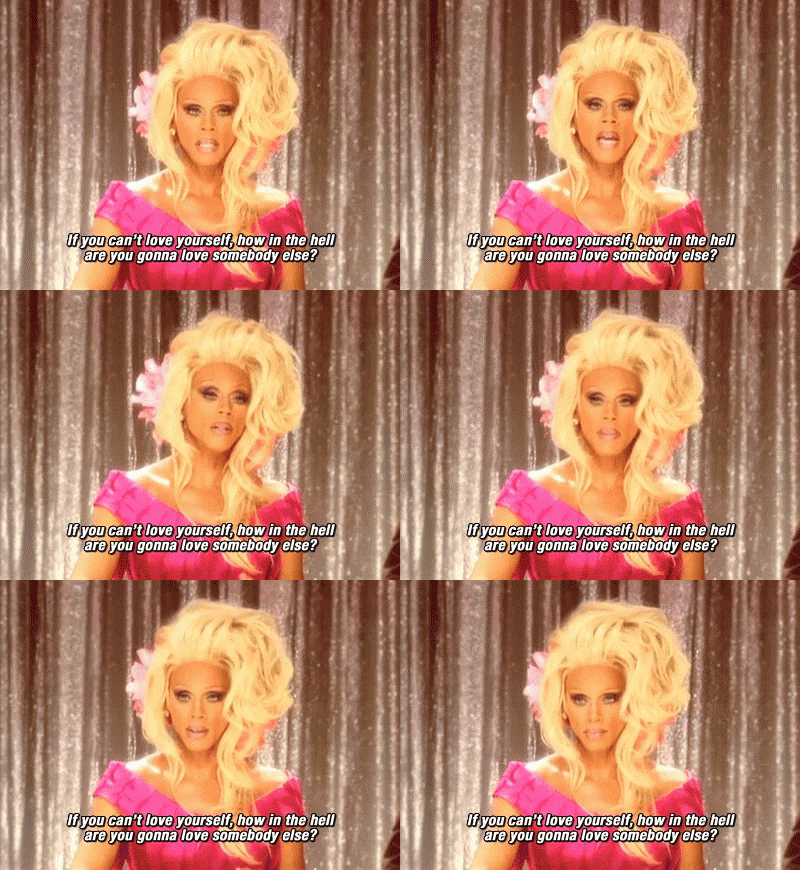
We need to balance this unhealthy tendency with a practice of self-compassion. I’ll be the first to admit, this can be a simple but deceptively difficult mindset to develop. It does not come naturally.
But when all is said and done, if you’re habits are not making you happier—even when you practice them imperfectly—what is the point?
We often talk about the importance of having a growth mindset—of believing in our own capacity to grow and improve. What we sometimes forget is that being a perfectionist is the opposite of having a growth mindset—because a perfectionist carries with them the misplaced notion that they’ve reached their capacity already, they simply need to execute on it. There’s no room for growth in that.
We’ll try to continue encouraging that kind of balance in what we publish on Better Humans. To that end, here are some articles from our archive that offer strategies for developing a more self-compassionate mindset.
Growth Mindset is a Habit You Want
Putting Carol Dweck’s research into practice so that you can grow faster by Coach Tony
How To Cultivate a More Helpful Inner Dialog
Using science-based practices, my self-talk became notably healthier — as did my self-esteem in general by Erin Savage Pollaro
A Complete Guide to the Science of Self-Talk
How to stop rumination, compulsive thinking, unrealistic rule-following, and negative self-talk by Brian Pennie
Using Socratic Questioning in CBT To Tackle the Root of Negative Emotions
The therapeutic technique I’ve been using for over six months to uncover core beliefs and keep my emotions in check by Ruchi Das
How I Learned To Stop Hating My Body
In researching how to teach my students to have a better body image, I taught myself as well by Michelle Loucadoux, MBA
A Step-by-Step Guide To Help Parents Develop Self-Compassion
How to explore negative feelings honestly, and grow through the experience by Kate Lynch
Caring About What Other People Think Is Okay
My recent experience overcoming shame, imposter syndrome, and feeling like I’m “not enough” by Sílvia Bastos