avatarSkanda Vivek

Free AI web copilot to create summaries, insights and extended knowledge, download it at here

3257

Abstract

where k is the Boltzmann constant. Turns out at room temperature, thermal energy is 0.026 eV. This is way lower than the maximum attractive energy felt by Copper atoms (-0.5 eV). What does that mean? In this case, as in the heuristic below, Copper at room temperature is a solid (interatomic energy much greater than thermal energy). However, what about at the melting point of Copper, 1358 K (1984 F)? Turns out that in this case, thermal energy is 0.12 eV. That’s much closer to the minimum energy between Copper atoms of 0.5 eV, and thus initiates melting of Copper into liquid.</p><h1 id="e58d">Solids and Springs</h1><p id="9bd8">OK so now you understand why solids form at low temperatures. But what determines the properties of a solid? The most characteristic property of a solid: it’s elasticity, can be understood as emerging from the interactions between atoms. That might sound complicated. <b>But the key contribution of physics lies in simplifying complex problems.</b> In fact one of the most common simplifications is to treat atoms as spheres and interactions between them as springs. This ball and spring model is one of the cornerstones of physics.</p><figure id="0128"><img src="https://cdn-images-1.readmedium.com/v2/resize:fit:800/0*yVgavrfaEt3KChJV"><figcaption>Harmonic Oscillator | Wikimedia Commons, Ivan Airole</figcaption></figure><p id="a952">Spring potential goes as 1/2kx² , where x is the distance from equilibrium position and k is the spring constant. Compress a spring and there is a potential energy that causes the spring to return back to equilibrium, same with elongating a spring. In a similar vein, atoms that sit a distance of 2.6 Angstroms from each other also experience a spring like interaction potential. Elongating atoms leads to them trying to recoil back, which is ultimately the origin of elasticity. However this analogy will not suffice. We will go in more detail and derive elasticity as arising from atomic springs!</p><figure id="7fe6"><img src="https://cdn-images-1.readmedium.com/v2/resize:fit:800/0*ClrRiY86Y3--f0Zi"><figcaption>Spring approximation | Multiple sources: Hyperphysics, Skanda Vivek</figcaption></figure><p id="d9a4">A spring has a characteristic spring constant k. The spring constant determines the force that is required to displace a spring, according to Hooke’s law. Higher the spring constant, larger the force required to displace a spring and consequently, stiffer the spring. Lower the spring constant, softer the spring.</p><figure id="e338"><img src="https://cdn-images-1.readmedium.com/v2/resize:fit:800/0*rpR3bizgYDKHMg8a"><figcaption>Hooke’s law | Skanda Vivek</figcaption></figure><h1 id="d4bd">What happens when you connect many springs?</h1><figure id="e93f"><img src="https://cdn-images-1.readmedium.com/v2/resize:fit:800/0*4Juj2RNCtLpyMn_K"><figcaption>Ball and spring approximation of a solid: VPython code from Bruce Sherwood</figcaption></figure><p id="4365">Now that we understand a single spring, what happens when multiple springs are connected? First let’s imagine a solid wire of length L and cross-sectional area A. How does the stiffness of the material change with A vs L?</p><figure id="4669"><img src="https://cdn-images-1.readmedium.com/v2/resize:fit

Options

:800/0CSr4IWMPkiNvND8i"><figcaption>Parallelogram approximation of a solid: Skanda Vivek</figcaption></figure><p id="a9bb">Think about the simple cases of connecting 2 springs lengthwise (series), like 2 Wrigley chewing gum sticks. It’s much easier to pull on them when there are 2 connected. In fact the spring constant becomes ks = k/2 for 2 springs connected lengthwise. But if you stick the 2 Wrigleys to each other like velcro instead, now they are connected in parallel and harder to pull. In this case the springs are stiffer, and the spring constant becomes kp = 2k for 2 springs connected in parallel.</p><figure id="daa9"><img src="https://cdn-images-1.readmedium.com/v2/resize:fit:800/1*MT5PVcrYaw9L9E2vc7qaLw.png"><figcaption>Connected springs | Skanda Vivek</figcaption></figure><p id="01de">In general for n connected in series, the spring constant is k/n . Similarly, for n connected in parallel, the spring constant is kn . How does that translate to solids? Well if the length between atomic springs is d, then the number of springs in series across the length L of the solid is ns =L/d. Similarly, the number of springs in parallel is np =A/d² .</p><figure id="f0ea"><img src="https://cdn-images-1.readmedium.com/v2/resize:fit:800/0*84Bc4X_L3KS8dVTX"><figcaption>Net spring constant | Skanda Vivek</figcaption></figure><h1 id="caab">The emergence of elasticity from atomic springs</h1><figure id="4041"><img src="https://cdn-images-1.readmedium.com/v2/resize:fit:800/0*XwZMmGTYCj5ypTZK"><figcaption>Stretching a rubber band | <a href="http://www.colapep.com">www.colapep.com</a></figcaption></figure><p id="b315">We now have a formula for the net solid spring constant as connected to atomic spring constant k and distance between atomic springs d. But how does that translate to elasticity? For that we need to go to the definition of elasticity. Elasticity is Stress/ Strain. Where Stress is the force per unit area applied say on a rubber band and is measured in Pascals. Strain is how much the solid deforms relative to it’s original length.</p><figure id="03e8"><img src="https://cdn-images-1.readmedium.com/v2/resize:fit:800/0*xT50u7wypUTXE50u"><figcaption></figcaption></figure><figure id="4b53"><img src="https://cdn-images-1.readmedium.com/v2/resize:fit:800/0*S1wjIaSGPB73VgRq"><figcaption>Stretching a solid | Skanda Vivek</figcaption></figure><p id="7443">When you plug in the variables, finally you get elasticity as k/d: the ratio of the interatomic spring constant to the distance between springs. Let’s pause and think about that for a moment. Elasticity is something that you are familiar with: a rubber band is elastic. While you might not think a rod of iron is elastic, it is, albeit a very high stiffness thus making it much harder to stretch. I’ve shown how stretching a solid is directly related to atoms that are billions of times smaller, moving apart from each other.</p><p id="0e95"><i>If you liked learning about how macroscopic properties emerge as a consequence of interactions at appropriate lengthscales, follow the <a href="https://medium.com/emergent-phenomena">Emergent Phenomena</a> publication where we uncover how complex everyday phenomena from materials to societies emerge.</i></p></article></body>

What can springs can teach us about solids?
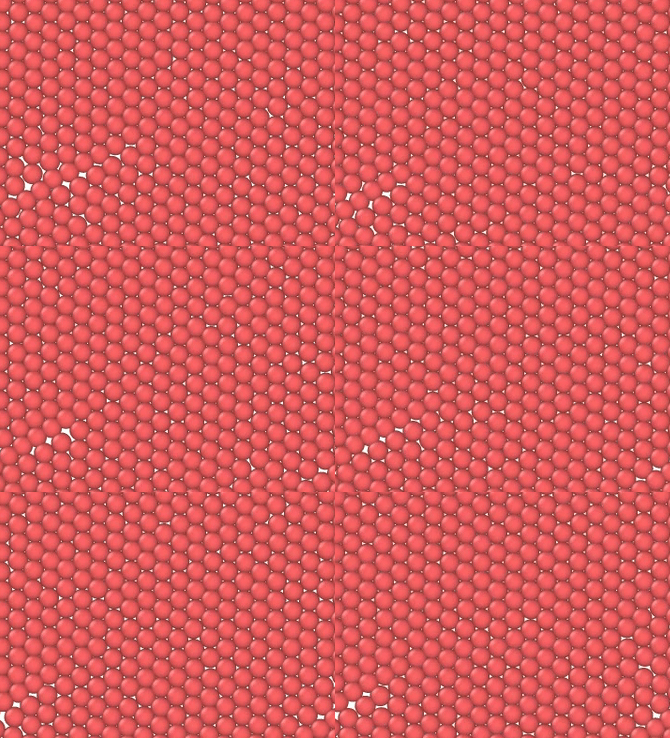
LAMMPS simulation | Skanda Vivek

You might think of solids as fixed objects with atoms fixed in place. However, atoms in solids keep bouncing off each other in the same way as in a gas. The main difference is that in a solid, atoms don’t move relative to their neighbors. They maintain a fixed pattern like the hexagonal structure (each atom has 6 neighbors) in the animation and this is essential for the key properties that distinguish solids from other phases of matter.

Why do atoms in solids like to stick together unlike gases?

At this scale, atoms experience two kinds of relevant energies. One is thermal energy, the other is energy due to electrical interactions between atoms. This is quite an oversimplification of the interactions at the atomic scale. There are other energy contributions due to electron numbers, magnetic fields arising from motions of charges within atoms, nuclear energies, etc. A complete understanding of these contributions on material properties lies in quantum mechanics. And don’t get me wrong, they are important. Properties like what color a material is and how well it can conduct electricity depend on these interactions. However, for the purpose of this discussion: why do atoms in a solid stick together, we can ignore the complex interactions for now. Maybe in a later blog I’ll discuss other types of interactions and quantum mechanics and how that leads to the emergence of some key material properties.

The idea is straightforward. If thermal energy is high, atoms keep bouncing around. But when temperature becomes lower, thermal energy reduces and atoms feel their interactions between neighboring atoms much more. At a low enough temperature, atomic interactions win over thermal interactions and atoms would rather stick close together and crystallize into a solid.

Energy contributions | Skanda Vivek

In the figure for Cu (Copper) interaction potential, the y-axis denotes the potential in electron Volts and the x-axis denotes distance between atoms in Angstrom. When separation between atoms is less than 3.5 Angstroms or so, atoms start to feel a negative potential. The negative means that they like to stick together. The most negative value is around a separation of 2.6 Angstrom, roughly -0.5 eV. Below that distance of separation, Copper atoms start to experience a positive potential, meaning that they repel each other. More positive, larger the repulsion they feel. Finally, at separations larger than 5 Angstroms or so, the atoms are too far from each other and basically don’t feel another atom that’s more than 5 Angstroms away.
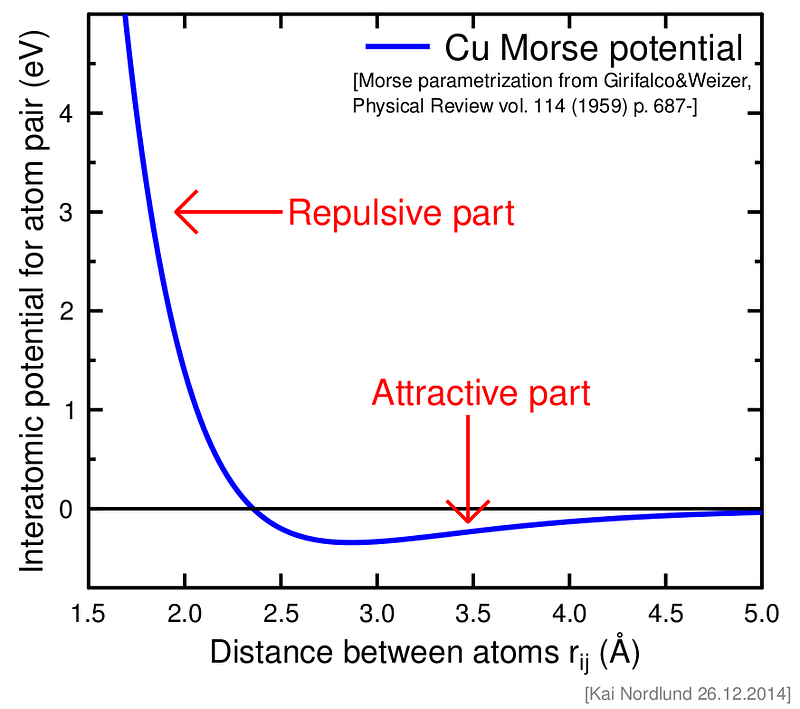
Copper interatomic potential | Citation in figure

The thermal energy is kT where k is the Boltzmann constant. Turns out at room temperature, thermal energy is 0.026 eV. This is way lower than the maximum attractive energy felt by Copper atoms (-0.5 eV). What does that mean? In this case, as in the heuristic below, Copper at room temperature is a solid (interatomic energy much greater than thermal energy). However, what about at the melting point of Copper, 1358 K (1984 F)? Turns out that in this case, thermal energy is 0.12 eV. That’s much closer to the minimum energy between Copper atoms of 0.5 eV, and thus initiates melting of Copper into liquid.

Solids and Springs

OK so now you understand why solids form at low temperatures. But what determines the properties of a solid? The most characteristic property of a solid: it’s elasticity, can be understood as emerging from the interactions between atoms. That might sound complicated. But the key contribution of physics lies in simplifying complex problems. In fact one of the most common simplifications is to treat atoms as spheres and interactions between them as springs. This ball and spring model is one of the cornerstones of physics.
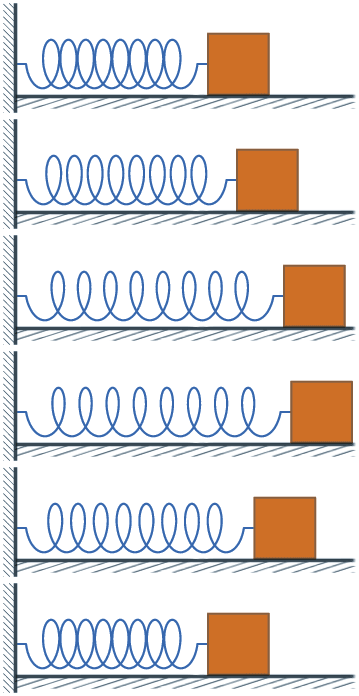
Harmonic Oscillator | Wikimedia Commons, Ivan Airole

Spring potential goes as 1/2kx² , where x is the distance from equilibrium position and k is the spring constant. Compress a spring and there is a potential energy that causes the spring to return back to equilibrium, same with elongating a spring. In a similar vein, atoms that sit a distance of 2.6 Angstroms from each other also experience a spring like interaction potential. Elongating atoms leads to them trying to recoil back, which is ultimately the origin of elasticity. However this analogy will not suffice. We will go in more detail and derive elasticity as arising from atomic springs!
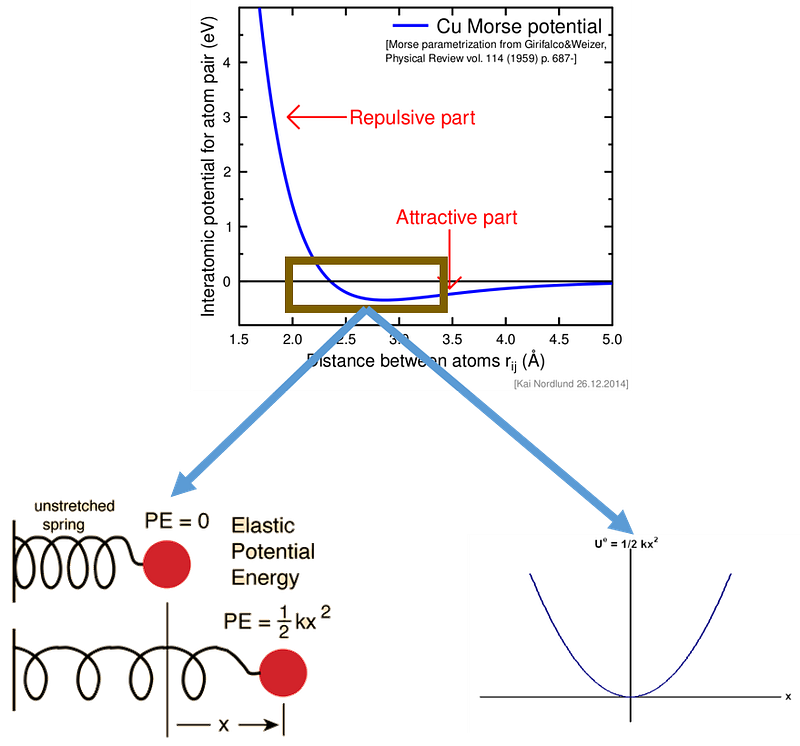
Spring approximation | Multiple sources: Hyperphysics, Skanda Vivek

A spring has a characteristic spring constant k. The spring constant determines the force that is required to displace a spring, according to Hooke’s law. Higher the spring constant, larger the force required to displace a spring and consequently, stiffer the spring. Lower the spring constant, softer the spring.

Hooke’s law | Skanda Vivek

What happens when you connect many springs?
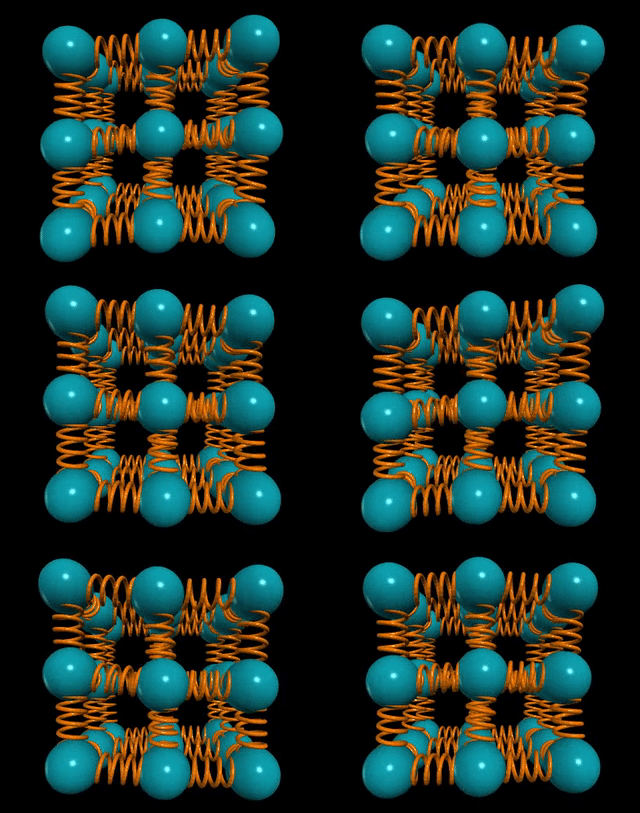
Ball and spring approximation of a solid: VPython code from Bruce Sherwood

Now that we understand a single spring, what happens when multiple springs are connected? First let’s imagine a solid wire of length L and cross-sectional area A. How does the stiffness of the material change with A vs L?
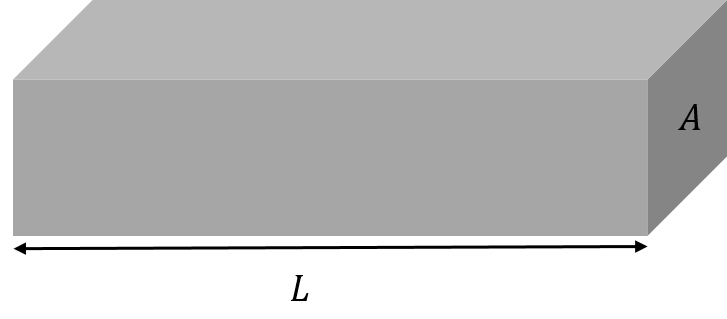
Parallelogram approximation of a solid: Skanda Vivek

Think about the simple cases of connecting 2 springs lengthwise (series), like 2 Wrigley chewing gum sticks. It’s much easier to pull on them when there are 2 connected. In fact the spring constant becomes ks = k/2 for 2 springs connected lengthwise. But if you stick the 2 Wrigleys to each other like velcro instead, now they are connected in parallel and harder to pull. In this case the springs are stiffer, and the spring constant becomes kp = 2k for 2 springs connected in parallel.
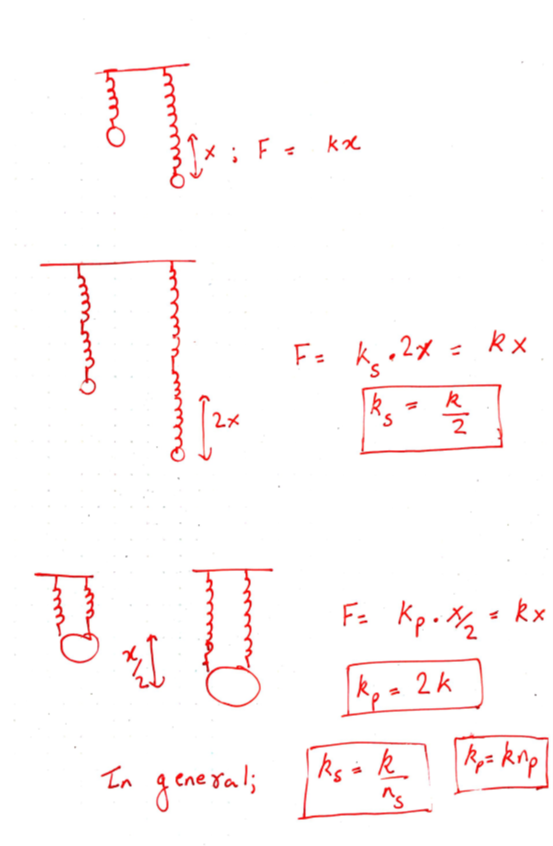
Connected springs | Skanda Vivek

In general for n connected in series, the spring constant is k/n . Similarly, for n connected in parallel, the spring constant is k*n . How does that translate to solids? Well if the length between atomic springs is d, then the number of springs in series across the length L of the solid is ns =L/d. Similarly, the number of springs in parallel is np =A/d² .

Net spring constant | Skanda Vivek

The emergence of elasticity from atomic springs
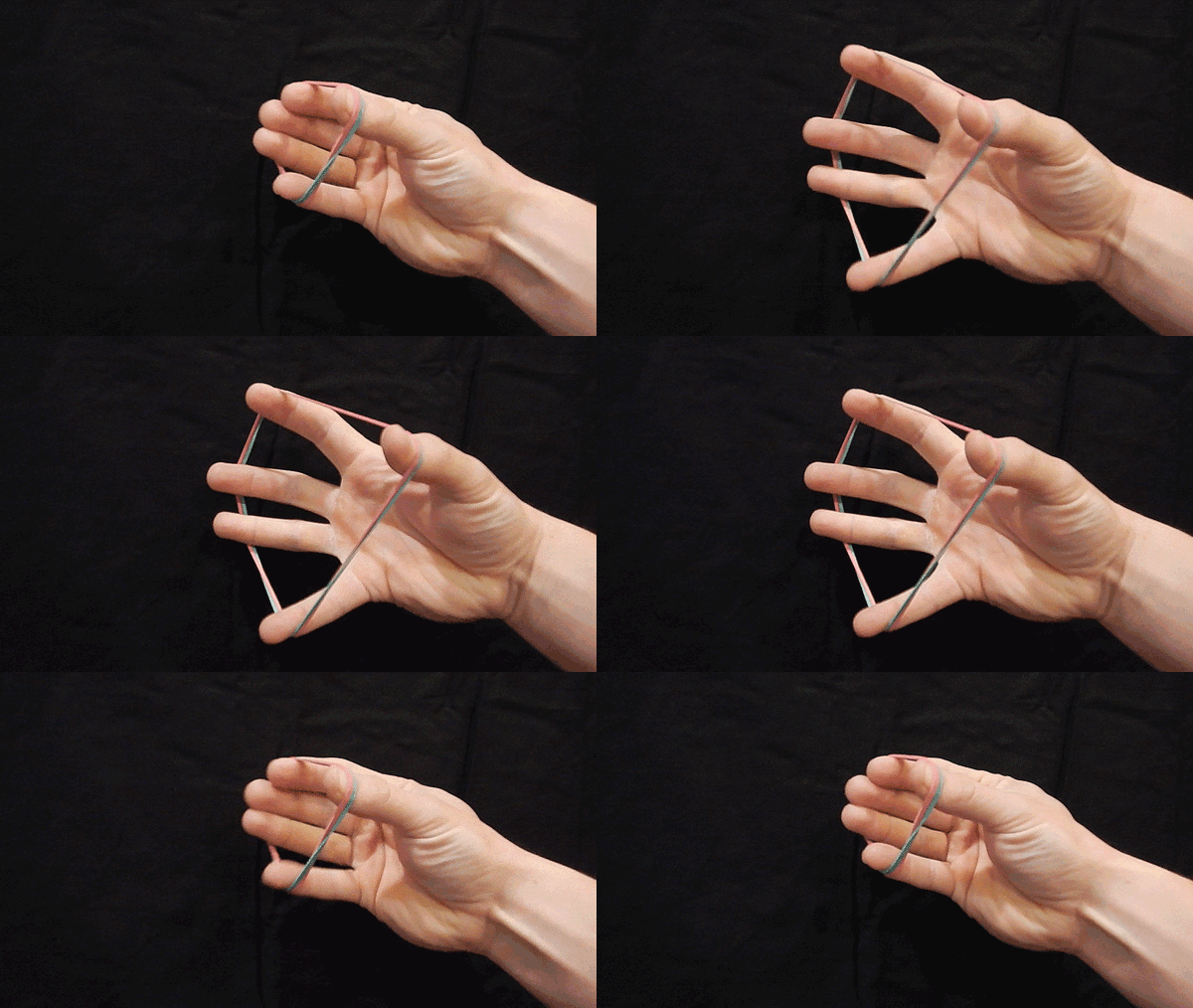
Stretching a rubber band | www.colapep.com

We now have a formula for the net solid spring constant as connected to atomic spring constant k and distance between atomic springs d. But how does that translate to elasticity? For that we need to go to the definition of elasticity. Elasticity is Stress/ Strain. Where Stress is the force per unit area applied say on a rubber band and is measured in Pascals. Strain is how much the solid deforms relative to it’s original length.
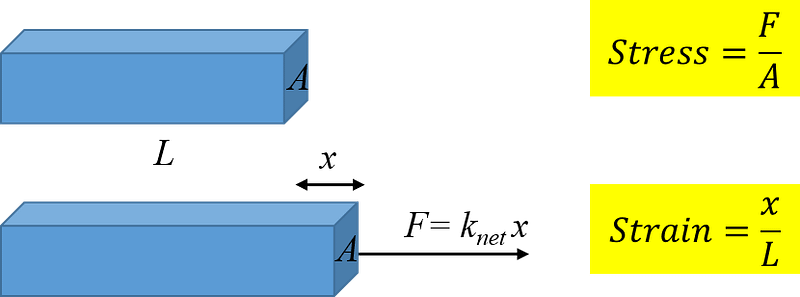
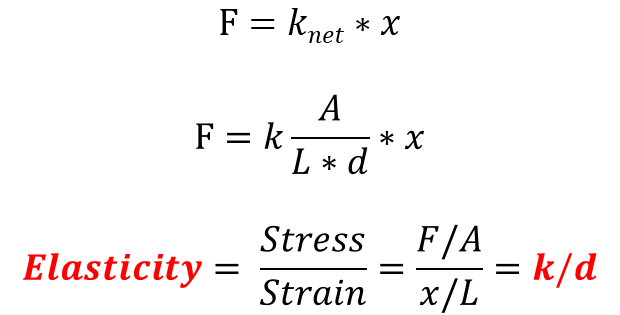
Stretching a solid | Skanda Vivek

When you plug in the variables, finally you get elasticity as k/d: the ratio of the interatomic spring constant to the distance between springs. Let’s pause and think about that for a moment. Elasticity is something that you are familiar with: a rubber band is elastic. While you might not think a rod of iron is elastic, it is, albeit a very high stiffness thus making it much harder to stretch. I’ve shown how stretching a solid is directly related to atoms that are billions of times smaller, moving apart from each other.

If you liked learning about how macroscopic properties emerge as a consequence of interactions at appropriate lengthscales, follow the Emergent Phenomena publication where we uncover how complex everyday phenomena from materials to societies emerge.

Science
Education
STEM
Materials
Physics
Recommended from ReadMedium