
What building blocks are needed to create a universe? (# 5)

This series of articles does not follow the traditional scientific approach where each development builds on previous research. The starting point is to outline a set of building blocks that provide the foundation for an alternative perspective on the origin of reality. These ideas are preliminary and more detailed investigation is required.
The challenges addressed in these articles include identifying or explaining:
- An eternal mathematical reality;
- How that eternal reality can evolve without any external assistance;
- Emergence of seemingly inexplicable features;
- Why quantum-like phenomena naturally emerge in a mathematical reality;
- Fields, energy and matter;
- Physical laws in our universe;
- Origin and nature of consciousness;
- Origin and purpose of free will;
- Heaven;
- Purpose of our lives.
Building Blocks
- Mathematical description of an eternal truth
- Unfolding of an eternal truth
- Source of quantum phenomena
- How new features emerge
- Appearance of fields and matter
- Emergence of laws of physics
- Origin of consciousness
- Evolution of consciousness
- Set-theoretic universes
- Reason for Free Will
- Emergence of qualia
- A model for our universe
An eternal reality
Most theories of reality are based on some unverifiable hypotheses e.g. String Theory does not explain the origin of one dimensional vibrating strings. Other theories assume consciousness exists but do not provide an explanation for the origin of that consciousness. To avoid the problem of needing to explain where something comes from, these articles explore the idea of a self consistent, eternal, mathematical truth. This exploration, however, should not be seen as a claim that mathematics is the only possible source of something that does not require an explanation for its origin. If mathematics can provide a logical explanation then other explanations not requiring some hypotheses about their origins may also exist.
Unfolding of an eternal reality
The philosopher, Aristotle, put forward the concept of an unmoved mover. According to Wikipedia:
The unmoved mover … [is] a primary cause or “mover” of all the motion in the universe. … [T]he unmoved mover moves other things, but is not itself moved by any prior action.
The idea of an unmoved mover seems paradoxical. One resolution of this paradox involves the mathematical concept of a black hole. What happens inside a black hole is not directly observable from outside the black hole. Nevertheless, content inside a black hole may re-emerge in the eternal geometry that created the black hole.
Imagine the shape of a universe is a Mobius strip or a Klein bottle. A Klein bottle is a one-sided surface which, if travelled upon, could be followed back to the point of origin while flipping the traveller upside down. A shape/traveller within a Klein bottle turns upside down even though there is no action causing the shape to invert.
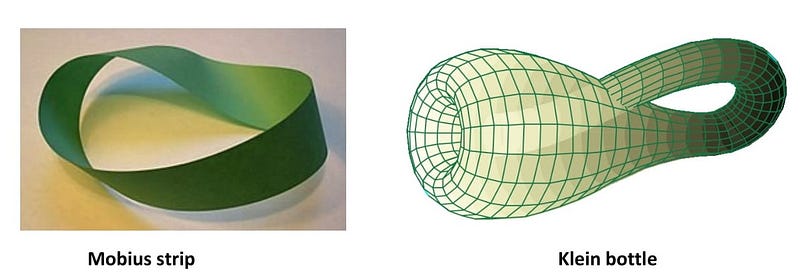

The original eternal geometry exists as a notional idea. An aim of these articles is to explain why that geometry immediately transforms itself into a more complex mathematical construction through its topology e.g. a Klein bottle. In brief, while an eternal truth notionally exists, the emergence of an ‘unmoved mover’ is a consequence of an automatic transformation of that eternal truth.
Source of quantum phenomena
Any theory of our universe needs to explain the origin of quantum phenomena. Not only do quantum phenomena appear to exist but they are essential ingredients in explaining other phenomena. Richard Feynman, Nobel Prize winner in physics, is, possibly apocryphally, quoted as saying: “If you think you understand quantum mechanics, then you don’t”. Not only is the nature of quantum particles not understood but quantum physicists often do not look for explanations for the existence of quantum phenomena. The explanation advanced in a subsequent article in this series is meant to encourage debate. Alternate explanations may be discovered once there is acceptance of the idea that the emergence of quantum phenomena is logically explicable.
Quantum phenomena provide a mathematical environment conducive to the emergence of new phenomena, more complexity. Over the last ten years, physicists working independently in several laboratories have observed the Efimov effect. As theorised in 1970s by the Russian physicist, Vitaly Efimov, a combination of three quantum particles can produce a force, increasing complexity, not apparent in any of the particles on their own.
Emergence of new features
In our universe, the Efimov effect shows greater complexity can emerge from combining three quantum particles. In the context of describing the evolution of an eternal mathematical reality, Efimov effects increase the mathematical complexity created by prior Efimov effects i.e. the underlying reality becomes a process for continually increasing complexity. Continual increases in complexity are not an objective but a property, an axiom, of a reality that automatically creates quantum phenomena. Professor Susskind of Stanford University has argued that content inside a black hole is increasing computational quantum complexity; the inside of a black hole provides a description of a reality where complexity continually increases.
Combining the property of increasing complexity with Constructor Theory (CT) provides a way of explaining the origin of various ‘laws’ or rules in quantum mechanics e.g. the rule of ‘What can happen, does happen’.
CT was conceived by David Deutsch who is one of the creators of the idea of a quantum computer. CT argues that information is not a mathematical, logical or abstract concept but something that can be derived from the laws of physics. CT explains how new features emerge in a mathematical environment such as the inside of a black hole in quantum space-time i.e. there are external mathematical principles that cannot be changed but new laws based on these principles may naturally emerge inside a black hole.
CT is a meta-level theory. It describes systems in terms of what is possible instead of what a system can do. What a system actually does is an emergent property. Laws created by CT would complement the over-arching process of continually increasing complexity e.g. the principle of least action (a meta concept) is a consequence of maximising complexity within the finite framework that is the inside of a black hole.
By describing a mathematical reality that produces rules such as ‘What can happen, does happen’, the creation of our universe can be understood as a natural consequence of such rules i.e. when the various features of our universe can be shown to emerge from mathematics then our universe automatically emerges. An objective of these articles is to describe how observed features of our universe are natural consequences of mathematical phenomena.
Appearance of fields and matter
Once the mathematical infrastructure for Efimov effects is in place, mathematical descriptions of force fields and matter emerge naturally. As content such as Platonic solids enter and exit black holes, descriptions of that content change. Efimov effects inside a black hole result in content exiting that black hole as force fields. As force fields enter and exit black holes, different types of force fields and matter emerge.
As is recognised by modern theories of cosmology, such as the Many Worlds Interpretation (MWI), many possible universes could exist contemporaneously including those with different laws of physics. These articles are concerned with identifying how laws of physics relevant to our universe could emerge.
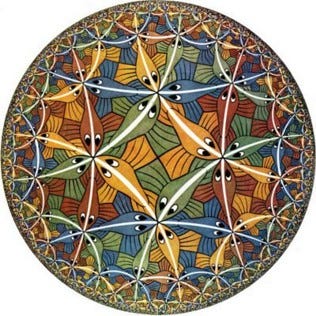

Universes with features like ours are ‘observed’ i.e. mathematically described, in a boundary of the space-time inside a black hole. Such a boundary is analogous to a mirage where the contents of the space inside a black hole are displayed in one less dimension. Escher’s Circle Limit is an artist’s rendition of what a boundary in AdS space might look like. Holographic images in the boundary create the impression of a force of gravity even though gravity does not exist in the higher dimensional space containing the boundary; gravity is part of the description of the fabric of space in the boundary.
Emergence of laws of physics
The emergence of rules equivalent to ‘What can happen, does happen’ is consistent with content inside a black hole being displayed in a boundary in a variety of ways. Similar to the way geometric shapes can morph into more complex mathematical constructions, Constructor Theory (CT) produces many different rules. Only rules associated with self referencing, however, are discussed in these articles.
Geometry consisting of eternal Platonic solids evolves because a Distinction is made when a Platonic solid enters a black hole. The making of a Distinction is part of a primitive logic developed by the mathematician, George Spencer-Brown, in his Laws of Form. Spencer-Brown’s logic was extended by the neuroscientist, Francisco Varela, by including the dynamics of re-entry. By adding re-entry as an additional value, something can be true and false simultaneously. Furthermore, mathematically, self-referential dynamics establish the presence of time. Self-referencing can lead to self-organising.
The notion of Distinction is implicit in the topology of a Klein bottle. A Klein bottle is a one-sided surface which, if travelled upon, could be followed back to the point of origin while flipping the traveller upside down. A shape/traveller within a Klein bottle turns upside down even though there is no action causing the shape to invert; the topology of a Klein bottle creates a Distinction.
Self-referencing systems can experiment with CT inside a black hole to discover rules of physics (ways of organising content) that create new ways of content expressing itself.
Origin of consciousness
Consciousness is a force that is not inherent in any individual quantum particle but created through an Efimov effect. The initial form of consciousness or awareness may bear little resemblance to consciousness in our universe. At first, consciousness may be the mathematical equivalent of recognising ‘I Am’. In other words, initially, consciousness does not have power to do anything, it is primitive self awareness.
The neuroscientist and psychiatrist, Giulio Tononi, has developed one of the better known theories of consciousness called Integrated Information Theory (IIT). His approach which is intentionally mathematical, defines consciousness in mathematical terms. He argues that consciousness arises when an organism becomes more and more complex; in particular, self consciousness arises when parts of a complex organism start to control the behaviour of other parts of the organism.

Evolution of consciousness
Content inside an AdS black hole is displayed in a boundary inside that black hole. As content becomes mathematically ‘self-aware’ that it is being displayed as a hologram in the boundary, it reorganises itself in order to display itself in different ways e.g. the form that a shape takes depends on the shapes of its neighbours. By applying CT principles, content can become increasingly complex.
As there are two time dimensions inside a black hole, a hologram in one boundary can describe content when one of the time dimensions is compressed, a hologram in another boundary could display content associated with compression of the second time dimension. The mathematical descriptions of content in each boundary could include descriptions of compressed content in the other boundary.
Instead of consciousness evolving as a result of random Efimov effects, once ‘self-awareness’ develops the ability to control how content is displayed, it could influence its own evolution by arranging how content in one boundary is displayed in the other boundary. The result could result in a spiral of increasing complexity in consciousness.
Researchers in Artificial Intelligence have developed an approach to machine learning called Generative Adversarial Networks (GAN) where two neural networks contest with each other to produce more complex content. Something similar to this idea could explain the evolution of consciousness where the objective of evolution is fulfilment of rules equivalent to ‘How to make content increasingly complex’.
Set theoretic universes
As consciousness becomes more complex, consciousness may ‘discover’ ideas about its own origins as well as ‘new’ mathematical ideas. While there may have been a specific eternal truth leading to the origin of our universe, reverse engineering may deduce there are many possible truths i.e. the origin of our universe may be consistent with many explanations. For example, the mathematician, Joel David Hawkins argues:
The multiverse view in set theory … is the view that there are many distinct concepts of set, each instantiated in a corresponding set-theoretic universe. The universe view, in contrast, asserts that there is an absolute background set concept, with a corresponding absolute set-theoretic universe in which every set-theoretic question has a definite answer. The multiverse position … explains our experience with the enormous diversity of set-theoretic possibilities.
Consistent with rules leading to ‘making content increasingly complex’, the source of our universe could be associated with many set theoretic truths. As the pathway to the creation of our universe requires many steps, it may not be possible to determine whether there is a single set-theoretic truth. These articles discuss one possibility; namely, a set theoretic universe consisting of a limited set of axioms (mathematical assumptions) i.e. self consistent axioms designed to achieve a desired purpose.
Universes may be created and populated with conscious mathematical agents who have specific characteristics. One of the tasks of our universe could be to discover conscious agents who have the required characteristics needed for populating specific set-theoretic universes. One of the challenges addressed in these articles is explaining how to manifest conscious agents with various characteristics.
Reason for Free Will
Inside an AdS black hole, everything may be knowable. In a De-Sitter universe, however, the mathematician, Kurt Gödel, discovered two Impossibility Theorems. These theorems prove that there are mathematical systems that are not self consistent i.e. all the axioms cannot be proved even though those axioms may still be true. Providing complete descriptions of such systems is mathematically impossible. When universes are created based on these axioms, agents in such universes could not be pre-programmed to have unique responses to every situation because unpredictable situations will arise.
One strategy for managing the evolution of set-theoretic universes where everything cannot be known at the time of creation is to populate new universes with agents who have free will. To manage the risks associated with a universe where its future is unknown, agents could be ‘field tested’ or ‘auditioned’ to examine how they are likely to respond to new situations before being selected to populate a new set-theoretic universe.
Our universe could be a place for field testing how agents use their free will. CT in conjunction with Efimov effects can explain the origin of both the principle of least action and free will. Free will is associated with the capacity to forget. Individuals choose what memories they re-purpose. In a finite system, anything that can be done with the least effort is the most natural. Forgetting can lead to new complexity with least effort.
A bazillion of iterations could have been trialled to create universes like our own. We are conscious mathematical agents who have the opportunity to apply our free will in a variety of situations in order for our personalities/characters to be assessed. Once we have completed some personality assessment, we may become part of a new set-theoretic universe.
Emergence of Qualia
Design features of our universe could include: (i) consistency with a set-theoretic universe for which we are being ‘field-tested’ e.g. a universe with laws of physics different from the underlying reality; and (ii) being endowed with emotions e.g. uncertainty about the future causes anxiety. Some string theorists have suggested that a mathematical universe may only be stable when it consists of 10 or 11 dimensions where most of the dimensions are curled-up. If so, each of the curled-up dimensions in our universe could be related one of our senses, including a sixth sense namely the ability to conceptualise. Each sense is associated with qualia or subjective experiences.
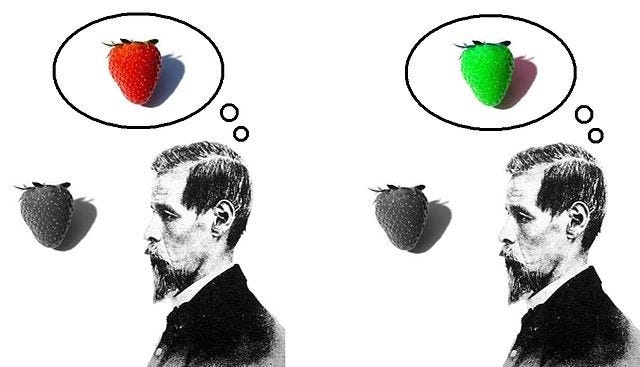

Qualia are part of what has been described as the Hard Problem of Consciousness. We cannot be sure that other people experience qualia in the same way i.e. what it is like to see red or feel pain. This problem is similar to one of the conclusions of Godel’s Impossibility Theorems: it may be true that the colour ‘red’ is the same for all of us but we cannot prove it.
The impossibility of proving we all experience qualia in the same way has similarities to science’s inability to prove that some of us can sometimes predict the future. Furthermore, an intuitive ability to know the future may be unprovable because such proof could be inconsistent with one of the reasons for the creations of our universe, namely utilising our free will to develop and use our intuitive abilities.
Model for our universe
These articles set out an argument suggesting our universe was created as a means of identifying conscious mathematical agents who will subsequently inhabit various set-theoretic universes i.e. universes constructed on the basis of their inhabitants having particular characteristics or personalities. One of our roles in our universe is to ‘be ourselves’ including exercising our free will. Another role could be identifying our capacity to create and manage emergent phenomena. We could be part of a trial where some of us have unknowingly been given the equivalent of a placebo i.e. a sugar pill.
The design of our universe could be the result of a process of trial and error involving a bazillion iterations. Our roles are like players in a video game who do not realise they are playing a pre-programmed game. Our emotional responses to pre-programmed events in the game are monitored; the game evolves based on those responses. Only ontologically acceptable emotional responses are incorporated in the evolution of events.
Our real identity is a mathematical structure inside a black hole in Anti-de Sitter space. One of the boundaries inside this black hole displays events that we perceive as our universe, another boundary displays events in ‘heaven’. Events in our universe repeat as if they are on a continuous loop; we ‘view’ ourselves in many different roles in this loop. Time evolves in ‘heaven’ at a different rate to our universe. ‘Heaven’ could be both the creator of new universes as well as a decision maker in respect to who inhabits those new universes.
For serious consideration of these ideas, something needs to be testable. One approach involves developing an explanation for ‘dark energy’ and ‘dark matter’. The proposed test is derived from research by Professor Leonard Susskind of Stanford University into the growth in computational quantum complexity inside a black hole. The logic behind the proposed test shows that when Newton’s inverse square law for gravity is applied to the movement of stars and galaxies, the law needs to be modified to take into account factors such as the history and temperature of the smaller mass as well as some kind of memory of previous events.
The question for this article is:
Is our universe designed to assess our emotional responses to existential threats?
To obtain a copy of the book ‘Orbiting Stars’ which contains the first drafts of all these articles, please visit www.amazon.com
To view the headings of all the articles to be published in this series please click on https://readmedium.com/orbiting-stars-and-origin-of-our-universe-338906930f51