
WORK
Reflections of a Bad Leader in an Organization’s space
From my Leadership Roles and Individual Contributor Roles Experiences and Observations

Leadership is a word we often use nowadays to portray ourselves on different occasions, as it is a heavyweight quality, to be frank. Is it easy to escalate at that level? No, it takes hard work and traits to be considered as a leader. In our lives, we have experienced the guidance of some good leaders (if not great).
“True leadership lies in guiding others to success. In ensuring that everyone is performing at their best, doing the work they are pledged to do and doing it well. “— Bill Owens
Most certainly, we might come across to people, with little or no leadership qualifications at all. Sometimes, it is the person’s characteristics, the mindset of that individual, or the relevant practices that person went through, impacting their ability as a leader.
It is important to revisit what you should identify as the qualifiers for a lousy leader/manager in your workplace.
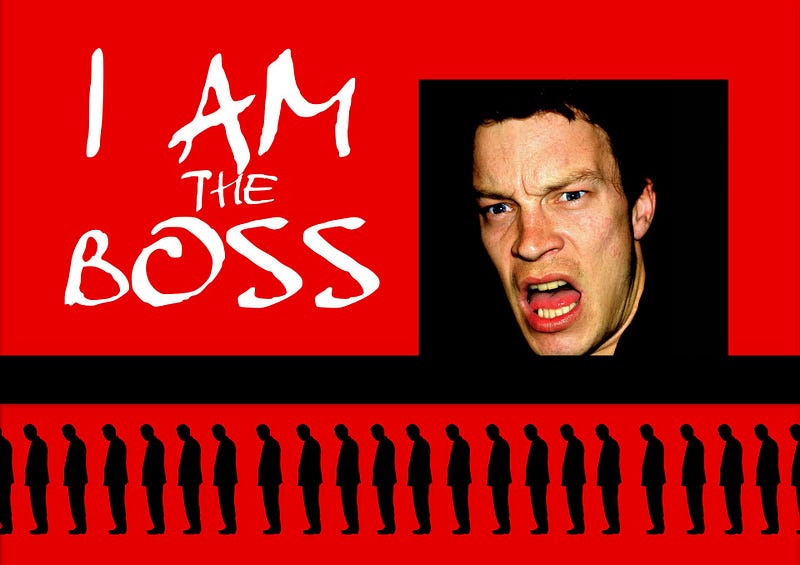
Lousy leaders mostly operate on the ‘I’ perspective.
S/he does it all and describes everything from her/his perspective.
Example: A bad leader/Manager: ‘I have instructed my team to do the reporting regularly.’ or, ‘I want you to do these reportings every day.’ or, ‘I do not pay you to do this.’
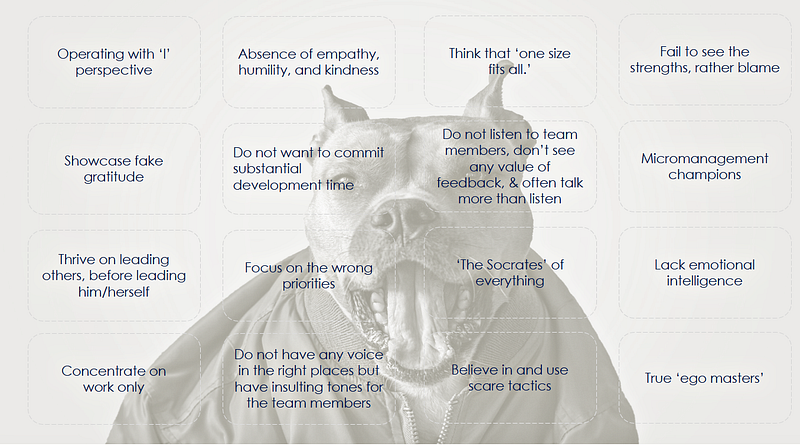
They have an absence of empathy, humility, and kindness.
It means they have to be human first as they lack those moral characteristics embedded. Showing compassion, humility, or kindness doesn’t make you a weak leader or manager.
For example, on a Monday morning of a distant past (might not be that distant at all), I had to call a sick-day because of severe migraine headaches. The next day when we were having the team-meeting, my manager made a joke about why it is not Monday than he could have taken a sick-day for vacation. Funny, right?
They think that ‘one size fits all.’
Leaders need to know the strengths & weaknesses of individuals and try to find suitable options to optimize impacts. As every individual is different, the work-style, engagement patterns, and development paths are different too. But, the bad (yet so-called) leaders push everything in one cup to sip everyone from it.
They fail to see the strengths of the team members.
Instead, s/he will look into the weak points to bash the teammates. It is a wrong approach to invest more time in the weakness area than spending minimum time in strength areas.
The key to successful leadership today is influence, not authority. — Kenneth Blanchard
Example: One of my teammates got a huge success- which was fabulous in terms of investments and engagements. Before even speaking about the project’s success, that particular manager started talking about ‘lessons learned’ on a specific area of the project engagement, where the teammate didn’t commit more time — as it was an unimportant part of the project. So, instead of cheering up the team, he successfully promoted a fear-culture (and grabbed the title of the ‘bad-apple’ of the region).
They showcase fake gratitude.
It shows. And it also proves that the manager is not trustworthy as a person, hence not a reliable person to provide the responsibility of the team.
They do not want to commit substantial development time for their teams.
The only thing they think essential is providing coaching/mentoring by themselves. They think of themselves as the best coaches, and by pushing their weaknesses to others, they also spread the issues across organizations.

They often do not listen to team members, don’t see any value of feedback, and often talk more than listen.
It shows the value s/he sees of the team, which means no trust, no respect, and no growth mentality.
They are micromanagement champions.
The name says it all. Micromanagement is crucial in certain aspects for sure, but managing everything by taking a breath on the teammate’s shoulder is not a sign of a good leader. It also means, trust issue within the team.
They thrive on leading others, before leading him/herself.
A lousy manager/leader will always portray her/himself as the pigeon of success and then tell the team to follow. A leader leads by example, and when good examples are there, the leader does not need to ask your teammates to follow your path, most of them will automatically follow the leader to have success (plus, respect).
The challenge of leadership is to be strong, but not rude; be kind, but not weak; be bold, but not bully; be thoughtful, but not lazy; be humble, but not timid; be proud, but not arrogant; have humor, but without folly. — Jim Rohn
They focus on the wrong priorities.
It tells the lack of judgment of the person.
They are ‘the Socrates’ of everything.
Tells that s/he might not know anything at all. Or, might guide you in the wrong direction, as what s/he knew previously might have changed, which s/he is not ready to admit.

They lack emotional intelligence.
If the person doesn’t have this quality, please do not expect the other good qualities of a leader.
They concentrate on work only.
For the person, work might be the only life or most important aspect of life, no objections. But, the teammates have different priorities in life. Plus, at work — you can’t always engage in action, you should have some relaxing time to reconcentrate. Putting workaholic culture to the team is a red sign.
They do not have any voice in the right places but have insulting tones for the team members under them.
If any relevant points are required to be raised in the higher management, this sort of managers’ do not have the guts to say so (even though policy and office-culture promote open culture). The same manager becomes a lion when s/he returns to the team and insults teammates on different grounds.

They believe and use scare tactics.
Example: one employee communicated her manager that she might not be able to visit the client during the pandemic season, as it was the peak time in Toronto. The manager threatened to take her wording into HR as (according to the manager) showed a lack of commitment.
Another one was to continuously tell team members that if you didn’t achieve KPI parameters during this time, s/he would be able to take that person to the HR to fire up the employee.
They are the true ‘ego masters.’
Most (if not all) the bad managers/leaders are self-centered and in all sorts of wrong ways. They can’t take negative feedback; they stick to their path and direct their team on the same route; they believe in their tactics and are not open to discussion. All indicates to the egoistic personality comprising negative ego aspects and a lack of emotional intelligence.
Other not-good virtues:
- A true follower of personal vindictiveness
- Miles away from supporting team-members
- Insult others, lie to others and does bad word-of-mouth
- Push for unnecessary priorities
- Will embrace extra distance for her/him, but not for others
- Take credit for other’s success
- Lack of transparency
We always want to grow leadership mentality within ourselves, and for that, you do not need to look into successful leaders/managers, a leader can be, anywhere, in any place. An individual in a ‘self-managed’ role can be a leader if that person can show others the path to success, shows empathy, and are willing to support. We also need to mark the above mentioned bad virtues of a person, which indicates that s/he should not be considered as a leader.
Finding the right leader is always possible when you can identify the characteristics you do not want to experience. And, voila- you might find a leader with important qualities to aspire and inspire.
If your actions inspire others to dream more, learn more, do more and become more, you are a leader. — John Quincy Adams