
What Are Your Pronouns? The Changing Language of How We Talk to Each Other
Everyone has pronouns, and respecting them shouldn’t be controversial.
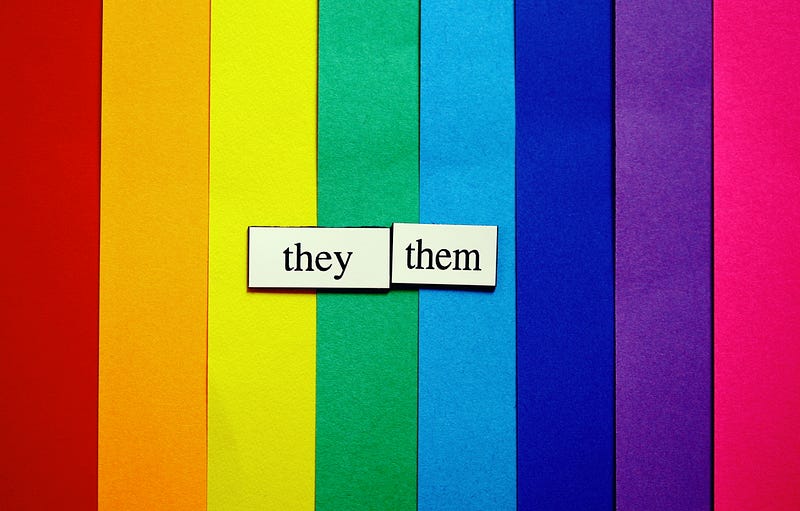
I was at Target the other day, and I found a wallet on the ground. Being a fairly considerate person, I took it to customer service. The person there helped me track down the owner of the wallet, and we returned it to them. They offered to give me a reward, but I declined. I wasn’t about to take money for returning their wallet — they had dropped it accidentally, and I didn’t want to take advantage of their honest mistake.
The moral of this story is that you damn well know how to use “they” as a singular pronoun, you’re just being a jerk.
For quite a while, we have talked about the use of pronouns as a means of respecting people’s identities. “What are your preferred pronouns?” was a common question among the groups I run with. The point of the exercise was to treat everyone with respect and not assume how someone wanted to be addressed based on their appearance.
However, language evolves, and I have found that we are increasingly dropping the word “preferred” from the question. This is an important step in the process, I think — we are moving from respecting pronouns as an option to respecting pronouns as a matter of fact.
The fact is, people do not have “preferred” pronouns, they have pronouns. I am a cis male, and my pronouns are he/him/his. A lot of people I know are cis (at least, they haven’t come out otherwise) and use the pronouns they were assigned at birth.
On the other hand, I have friends who were assigned male at birth (AMAB) or assigned female at birth (AFAB) who have since transitioned and use different pronouns. Some of my AFAB friends use he/him pronouns now, and some AMAB friends use she/her pronouns.
Respecting these pronouns isn’t a matter of preference for them. It is a matter of treating them as what they are. Preference implies the option to not use their pronouns, which is disrespectful.
One friend of mine regularly gets misgendered at his job, even though he wears a pin with his pronouns, and it can be painful. Often, it’s an honest mistake, but other times, it’s intentional. I’ve had trans friends talk about being called “it” in public, and that’s incredibly painful to them. That takes the intentional misgendering one step further — from disrespecting someone to dehumanizing them. It’s terrible and just plain wrong. Don’t do that.
I understand that I am approaching this from a straight cis male perspective, which means that I will never completely understand. However, I am a bit of a language nerd, which doesn’t necessarily qualify me to talk on this subject but makes it a matter of interest for me.
Language is a fascinating human construct, and languages are living things. If I told you in 1990 that I made money as a blogger, you’d think I was a bit weird, since the term “blog” wasn’t a word that existed then.
Similarly, the terms we use to describe the LGBTQIA+ community change as well. Terms that were common and acceptable in the 80s among the queer community are no longer acceptable to modern LGBTQIA+ folx.
The funny thing to me is how outraged people get over pronouns. Daring to suggest that someone has different pronouns is an affront to human decency, according to some people. Using “they/them” to refer to a singular individual is just plain wrong according to many — these pronouns are reserved for multiple people, they insist.
The funny thing is that people who are suddenly pedants for “proper” use of the language will subconsciously use “they/them” pronouns in the singular when they don’t know the gender of a person. Technically, according to their shaky logic, you should always refer to people whose gender identity is unknown as “he or she” and variants thereof.
The fact is, almost nobody does that in common speech — we almost universally use “they/them” when gender is unknown, whether in conversation, in writing, or in our heads. I think I have only encountered one person who universally uses the term “he or she” and such when referring to someone of unknown gender, and that person apparently received a very strict formal education.
The funniest to me is the people who insist that they don’t have pronouns, as apparently, pronouns are a “gay thing.” To me, this is indicative of a lack of common sense at best and abject stupidity at worst. For reference, a pronoun is:
any of a small set of words (such as I, she, he, you, it, we, or they) in a language that are used as substitutes for nouns or noun phrases and whose referents are named or understood in the context
-Merriam-Webster, www.merriam-webster.com/dictionary/pronoun
When you say “I don’t have pronouns,” you are using a pronoun to refer to yourself. A pronoun is a simple building block of the English language; I don’t think it’s possible to not have pronouns. You’re not being clever or edgy by saying you don’t have pronouns, you’re just being dumb. You’re also not being clever when you say your pronouns are “desk/chair” or something similar. Those aren’t pronouns, you’re just being obstinate for no reason.
As I’ve talked about, language is fluid and ever-changing. The use of they/them as singular pronouns has a long, storied history that includes Shakespeare. If it was good enough for one of the most famous playwrights of all time, I think it’s good enough for everyone.
It is a simple sign of respect to acknowledge someone’s pronouns. It takes minimal energy and effort, and simply making an honest effort to use the right pronouns and correct your mistakes will get you a long way.
This is the way the world is going, whether you like it or not. Queer and trans folx have been around since the dawn of time — they didn’t just spring up out of nowhere in the 1980s. And, as such, English as a language is changing to accommodate the changing world. The only reason they/them singular pronouns are controversial is that there is a concentrated effort to make them controversial. They’ve always been acceptable.
The world is changing whether you like it or not, and the language will change with it. As with all progress, you should get on board and start respecting pronouns. Otherwise? Be quiet and get out of the way.
If you liked this, please subscribe to my publication, Thing a Day. I publish something every day on a variety of topics, so you never know what you’re going to see!
Here are some other things I’ve written:


