
What Are You Passionate About?
Is it Harmonious or Obsessive Passion?
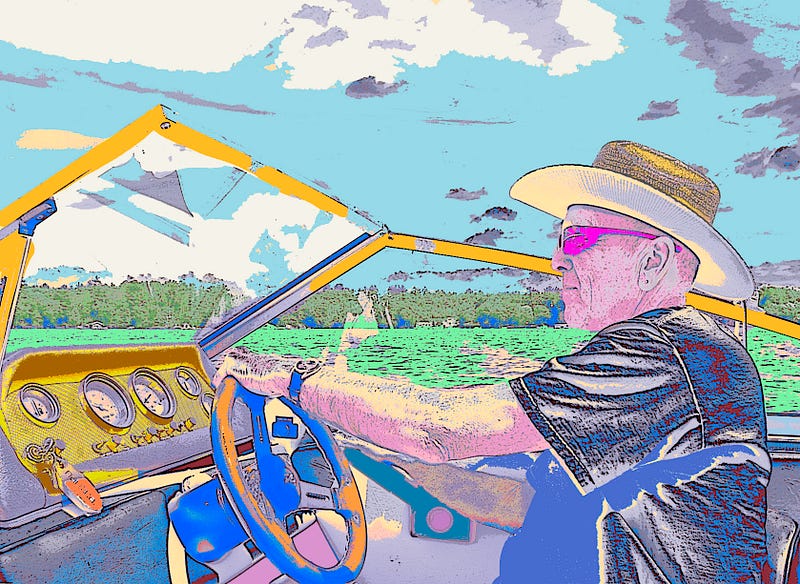
Passion is something that lives inside you. It is with you at all times. It is not a part-time tenant. You constantly engage with it, even without external rewards or recognition.
It could be your profession, like teaching. Or your academic focus, like philosophy. Or a creative activity such as painting or writing.
It is an inclination toward a self-defining activity. Something you love, find important and are willing to invest time and energy into — on a consistent basis.
Recent research by Lyubomirsky et al. suggests that engaging in what they refer to as *intentional happiness-relevant activities* leads to psychological well-being.
If you are wondering what psychological well-being means, it is “broadly defined as happiness, life satisfaction, and self-growth, it represents one of the most important aspects of efficient psychological functioning.” (source)
It is no secret that happy people benefit from deeper, more meaningful relationships, improved physical health, and high-level performance.
So, what makes us happy?
I am not going to suggest that there is a universal recipe for happiness. But what I have learned is that our happiness level is determined by three major factors:
- a genetically determined set point for happiness.
- happiness-relevant circumstantial factors.
- happiness-relevant activities and practices.
The authors of the study Pursuing Happiness: The Architecture of Sustainable Change asserts that “the activity category offers the best opportunities for sustainably increasing happiness.” (source)
It was certainly the activity category that piqued my interest. It made me question whether I know someone who has a passion for an activity.
I looked around my circle of influence for someone who radiates happiness. Someone I know well. Someone who genuinely projects the psychological well-being we refer to as happiness. Someone who is passionate.
I didn’t have to dig very deep to conclude that my friend Johnny fit the bill. I introduced him to you in my story What Defines a Solid Long-Term Friendship? In that story, I mention that we share a deep interest in photography. Call it a passion if you like, but that is not where we are going in this story. We are headed for the water.
From the moment I met Johnny he has displayed an unbridled passion for boats. He unapologetically owns power boats, sailboats, rowboats, canoes, and more recently a pontoon. Usually many of those at any one time.
Living on a lake seems to support the idea.
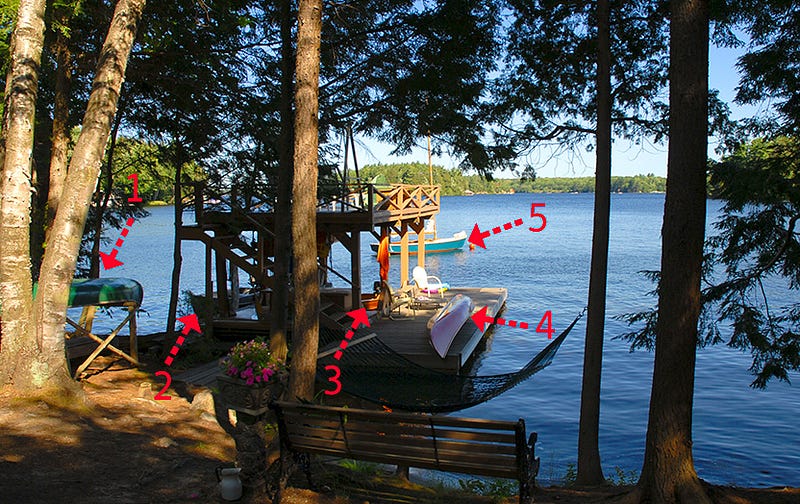
Early in our friendship, I asked him about his love of boats. He answered “Remember? My last name is Keeler. KEEL…er.”
KEEL…er… “Say no more, say no more…Nudge nudge. Wink wink.” I responded in the best Monty Python tone I could muster. Suddenly it all made perfect sense.
What I learned through time is that Johnny’s passion for boats is rooted in a connection to their history, design, and construction. Most of the boats he owns are wooden vessels that have been neglected, abandoned, or no longer wanted by others. He will lovingly rebuild them, dress them up, and resuscitate them. Give them a new life.
His passion is connected to the soul of the vessel.
Over the years I understood that Johnny’s passion for boats had become so self-defining that it represented central features of his identity. He was indeed a KEELER. No different than someone who has a passion for reading or swimming — they identify as a “reader”, or “swimmer.” The activity becomes an inherent part of who the person is.
In a recent email, he told me:
“I’ve read somewhere that our names are closely related to our long past endeavours. When I say endeavours I really mean the life we have led for generations; or our original culture. I feel that boats and water are somehow a part of my genetic code. Could it be that my ancestors were coal barge operators, unloading square riggers, in the ports of Europe? Could I have deeply retained those genes? Am I predisposed to water?”
My friend illustrates what Vallerand et al. refer to as Harmonious Passion, which occurs “when individuals have freely accepted the activity as important for them without any contingencies attached to it.” (source)
Those are individuals who freely choose to engage in a passionate activity. That differs from an Obsessive Passion which leads to experiencing an uncontrollable urge to partake in the activity. People who cannot help but engage in an activity. That obsession can bring conflict and other negative behavioral consequences into their lives.
That is an important distinction. Harmonious Passion occupies a significant, but not overpowering, space in the person’s identity. There is a balance between their passionate activity and other aspects of their life.
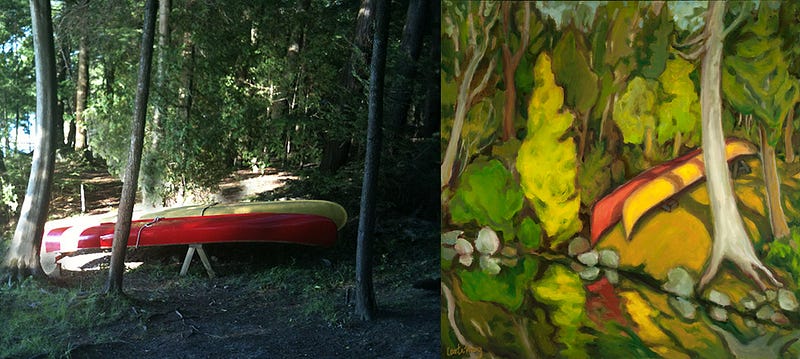
Although I don’t share Johnny’s passion for boats I have enjoyed sharing experiences aboard his sailboat, paddling a canoe, or trolling for salmon in his motorboat. His collection of vessels inspired my partner to create a painting of two canoes resting on the shore of his property.
“Passion is contagious. When you’re fully present and passionately engaged with your life, people around you take notice and want in on whatever you’re doing” writes M. Forleo. (source)
I fully agree with that statement. If you are passionate about cooking people will want to share your food. If you are passionate about writing people will want to read your work. If you are passionate about art people will want to view your creations. You may inspire others to cook, write, or make art.
So what is your passion? What is the fuel that drives you? What inspires you? What brings you joy and happiness? Feel free to share.


