
What are the most effective ways to manage production container (K8s) environments?
Increased interest in containers and is being adopted quickly. Despite this, due to lack of technological development and operational knowledge, running them production requires a very serious learning initiative for teams. Therefore, organizations should bring a realistic perspective to the business requirements of live workloads.
IT leaders should be well analyzed, given their learning activities, whether they have the right skills on a team-by-team basis to progress. Question sets in No: 1 can provide ideas for this.
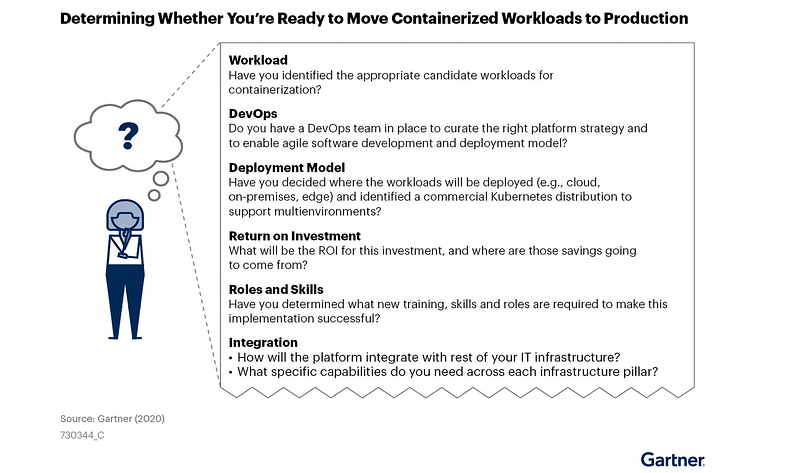
For reasons such as the lack of DevOps culture and an unclear return on investment, pilot projects are losing time in determining the right time to scale the production deployment side.
The use of containers for production deployments in enterprises is still constrained by concerns over operational complexity in the areas of security, monitoring, data management and networking.
Local applications in the cloud require a high degree of infrastructure automation and specialized operations skills not commonly found in enterprise IT organizations.
Developers take to determine the correct operational model for Kubernetes deployments due to uncertain matrices of responsibility and accountability between infrastructure and operations and security teams.
As a recommendation, teams in charge of the Tecnology Operations should proceed as follows:
- To ensure a smooth transition to the production environment, it must be determined whether they have a clear return on investment and robust workload assessment model for Kubernetes, supported by a strong DevOps culture.
- A Kubernetes platform compatible with application architecture and multi-media deployment goals should be selected.
- Develop a Kubernetes strategy that provides best practices across security, monitoring, storage, networking, inclusive lifecycle management and platform selection.
- The Kubernetes platform must be integrated with continuous integration/continuous delivery, security and operational tools.
- It should create a very strong platform operations team that works with application developers for platform selection and operations and focuses on continuous improvement to meet the required SLAs of the production application.
Strategic Planning Points:
According to Gartner data, more than 2025% of enterprises globally will adopt a centralized platform engineering and operations approach to facilitate DevOps self-service and scaling, which is 20% in 2020'by 2025, more than 85% of global organizations will be running inclusive applications in production.
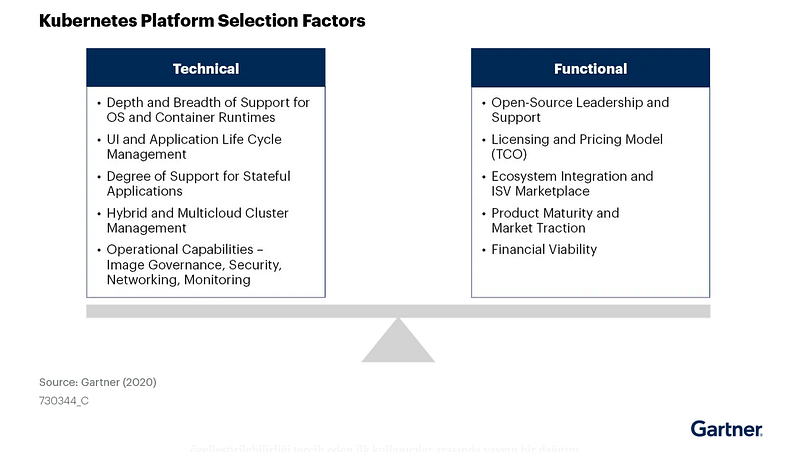
Kubernetes has taken its place in the world as the de facto standard. Customers who decide between the various K8s deployments can identify the right product by comparing it between the technical and functional factors shown in No:2.
Kubernetes distribution models can be divided into three models:
Do It Yourself (DIY) With Upstream Version: A distribution model where users create and manage Kubernetes clusters using the open-source Kubernetes upstream version from GitHub repositories. This has been a common distribution model among the first users to opt for customizability. However, for most businesses, it is complex to build and operate.
Public Cloud Container Services: A deployment model where users use a managed Kubernetes service offered by the public cloud infrastructure as a service (IaaS) provider. Examples include Amazon Elastic Kubernetes Service (EKS), Microsoft Azure Kubernetes Service (AKS), Google Kubernetes Engine (GKE). Some public cloud container services, distributed cloud products (e.g. Amazon Web Services (AWS) Outposts can run on-premises through Google Anthos and the AKS engine on Azure Stack). Cloud services offer operational simplicity and faster time to production.
Container Management Software : A distribution model where users create and manage Kubernetes clusters inside and/or outside the company using a package software solution. Software vendors can be classified as:
Operations-Focused: This approach focuses on simplifying inclusive operations management, ensuring greater vendor neutrality across DevOps vehicle chains and application infrastructure software. Examples include Mirantis Docker Kubernetes Service, Rancher Kubernetes Engine, and VMware Tanzu Kubernetes Grid. In addition, managed service providers such as Platform9 and Giant Swarm (MSPs) provide Kubernetes as a managed service in on-premises, end-and-multi-cloud environments with potential for simplified operations.
Developer-Focused: This approach provides a more comprehensive DevOps and micro-service development experience by including DevOps tool chains and application infrastructure software for adjoining middleware services. Examples are Red Hat OpenShift Container Platform and VMware Tanzu Application Service.
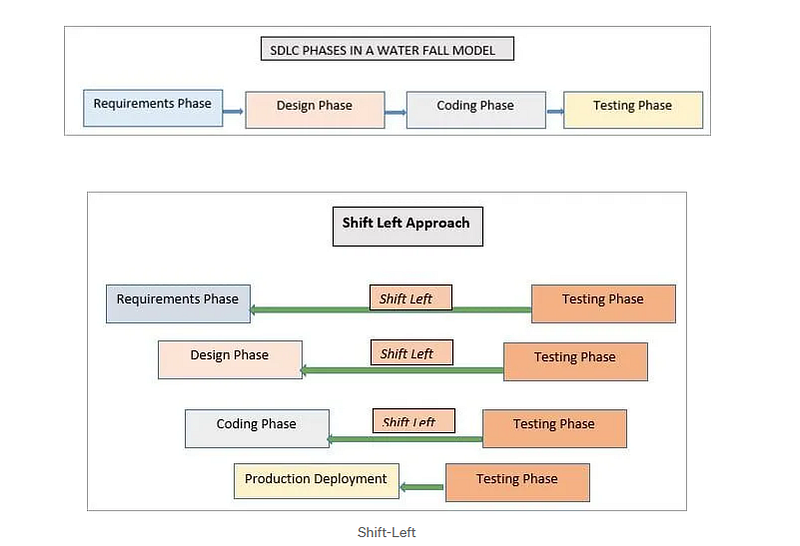
In addition, Powerful version control for code and components (Shift-Left).
Applications for Storage Subject: as container adoption for workloads that are statusfull grows, customers need to consider data retention beyond the host and the need to protect that data. If your primary use case is “lift and shift” of older applications or non-statefull use cases, there may be little change in storage requirements. However, if the application is to be significantly restructured or if this is to be a new, micro-service-oriented, state-of-the-art application, the availability of this workload by the infrastructure and operations team (cloud operation should be called:), is, it needs a storage platform that can maximize its agility and performance.
Definitions about methods :
Greenfield describes a completely new and zero-built software project. Does not contain old code. Brownfield describes a software project built on an existing application. Can inherit old code or frameworks. Lift and shift is a strategy to move workload to the cloud without redesigning the app or making code changes. It is also called rehabbing. Cloud-optimized application is a strategy that needs to be known for switching to the cloud by re-encoding an application to take advantage of cloud local features and capabilities.If you don’t know, ask the knowledge holders:)
Suggestions about methods :
Storage solutions that comply with the principles of micro-service architecture, comply with the requirements of inclusive local data services, demonstrate hardware agnosticism, have API-focused, distributed architectures and support on-premises, end and public cloud deployments should be selected.
Extensively study the performance and stability of the storage product and should support containerized storage interfaces (CSI) as they integrate with your Kubernetes deployment.
Link:
Turkish Part: