What Are Silent Push Notifications and Why Should You Care About Them?
Most digital consumer product companies leverage push notifications as a tool to increase user engagement and retention for their mobile apps. A recent study even claims that apps that go from 0 notifications to weekly notifications double their retention rate on iOS and see a six-fold increase on Android.
While there are a lot of strong opinions about their content, user experience, and cadence, push notifications have proven to be an invaluable tool in increasing user engagement and activity for consumer products. That being said, they are also known to hurt long-term retention if used aggressively since they lead to en masse app uninstalls and unsubscribes.
Note: This post does not talk about the benefits or potential downsides of sending push notifications. Instead, it aims to surface the need to supplement your push notifications with another type of notification.
Silent Push Notifications
According to Apple’s official documentation, “A silent push notification is a notification that doesn’t display an alert, play a sound, or badge your app’s icon. It wakes your app in the background and gives it time to perform some actions”.
Essentially, a silent push notification is nothing but a hidden instruction that can deliver a payload to the app on your user’s device. Instead of causing an interaction with the user like typical push notifications, silent notifications can quietly deliver data to the app, allowing the application to act upon that data in the background.
You can leverage these silent pushes to gain invaluable information about how your users are reacting to the push notifications they are receiving. In particular, you can track how many users are uninstalling your app because of the push notifications and use that metric as a guardrail while trying to increase engagement.
Uninstall Tracking
Why should you be worrying about uninstall rate?
Uninstall rate should be a critical metric for any consumer product because a user that uninstalls your app cannot help you deliver on your Key Performance Indicators or KPIs. Simply put, their Life Time Value or LTV becomes 0 and all the effort you had put in to acquire and engage them in the past becomes a total waste.
While the actual ranking algorithms are secret, some studies have also shown that the Google Play Store tends to reduce the search ranking of applications that have a high uninstall rate. This pushes you into a vicious cycle of getting fewer app installs because of bad app store ranking and losing the few installs you get due to certain campaigns that have a high uninstall rate.
How can you track uninstalls from push notifications?
Spoiler Alert: Silent push notifications!
TLDR: If you are unable to deliver a silent push notification to a device after having sent a push notification a few hours ago, you can be fairly certain that the user has uninstalled your app.
Here’s a simple workflow you can use to track uninstalls:
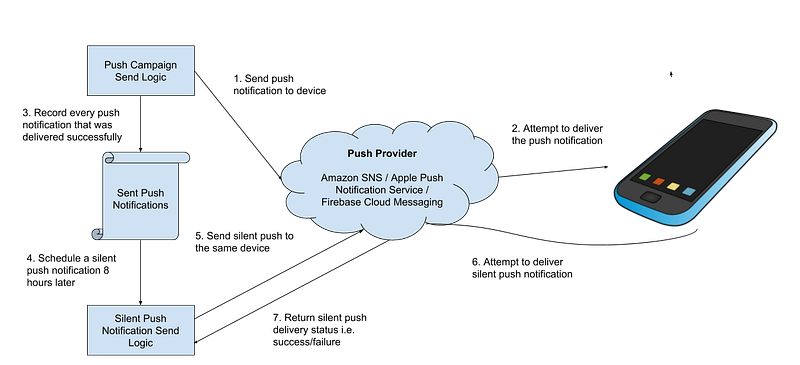
The high-level takeaway from the uninstall tracking workflow is that every successfully delivered push notification should be followed by a silent push notification ‘x’ hours later (where x is your attribution window and is specific to your product). If the silent push notification is deliverable, it means that the device still has your app. If not, it is fairly safe to assume that the user has uninstalled your application from their device.
This simple test allows us to measure an invaluable metric known as the uninstall rate, which is nothing but the percentage of push notifications that resulted in users uninstalling your app.
How should you be analyzing uninstall rates?
When it comes to push notifications, it is important to be able to attribute app uninstalls at a campaign and creative level so that when a particular campaign or creative is driving high uninstall rates, you know it’s time to adjust your mix to favor better performers, or make revisions to bring down the uninstall rate.
Thus, in today’s world where companies run thousands of experiments in parallel, uninstall rates can act as an invaluable metric to improve user experience over time and limit the churn for your app.
While Apple may define silent push notifications as hidden instructions that you deliver to your app in the background, I like to think of them as the heroes your product deserves. The silent guardians. Your watchful protectors.