
What Are Short Squeezes and Should You Invest in Them?
Short squeezes are turning average investors into millionaires. Should you follow the herd?

2020: The year of the Coronavirus pandemic.
2021: The year of…GameStop?
This year alone, shares of GameStop (GME) have skyrocketed by 1,962% (as of this minute). That percentage explodes to 9,785% if you go back to last January when shares traded for $3.84. I can’t even come up with powerful enough verbs and adjectives to capture the ridiculousness of these percentages.
No, GameStop didn’t invent a new source of renewable energy, cure cancer, or discover a hidden body of water on the moon. GameStop isn’t even succeeding in its own much less impactful industry.
Instead, the brick-and-mortar video game retailer’s exorbitant (yeah, that’s a fitting word) share price growth can be attributed to a unified social movement. If you happened to lurk within and study the investing threads of Reddit over the last year, you might have seen this coming. A vocal minority of users argued that GME was heavily undervalued — and over-shorted.
One Reddit user, u/deepfuckingvalue, falls within that minority and has likely profited more than any other retail investor.
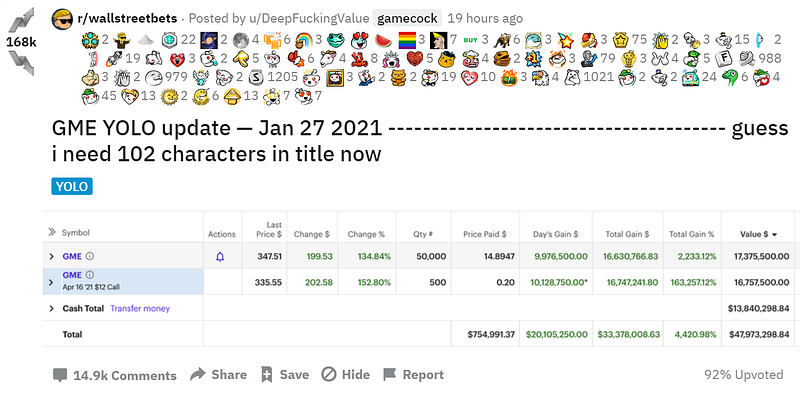
Truly staggering figures. He’s made literal Brink’s truckloads of money.
Unfathomable percentages and instant fortunes can spur the less-informed to make hasty decisions. So, before you join the social movement and succumb to the “to the moon 🚀🚀🚀” stock predictions, do yourself a favor and understand the risks of a short squeeze first.
Let’s start with the concept of shorting a stock.
What does shorting a stock mean?
When shorting a stock, investors borrow stock shares from someone (usually a financial institution) and enter an agreement to return the shares at a pre-determined date in the future. The short-seller immediately sells the borrowed shares at market price with the expectation that the stock’s price will decrease; assuming share prices drop, the investor can buy the stock back at a lower price and return the shares before the agreement’s expiration date. The investor’s profit is the difference in the share prices.
Let’s walk through a simplified example, assuming Bacon Bits is a public company (it’s not).
Cornelius thinks my writing is going downhill — he believes we’re going to fail as a company, so he shorts 10 shares of Bacon Bits, which are trading for $15 a share at the time. He borrows those shares from the Bacon Bank and immediately sells them, collecting $150 (10 shares x $15 share price). As predicted, Bacon Bits' performance and earnings trend downward — share prices dip to $5.
Cornelius capitalizes on the opportunity and buys 10 shares for a total of $50. He returns them to the Bacon Bank and earns a profit of $100.
Why do investors short stocks?
Why do investors bet against companies? An investor can have a number of reasons — a stock could trade at a much higher price tag than its fundamentally worth — Tesla and Netflix are popular examples with 2020 P/E ratios of 1,350.25 and 86.07, respectively.
A company’s management team could sell its shares, signaling a bleak outlook for the company.
A stock could have a defunct business model (*cough* GameStop *cough*). Whatever the reason, a short-seller expects the company to trend downward in the near-term.
But negative expectations — even when they’re justified — don’t always pan out. Earnings surprises, major acquisitions or investments, or new products/services can turn a company’s stock price around.
Or, you know, massive social movements.
What causes a short squeeze?
Short squeezes occur when the share price of a highly-shorted stock unexpectedly increases. Quite literally, investors with short positions are squeezed out.
It’s somewhat ironic, but when share prices increase, short-sellers are forced to cover their position and buy the stock they bet against. More buy-transactions push the stock price further upward, which, in turn, causes even more short-sellers to cover their position.
It’s sort of like predicting that a forest will be torn down for a new strip mall, but a bunch of environmental activists start planting more trees and the government recognizes the area as a national landmark; to save face, you plant trees too.
There’s one key catalyst to focus on. To put it simply, for any stock, there are two camps of investors: (1) people who are betting for the company and (2) people who are betting against the company. Except when you bet against a company by shorting their stock, you embrace infinite risk because stocks don’t have price ceilings. Buy-and-hold investors have a price floor — they can only lose what they put in.
In that way, short-sellers are disadvantaged. To avoid infinite losses when they’re wrong, short-sellers have to cover their positions and buy shares back.
A useful metric to look at is short interest: the percentage of a stock’s outstanding shares that are sold short. If a company has 10 million outstanding shares and 4 million of those shares are short positions, the company’s short interest is 40%.
Looking at the GameStop example, people realized the video game retailer had a short interest in excess of 100%. In other words, there were more shares being shorted than there were available for purchase. With enough buy-transactions and upward momentum, the stock would skyrocket — and it has.
Are short squeezes risky investments?
Taking advantage of a short squeeze can be lucrative, but it can also cost you. As we’ve covered, shorting a stock is risky — but so is betting heavily on a heavily-shorted stock. Here are three reasons why it’s risky:
- There are usually significant factors working against a shorted company. In other words, there’s a reason investors are betting against them in the first place.
- Short squeezes inflate share prices way beyond a company’s intrinsic value.
- Short squeezes are temporary — not perpetual. Once short squeeze momentum slows, investors dump their shares to capture profits, sending share prices back down.
Investing in a short squeeze is a gamble — not a long-term investment strategy. Gambles are high-risk, high-reward.
Proceed with caution, GameStop believers.
A social movement spurs GameStop’s continued surge — not fundamental value. The fact is that GameStop’s current business model does not look promising, considering brick-and-mortar stores are on the way out as the gaming industry moves online.
Don’t take this as spewing doom and gloom for GameStop — maybe they convert to a fully digital business and figure out how to be profitable. I’m just saying the stratospheric prices GameStop is trading for don’t reflect the company’s existing value.
In short, proceed with caution and know the risks.
To be transparent, I bought a single share of GME to join the movement. I’m astonished by the collective power we, retail investors, have when we’re unified — which was reason enough for me to invest a very small sum of money.
Do you want to learn more about personal finance? But without the complicated jargon and dry explanations? Sign up here for Bits — our personal finance newsletter.