
Differential Equations
What Are Differential Equations Anyway?
The Essence of Every DE.
Steven Strogatz famously said,
”Since Newton, mankind has come to realize that the laws of physics are always expressed in the language of differential equations.”
But what does that mean? How can we visualize a differential equation?
In school — or university, for that matter — we get a problem and immediately try to solve it. We never stop to ask why we are working on a problem and what its repercussions for real life are.
It makes the whole process of learning differential equations (DEs) intangible. We cannot answer the question of why we are learning them. And this makes studying harder altogether.
Since I started studying for my Ph.D., which I will begin on the first of December, I thought it a good idea to write a blog about this topic and see if I have internalized it properly.
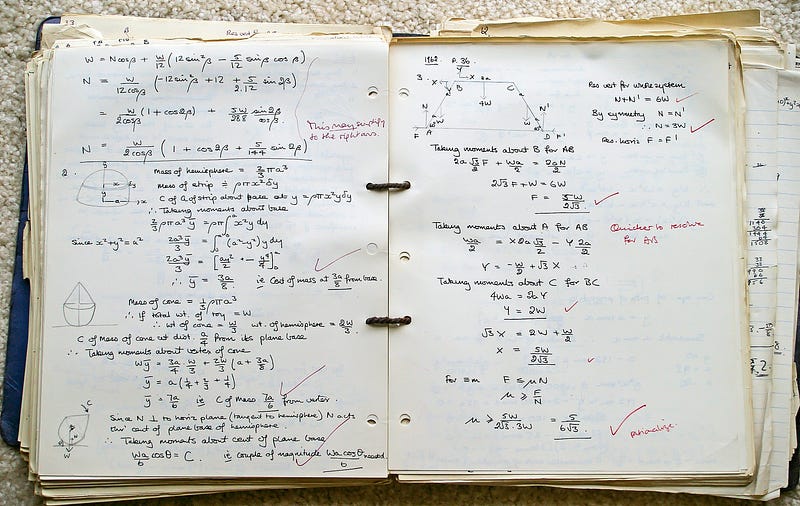
Let’s get to the core question here: What are DEs anyway?
Similar to algebraic equations describing an absolute state (e.g. x = 3), DEs describe a rate of change.
What do we mean when we talk about a rate of change?
A trivial example would be the acceleration of a car. Instead of describing the exact position of the car, we look at the change of velocity at any time. So, in other words, we put in the time and get the speed of the car. With one input, we speak of DEs as being Ordinary Differential Equations. In turn, where there are multiple ones, we call them Partial Differential Equations.
If you are a mechanical engineer and have dabbled with thermodynamics, you will know about the transfer of heat in solid bodies. Differential Equations tackling these kinds of problems are all considered partial. First, you have the change in temperature over time, followed by the position in the body itself. If it is a three-dimensional body, you have three additional inputs. In addition to this, you also have the starting temperature of the body itself and the environment.
If you ever had to solve one of these problems, you will understand that the solution to a DE is another function.
It is, by the way, a fantastic point to differentiate between a Differential Equation and an Algebraic Equation.
The solution to a Differential Equation is a function. The solution to an Algebraic Function is a single value.
You want to read more blogs? Become a member and support me and thousands of other writers directly. If you use my link I get paid a monthly commission, however, at no extra cost for you.
Now we know that DEs describe a rate of change, and they can have one or more inputs. But what can we expect when we work with DEs? Like everything in science, it must have an origin.
The word „differential“ is already enough of a hint for us because DEs consist of derivatives.
Assume we know an equation that gives us the position of a plane flying through the air depending on the time we look at it. What would be the derivative of this equation? It would show us the momentary velocity.
And what about the derivative of that equation? If the first derivative gives us the velocity, then the next one provides the acceleration.
Do you know what we get from the next derivative? Although often ignored, the third derivative does make sense.
What have we done up until the second derivative? We started with the position:
1 1. Position in meters at any given time: f(t) = m
Then came the velocity at any given time:
- Velocity in meters per second: f(t) = m/s
Next, we got the acceleration at any given time:
- Acceleration in meters per second squared: f(t) = (m/s)/s
Now we get the rate of change of the acceleration:
- Rate of change of acceleration: f(t) = ((m/s)/s)/s -> f(t) = m/(s³)
It does make sense because a car doesn’t have to accelerate at a constant rate over a fixed period.
To recap, with DEs, we have equations of derivatives. The goal in solving a DE is to find the equation of whose derivative is our Differential Equation.
Does the word „Integrals“ ring a bell?
With integrals, we are always looking for a function whose derivative is our currently given function. In other words, we would go the above-mentioned list backward.
That is all the magic behind DEs. However, as is with everything in mathematics, the difficulty ranges vastly. And if you ever had to solve a differential equation in thermodynamics, you will know what I mean.
Thank you very much for reading. If you liked what you read, I would appreciate a clap 👏, and don’t forget to follow me on Medium and Twitter for more blog posts.
You have feedback, complaints, want to collaborate, or anything you want to ask me? Please don’t hesitate to write me a DM on Twitter or an e-mail at [email protected]. Or just leave a comment on this blog.
If you would like to further support me, you could buy me a coffee. Thank you very much for any kind of support!