
What are AI Agents? Why are they popular?
A software program that can interact with its surroundings, gather information, and use that information to carry out autonomous actions to achieve predefined goals is called an artificial intelligence (AI) agent.
TL;DR
AI agents are software that interact with their environment autonomously in order to achieve goals, making intelligent judgements based on facts. They increase productivity, lower expenses, and improve decision-making by automating tasks. Unlike traditional software, they adapt and learn, handling everything from basic customer service to complicated processes such as autonomous delivery. Despite the benefits, they present concerns such as data privacy and technical complexity. Their popularity arises from their capacity to boost efficiency and creativity in a variety of industries.

In simple words, a software that is capable of observing its environment, coming to its own conclusions, and reacting to achieve particular goal is called an AI agent. For instance, in an AI call center, the agent will automatically ask various inquiries to the customer, analyse their mood/emotions, retrieve data from internal records, and provide a solution with empathy. And it is intelligent enough to know when to transfer that chat to a human
What makes AI agents different?
Artificial intelligence (AI) agents are crucial for modern technology since they are made to carry out tasks autonomously. AI agents are logical and adaptive; they make judgments depending on their surroundings and data, in contrast to traditional software, which performs tasks in accordance with predefined instructions.
- AI agents are good at logical reasoning as they use data and perceptions to come to a conclusion.
- AI agents interact with their environment through various interfaces. These can be physical, like sensors in robots, or software-based, like data inputs from user interactions. This interaction allows AI agents to collect the necessary information to make decisions and perform tasks effectively.

What are the benefits of using AI agents?
Increased Productivity: By automating time-consuming and repetitive chores, AI agents can free up human workers to concentrate on more important and creative work. Customer service representatives, for instance, can deal with routine questions, freeing up human representatives to solve trickier problems.
Reduced Costs: AI agents increase process efficiency and lessen the possibility of human error by automating processes. This elimination of manual procedures has the potential to save quite a bit of money. Automated financial reporting, for instance, can reduce errors and expedite the accounting process.
Intelligent Decision-Making: AI agents process enormous volumes of real-time data through machine learning, which facilitates quicker and more accurate decision-making. AI can be used in marketing to improve campaign strategy and ad targeting, for example, by analysing consumer behaviour.

Key Components of AI Agent Architecture
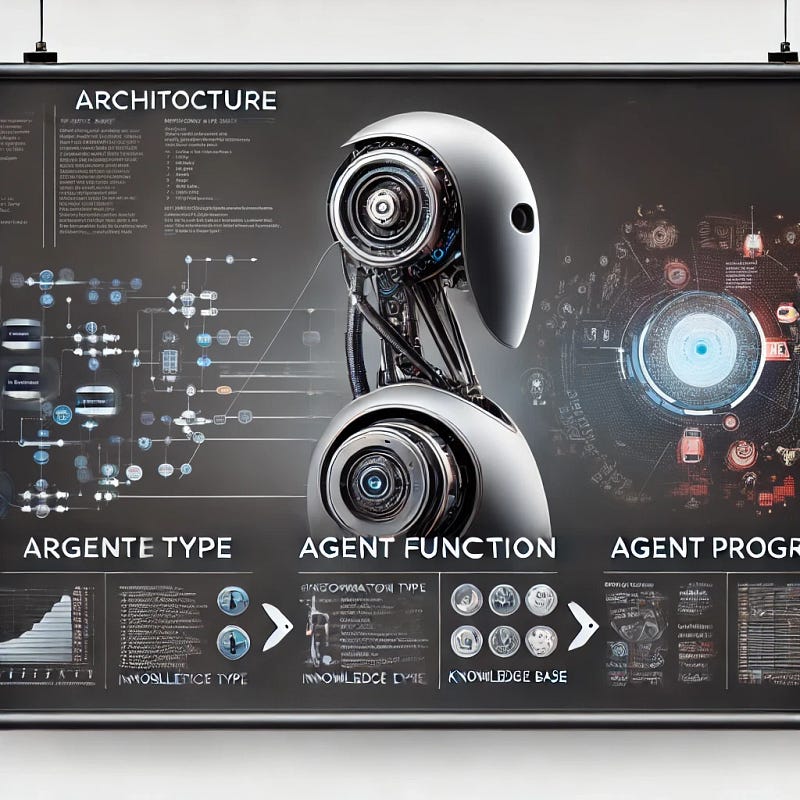
Architecture: An AI agent’s architecture serves as its operational framework. It could be a software framework, like a chatbot platform, or a physical system, like a robot. The agent’s operations and interactions with its surroundings are supported by this structure.
Agent Function: This is the process by which the agent utilises the information gathered into actions. It involves setting up algorithms and rules to direct the agent’s actions in response to the data it collects.
Programme for Agents: The agent function is carried out by the agent programme. It involves creating, educating, and implementing the AI agent on the chosen architecture. This guarantees that the agent performs in line with its performance standards and its intended purpose.
How AI Agents Work
- An instruction or goal is given to the AI agent, which then breaks it down into tasks that are achievable. A delivery drone, for instance, would want to carry a package, which it does by plotting a path and dodging obstructions.
- In order to carry out tasks efficiently, AI agents must obtain the data they need. This might involve communicating with other AI agents, obtaining information from the internet, or gaining access to databases.
- Supplied with the necessary data, the AI agent proceeds systematically with the tasks. To make sure it achieves its objectives, it constantly assesses its performance and adjusts as necessary.
Challenges in Using AI Agents
Data Privacy Issues: Managing huge amounts of data raises privacy issues. It is crucial for organisations to put strong data security procedures in place to safeguard confidential data. Ethical
Challenges: AI systems can occasionally yield unfair or biased judgments. To guarantee the ethical application of AI, human supervision and unbiased data practice must be incorporated.
Technical Complexities: Specialised knowledge and skills in machine learning and AI technologies are needed to develop powerful AI agents.
Limited Computing Resources: Developing AI models requires a significant amount of computing power, which can be expensive and resource-intensive for businesses.

Types of AI Agents
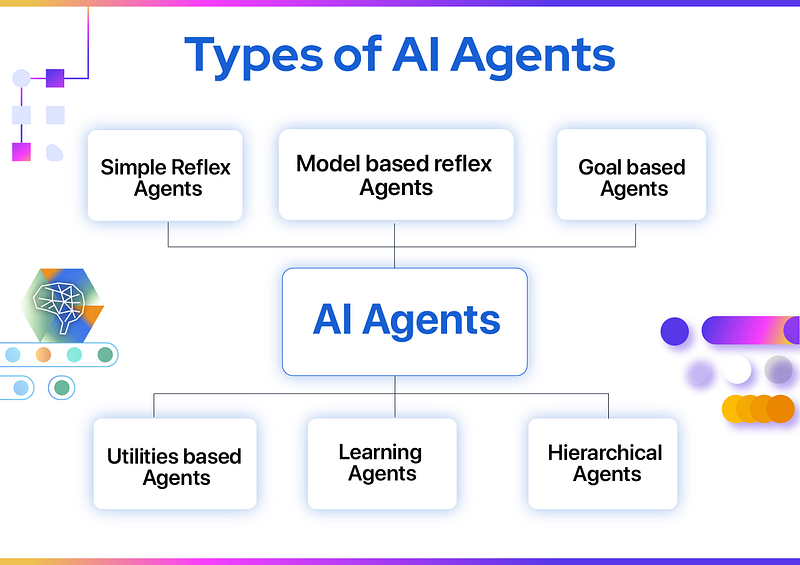
Simple Reflex Agents: These agents don’t take past experiences into account; instead, they function based on preset rules and real-time data. They work well for simple jobs like basic chatbots for customer care.
Model-Based Reflex Agents: Unlike simple reflex agents, these agents create an internal model of their surroundings and utilise it to guide their decision-making. This allows them to tackle more complex tasks. Goal-
Based Agents: These agents assess several approaches to accomplish their objectives, which makes them perfect for jobs requiring complex reasoning, such as robotics and natural language processing.
Utility-Based Agents: These agents compare several scenarios and choose the most favourable one, such as determining the best routes to travel, using algorithms to maximise the desired result.
Learning Agents: Learning agents are those who continuously take learning from their experiences and change their actions in order to get better over time.
Hierarchical Agents: These agents are organised in a hierarchy, with higher-level agents managing and delegating tasks to lower-level agents. This structure allows them to handle complex, multi-faceted tasks efficiently.
Artificial Intelligence (AI) agents hold great promise for the future of industry transformation, as they possess the ability to conduct tasks autonomously and make intelligent decisions. These agents are essential elements that will encourage efficiency and innovation, not only tools.
We’ll understand multi-agent systems in our upcoming blog post, where AI agents collaborate to find solutions to challenging issues. Additionally, we’ll start on interesting projects that will implement these innovative concepts.
Thank you for reading, Let’s connect on LinkedIn.


