
What an Involuntary Addiction Teaches us About Safe Prescription Drug Returns
One man’s fortune is another man’s demise.

Billy was a wanderer in our hamlet; I remember seeing him when I was young. Later in life, I learned the truth, how Billy’s story wasn’t an urban myth and what happened to him on that summer evening in the early 1960s. In learning about Billy’s story, we will examine current issues of environmental damage, opportunities for pharmaceutical returns, and the perils of self-medicating.
When my Mom was a child, she grew up in a little hole in the wall called Caesarea, a spec on the map on the south shore of Lake Scugog in Southern Ontario. She knew a boy named Billy Clements, who was the middle child of seven. The Clement family lived 15 minutes away from Caesarea on the outskirts of the hamlet. By all accounts, the fourteen-year-old was a good looking, regular kid, with sandy blonde hair and crisp blue eyes. Billy took great care of his younger siblings, possessed a laid-back and joyful nature. He was well known and liked in the tight-knit community.
One evening Billy rode his bike on the side of the gravel road heading toward home. In an instant, the gentle noise in the twilight broke, and Billy heard a loud screech of a police siren on hot pursuit. A car whizzed past him, and from the passenger window flew a heavy bag into the ditch. Billy jumped off the roadside, plucked the bag, and continued his journey home.
Once alone in his bedroom, Billy opened the bag to discover a wide assortment of drugs, some illicit, and other prescriptions.
Environmental Damage
In Billy’s story, one of the overshadowed challenges is drug disposal. Whoever threw the narcotics out the passenger window wasn’t in the frame of mind to stop and consider environmental repercussions. Had Billy not picked up the bag, the drugs may have decomposed in the ground, seeped into the water supply system with the potential to impact local wildlife, domestic livestock, or even worse, humans.
While Billy’s example is local, when the scope widens, pharma pollution from hospitals and pharmaceutical manufacturing plants has direct and severe implications for those living near production locations whose water and food sources contaminated with waste pharma products.
Axios article Big Pharma’s wastewater pollution problem describes why the issue matters:
Polluting rivers and lakes with pharmaceutical runoff is not illegal, but can be harmful to wildlife and the environment — and wastewater treatment plants don’t have the ability to remove pharmaceuticals.
Axio reports on 2019 findings:
- The U.S. Geological Survey found that discharges from seven treatment plants had “very high levels of some drugs.”
- An anti-seizure medication measured at nearly 90 times the amount considered safe for wildlife was discovered downstream from a plant in Morgantown, West Virginia.
- Hospitals also contribute to drug pollution, releasing antibiotics and cancer drugs into the water.
Global change will occur when the conscious collective shifts far enough for legislation to transform the current pharma disposal process.
Right now, we can make a positive impact on our actions to curb drug handling, safe return, and elimination.
Disposal of Post-Consumer Medication and Returns
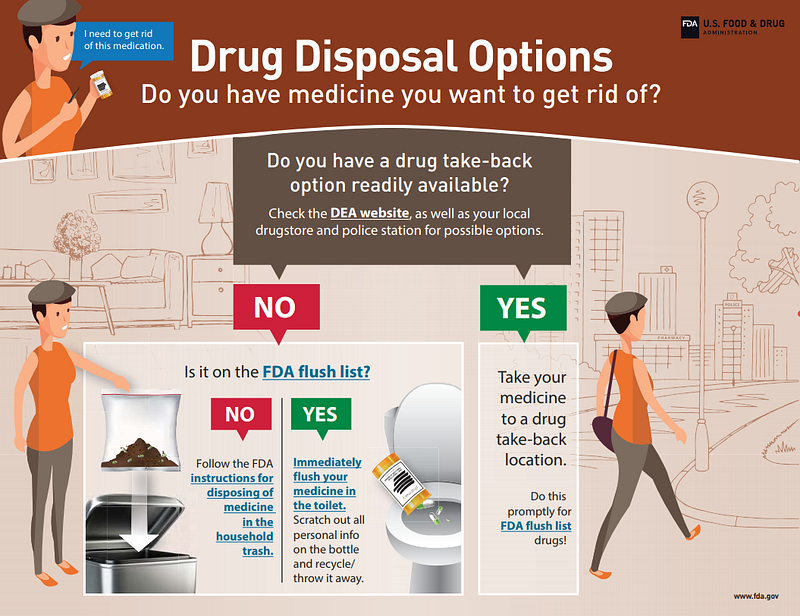
When Billy was a teenager in the early 1960s, North American society lacked awareness and infrastructure to support pharmaceutical returns. Today is different. In Canada and the U.S., the easiest return method is through your local pharmacy. It is worth calling the pharmacist in advance to confirm program availability and inform the individual what type and quantity of medication you’re returning. Before providing back meds, ensure it’s in the original packaging, and remove all personal identification.
According to the FDA website, some pharmacies have mail-back programs and disposal kiosks for unused medicines.
Many communities have drug take-back programs. Whether in Canada or the U.S., it’s worth checking with local law enforcement officials to find the closet location.
Both countries have adopted National Prescription Drug Drop-Off Days to address the crisis related to the misuse of medications, including opioids.
- US April 25 — Prescription Drug Take-Back Day
- Canada May 21 — National Prescription Drug Drop-Off Day
The purpose of the day is to highlight the importance of removing unused and expired drugs from households with the idea of ensuring the concept is top of mind throughout the year.
Note — 2020 dates will occur at a later time due to Covid-19.
The Argument Against Home Medication Disposal
The FDA website provides a list of drugs deemed appropriate to flush down the toilet or sink. Most are potent opioids such as fentanyl and morphine. The FDA:
believes that the known risk of harm, including death, to humans from accidental exposure to the medicines listed above, especially potent opioid medicines, far outweighs any potential risk to humans or the environment from flushing these medicines.
Axios is one of the thousands of pieces of journalistic evidence demonstrating how wastewater treatment plants cannot remove pharmaceuticals. In this light, it is essential to consider home disposal as the last option.
Pharmacy, police, and community drug return initiatives reduce or remove all chances of mishandling or accidents of dangerous pharmaceuticals, for example, skin contact with fentanyl patches.
Teenage Experimentation and Self Medicating
Billy was a curious pre-adolescent boy when he secured the bag of drugs on that fateful summer evening. Out of temptation, he hid the narcotics from his family. Like most teenage boys, Billy’s desire to “test the waters” without possessing the ability to contemplate or comprehend the ramifications of dabbling far outweighed rational thought.
There is a difference between teenage experimentation and self-medicating. Wikipedia explains the latter:
Self-medication is a human behavior in which an individual uses a substance or any exogenous influence to self-administer treatment for physical or psychological ailments.
You are the best advocate for your health and are responsible for the medication stored in your home. If you are concerned with the amount and dosage of prescription drugs prescribed to you or a loved one, do not be afraid to have a candid conversation with your M.D. An honest dialog opens the door to reduce, remove, or seek healthier choices. Once the accessibility of powerful narcotics and pharmaceuticals is decreased, the temptation and risk of addiction diminish.
My Mom recalls how, within a few weeks, people noticed something wasn’t right with Billy. He wandered into Caesarea in a daze, staring off lost into the distance. When Billy spoke, it was either to himself or into the air. Mom inquired into Billy’s condition with his older brother Jim, who confirmed he slept most of the time and was unable to return to school. The family eventually found one of his drug stashes and the father; a staunch military man kicked his son out of the house. From there on in, Billy roamed and gained the local nickname Veg-Ta-Bill. At least he knew when the situation was dire enough to check himself into the Whitby Psychiatric Hospital for temporary periods. Bill passed away in his forties and was never able to recover from severe drug addiction.
In Billy’s story, there is hope. He is a reminder of what is in our control. Whether it be through protecting our environment from the effect of dangerous pharmaceuticals in our water supply or ensuring the safety of medication returns to being conscious of the perils of self-medicating, it is in our power to create lasting change. Above all else, the adults in the room must take precautions and play the critical role of safeguarding our children from powerful unattended medication.
Resources
- USA — FDA Safe Opioid Disposal, Remove the Risk Outreach Toolkit
- CAN — Ontario Medications Return Program
More like this:


