
Parenting
What an African Tribe Can Teach Us About Minding our Language and Nurturing our Children
Many of us do not consider this important and we should
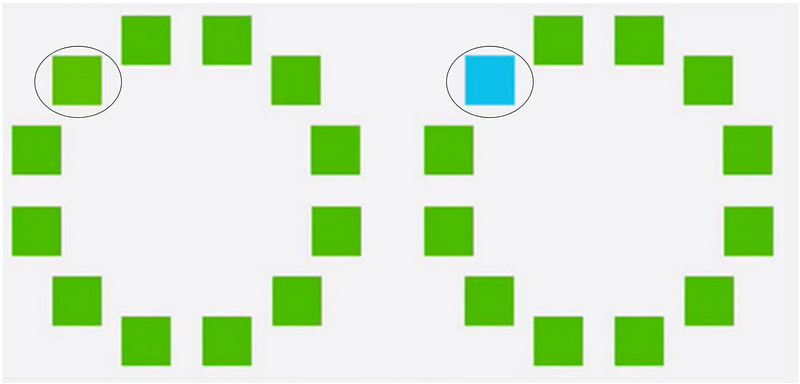
The Himba tribe in Africa (northern Namibia) are a fairly isolated crowd. Their language has only 5 words for colors while the English language has 11 words for colors.
Among their color names, the variation of green shades is given different names. On the flip side, some of the colors like blue are clubbed with sub-shades of green. A group of academics did an experiment — they showed the tribes color palates with one change (circled in the picture above). The tribe members quickly spotted the varying shade of green (first picture), while they took a while to distinguish blue from green.
Mind your words when it comes to emotions.
That African tribe color experiment reinforced a belief — the difference between good and great upbringing — the ability to use words in the most trying emotional situations. The best retort to young children when they are upset, frustrated or furious — “use your words.”
Here is my why.
Every emotion has a word. Every emotion has an apt word. Every emotion has shades of words that go deeper. Implicitly, we know them when we read them. Many times, even as adults, we don’t use the rights words. We are content with an approximation.
For every anger we experience — there is an intensity, there is an expression.
Angry, very angry and very, very angry works. So does upset, irate and furious. What about furious vs. seething? The chemicals our body release and the dosages are different — all for the same big umbrella — anger.
I may not know the chemicals, knowing my emotions makes my most useful vocabulary to good use — create self-awareness on something that is closely related to my mind — my emotions.
Our regrets in life are not our emotions, it’s our reactions to our raging emotions. And the best way to be aware of my emotions is to start naming them deeply.
Straight from NY times quoting research — “According to a collection of studies, finely grained, unpleasant feelings allow people to be more agile at regulating their emotions, less likely to drink excessively when stressed and less likely to retaliate aggressively against someone who has hurt them……People who achieve it [emotional granularity] are also likely to have longer, healthier lives. They go to the doctor and use medication less frequently, and spend fewer days hospitalized for illness.”
Expanding our emotional vocabulary is not easy, but it does have a wonderful side benefit. Emotions connect dots better than logic. That’s my personal ah-ha.
Parting Parenting Thoughts
I was at lunch with someone on my team, a couple of summers ago. In a moment of candor, he asked, “I have not seen you raise your voice, how is that?” I shared as a matter of fact, “when I get angry, the words that echo in my head if you raise your voice, you have to do 10 times more in return to make it up? I quickly figure it is not worth the effort to raise my voice.” My teammate’s reaction was one of surprise. I did not understand why he was surprised, now, I chuckle.
Those were my mom’s words when I was a teenager. In my most vulnerable moment of anger, she did not preach, she instilled in me the most greedy algorithm — what is in it for me long term.
And, I did not even realize it, until I became a parent. Learning without being aware that you are taught is simply amazing.
I marveled at her ability to transition from creating awareness to a “what is in it for me” — when teenage hormones ran high.
Today, as a parent, I have more options. I can work through science-backed research and expose my kids to emotional granular vocabulary. And pass on the wisdom of my mother.
Bottom line — mine your words, mind your thoughts, they become your reactions to the emotions.
Parenting at its precarious best.
— — -
Karthik Rajan
If you liked what you read, please sign up for my “connect the dots” short story-letter at this link.


