
What Am I Doing Here In The Deserts of Iraq?
Frank Glen struggles with his new set of circumstances
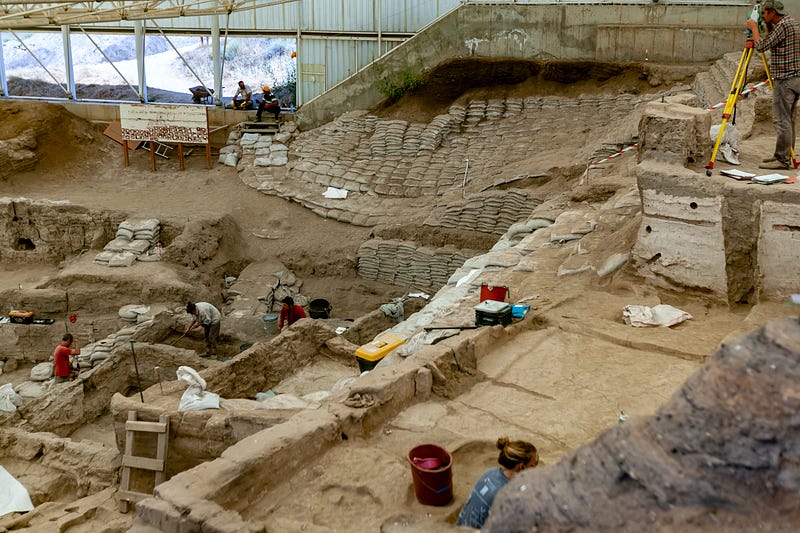
Frank Glen followed Stephanie down into the ravine, still overwhelmed by what he was seeing. He turned around in all directions, almost tripping on uneven stones at his feet.
“This was buried beneath thirty feet of sand. Only the point of the monolith protruded about a foot above the ground.” She pointed to the obelisk in the center of the square.
“How did you do this? Unearth all this?”
“It took over a hundred men with shovels and small earth movers over four years and once we unearthed the largest structure another year,” Stephanie explained.
“I’m surprised it’s all still intact,” Dr Matheson added.
“As were we.”
Glen began to calculate in his head the cost involved, and he surmised it must have been staggering.
“And who paid for this? Not the Iraqi government?”
“No, the Jamison Foundation among several donors.”
“But how could you possibly know where to dig?”
“It’s funny you should mention it. It was a blip in the radar. The satellite was off its position for a few minutes, and it managed to take a photograph of the site from space. Apparently an atomic clock in one of the satellites had shifted a few minutes. If it hadn’t been for a technical error, we would have never found it.”
The closer they came to the structures, the more both men marveled at their intricacy. There were granite stones cut with such fine precision, that they looked like they were cut by blades of industrial machines; and protruding from the bases of two of the buildings were complex stone carvings of various scenes of urban life, some, which Frank Glen surmised were ancient religious scenes.
“How old are these structures?” Glen asked.
“From the carvings and writing they appear about six thousand years old,” Stephanie answered.
“And what happened to them?” Dr Matheson queried.
“That we don’t know. For over two thousand years they flourished and about six thousand years ago they disappeared as suddenly as they had emerged.”
“Come on let me take some pictures,” Frank Glen pleaded in childlike fervour. “No one is going to believe this.”
“No photographs,” Sir Richard interceded once more. ”I’m sorry.”
Frank couldn’t recall how long it has been since he had felt such innocent wonder, and he fought the impulse to run through the ruins as a toddler might shake loose from his parent’s grip and dash away into a toy store.
“It’s not normal for you to find structures like this intact, is it?” Frank asked.
“Of course not,” Stephanie explained. “But then there is much about this site that defies explanation.”
“Why didn’t you let on about this yesterday? You dragged us both to see that propeller and not one word?” Dr Matheson asked her.
“And spoil the surprise?” she responded.
“This looks more sophisticated than I imagine a civilization of six thousand years ago,” Frank observed.
“The Sumerians were a sophisticated people. They had a highly developed culture, with high-level mathematics and astronomy. Some scholars believe that they even knew the sun was the center of the solar system.”
Frank was beginning to question his senses because, despite its obvious antiquity, the site seemed surreal to him and possessed an ambiance like that of a theme park. He pondered the logistics involved in constructing such a hoax and dismissed it once he thought it out.
Stephanie then led them into the largest structure through a doorway over twelve feet high into a darkened room about twenty-by-twenty meters. The flooring was cracked and uneven, but in sections of the room, one could still see the remnants of the blue granite tiles. A small pinhole lets the light scatter through and bumps off the walls.
“We believe this was some sort of civic building. Inside we found hundred tablets of financial records, divorce decrees, and some revenue lists. We also found coins and some religious records. I’ll show you later some of the objects we found.”
Frank noticed a large stone boulder carved in the shape of a small house with a human figure sitting inside.
“What is this?” he asked her as he pointed to the object.
“This is what they call a Sumerian memorial, usually to a god or some powerful person. In this case, it is to the benefactor who built the building. I could translate the name if you like.”
“Not now,” Frank responded. He noticed there were faint remnants of paintings on the walls, though highly stylized, showing the figures much like the others he had seen on the first tablets she’d shown them. He began to realize he lacked the knowledge to ask any intelligent questions of what he was seeing.
“Were there any metal objects?” Dr. Matheson asked her.
“Of course, many of them. That’s why you were brought here.”
“When can we see them?”
“Be patient, Professor. There is still much to see.” She gestured to them to follow her into a much larger room deeper into the building. Inside what appeared to be a common meeting room, they discovered an even larger object covered by a canvas tarp. It measured over ten feet long and five feet wide and the tarp rested awkwardly atop its irregular shape, and completely obscured it. Sir Richard, who had been lagging them, seemed amused by the way his daughter had been leading them around like a tour guide. He lit a pipe he had in his pocket and puffed ferociously blowing the smoke in huge billows above his head.
“Do you think you’re ready to see this?” Sir Richard asked them. “Sometimes a moment of revelation can change a whole life and leaves no turning back. Just think a moment before we lift the veil of obscurity and you see the world as it is. Do we have the strength to face its unsettling truths?” He paused. “In my experience, people would rather live in a comfortable lie than know the uncomfortable truth.” He placed the pipe in the corner of his mouth and let it dangle there. His attempts to dissuade them from looking at it had only served to incite their curiosity.
“The suspense is killing me,” Dr. Matheson moaned. “Let us look at it.”
Stephanie grabbed the thick edge of the tarp and began to pull it off the object. Glen could first see its metal edges as each successive inch of the object was revealed. His mind tried to recognize what he was seeing, though initially he had few points of reference. When the object was completely uncovered, he struggled to make sense of what he was seeing and then in a moment of recognition, he realized it was a metal sculpture of a man with an eagle’s head and wings sitting at what looked from initial impressions, it was another helicopter, with a large propeller in front and two smaller wings behind. This time completely intact.
“Is that what I think it is?” Frank asked her in hopes that she might dispel his first impressions.
Dr. Matheson cautiously approached it and touched it with his right hand, rubbing his index finger along its edge.
“It looks like an alloy of copper and iron and possibly manganese,” he commented.
“I don’t know what to say,” Frank struggled with his words.
“It certainly doesn’t fit with what they tell us in the history books, does it?” Sir Richard approached the object. He rested his left hand on top of the eagle’s head.
“Can you imagine what people’s impressions would be if they saw this in a museum?” Frank asked.
“It will never be shown in a museum,” Sir Richard interjected. “It will be locked away in a secret vault where other objects are kept that might unsettle and disturb the masses.”
Frank was pondering the implications of Sir Richard’s remarks.
“My father is demonstrating his famous cynicism,” Stephanie countered. “He was in naval intelligence during the Second Great War. He thinks everything is disinformation.”
“Napoleon said the victors write the history books. History is the stories we tell ourselves to make us comfortable with who we are.” Sir Richard exclaimed.
“What do you think this means?” Frank questioned as he pointed to the artefact.
“Things pretty much mean what we want them to mean,” Sir Richard responded. “But my theory is simple. Civilizations have risen and fallen on this planet many times. We reach a certain level of technical ability and then in time we have an uncanny knack of destroying ourselves.”
Frank was having tremendous difficulty assimilating what he was seeing. As Stephanie led them to another building and began to show them many of the smaller artifacts they had unearthed, including over a hundred coins. His mind became disengaged. Dr. Matheson seemed completely enthralled by it all, posing dozens of questions and at one point asking to hold the coins in his hand, a request which Stephanie graciously obliged. Frank, in contrast was detached, watching it all, unable to subdue the growing dissonance within his own consciousness. He remembered when his editor had called him into her office and asked him to go on this assignment. He was reticent at first, the fact that it was in Iraq with all it volatile political realities seemed sufficient reason to repel her request. But after her firm insistence, even at one point counseling him what a promising opportunity it presented, he finally agreed. But at this moment, he was having serious second thoughts about his decision.
“Is everything OK with you, Mr. Glen?” she asked him when she realized he was lost in his thoughts.
“Please call me Frank,” he responded. “I’m OK. I just can’t see what the magazine would want me to write about this. My editor gave me the material for this Anunnaki story a few weeks ago and I begrudgingly wrote it. Helicopters in ancient Iraq seem along the same lines and to be honest, my heart’s not in it. What am I supposed to do with this information?”
“You’re experiencing the first symptoms of paradigm resistance when the foundations of your whole belief system are shifting and the human mind naturally protects itself from such shocks to its equilibrium,” Stephanie explained. “It’s the same kind of inertia which prevents institutions from accepting new ways of thinking even to the point of violent resistance to it.” She paused. “My father and I have spent eight years at this site. I know every tablet, every artefact, every jot, and title. It tells a story and you were brought here to write this story. We have other things to show you. But it’s too much to absorb all at once.”
She walked over to a glass case in the corner of the room, where Glen had unconsciously been led; and she removed a small tablet written in Akkadian script. “I have something to show you.” She said, gesturing for him to approach her. He drew closer to her. “This is a children’s nursery rhyme” She placed her fingers into the impressions in the clay. “Would you like to hear it?”
“OK.”
“The gods mixed me like brightly coloured paint and spread me out on wood so my mother might marvel at me and as flowers bloom in bright red and yellow hues, she looks at me and sighs. There’s more.” She paused. “They had the same worries, the same hopes, the same longings that we have now.” She put the tablet back into its case. From her tone of voice and the compassion with which she spoke these words, Frank understood how much this meant to her. “I’ve never seen this as solely digging up artefacts. This is about rediscovering human lives, connecting somehow to these people who lived long ago.”
“I’ve never thought about it that way,” Frank commented.
“I surely hope you will.” She hesitated. “Tell me about yourself, Mr. Glen. We all have special stories.”
“There’s not much to tell,” he began, though he seemed reluctant to reveal himself. “I’m forty-two years old and I grew up in Dallas, Texas.” He pronounced Dallas with a Texas drawl. “I’ve been living in New York for over fifteen years now. I’m a literature major graduate from Southern Methodist University. I’ve worked as a journalist all over the country. As I mentioned before my big break came about a year ago, when I broke the Nigel story. Now I’m here halfway around the world looking at Sumerian artefacts.”
“I’ve always wanted to visit the States again. I was NYU as an undergraduate,” she told him. “But there is still so much work to do, a life of work yet to do.”
“And you’ve never thought of doing anything else?” he asked her,
“No, never. I love this work.”
Frank looked intensely at her burnt red face and his eyes followed the contours of her delicate features down her slender neck, across her shoulders and down her slender frame to her small feet nestled tightly in worn brown work shoes. He imagined her cleaned up in a red evening gown with her blonde hair neatly coiffured.
“May I ask an impertinent question?” Frank told her.
“Of course.”
“How old are you?”
“I’m thirty-two. And I’ve never been married. And you?”
“Now that’s a sad tale. My wife, Veronica, died of cancer. Just thirty five years old.”
“I’m so sorry!” she consoled him.
“It’s OK. I’ve been seeing someone else now, a woman who lost her husband to cancer as well.”
Frank was surprised at himself, how willingly he unburdened himself to a stranger and he felt the awkward uneasiness that comes with vulnerability.
“We were married six years and she got cervical cancer and it took her in months,” he explained.
“I have something else to show you,” Stephanie acknowledged and gestured for him to follow her. Dr. Matheson was still preoccupied examining the coins and Sir Richard had disappeared into some other part of the dig.
She led him out of the building across the stone remnants of the brick walkway through a smaller building about a hundred yards away, no more than eight feet tall with a carved entrance way with steps leading downward. She bent her head to enter the structure and emerged a few minutes later with a kerosene lantern.
“Come and see,” she gestured, and he followed her into the darkened entranceway. As they climbed what seemed nearly twenty steps with Frank’s foot slipping once on loose gravel, the air around them grew cooler and more aromatic. When they reached the bottom, the room felt air-conditioned.
“Quite amazing isn’t it, the differential in temperature?” Stephanie acknowledged.
She drew him down a long corridor, the lamp blanketing everything with a yellow haze.
“We only discovered this a few weeks ago, and this is by far the most intriguing find.”
Frank paced slowly, unsure of what awaited him. He lingered a few steps behind her while watching the lamp bob rhythmically in her left hand. Soon she turned left into another entranceway.
“Well, we’ve arrived,” she said with a broad smile spread across her face. She held the lamp out in front of her and gestured for Frank to peek inside.
To his surprise, he discovered a room filled with ornate artifacts and furniture. Frank could see dozens of wooden chairs and cabinets with carved drawings of moments of Sumerian daily life; women washing clothes and merchants selling goods, and stylized Sumerian religious scenes of Enki, Enlil and Anu. Over two hundred scattered clay jars with brightly painted scenes on them were also scattered across the floor. Frank recognized that each artifact captured a moment in Sumerian life as a photograph might capture a memory. He was surprised by all the metal objects, when he had been taught that ancient societies did not have the ability to smelt. He saw metal pitchers and cooking pans, eating utensils and metal combs of the same alloyed metal as the helicopter propeller Stephanie had first shown them. Among the artifacts were also large tapestries that displayed lions, bears, and wolves, and Sumerian soldiers in battle armor, and even a Zebra. His eyes darted randomly across the room until his gaze settled on some of the larger objects. In the back of the room, stood two large carved reliefs, depicting the Seven Tablets of Creation.
They all seemed inexplicably well-preserved.
“What you’re seeing is like a glimpse back six thousand years,” she said. “Never have so many objects been discovered at one time, and they’ve completely altered our perception of the ancient world.”
As Stephanie moved the lamp, some of the metal objects created small circular rainbows, as though a circle of concentric colors, dancing or darting like bees, from object to object. The light reflected back and forth between each artefact, creating a three-dimensional hologram of what looked like a Sumerian boy standing in the middle of the room. He stood motionless, with jet black hair and small curls, a large broad nose and bright green eyes. The boy was there for but a few seconds until Stephanie moved the light. His face seemed in those seconds as if he recognized Frank, as if he was staring directly at him.
After the boy disappeared, Frank thought his mind was playing tricks.
“Did you see him?” he asked.
“You mean the boy? I’ve come down here before at night, and thought I saw things that weren’t there.” She looked back at Frank.
“What is this room?” he asked.
“I’m not sure you’re ready to hear what we’ve discovered, what we’ve learned about ancient technology.”
Stephanie shined the light again in the same direction and the boy appeared a second time. The image flickered in the room like a flame would.
“This is more than just a story about an ancient helicopter, isn’t it?” Frank answered. He looked intensely at the boy standing before them.
“This is a story about how we view history,” Stephanie acknowledged.
“And what about this boy?” Frank asked.
“I don’t know. There is still so much we do not understand,” she answered.