
What Achievements to Put in Your Resume and How to Hit the G-Spot
A fun and methodical way to determine what achievements to put in your resume by stimulating the G-Spot.

Firstly, congratulations! If you’re reading this article, you are probably someone who has so many achievements that you can not possibly decide what to put in your resume. Must be a tough life for you, buddy.
Also, wait. Did you just read the words ‘resume’ and ‘G-Spot’ in the same sentence? Yes, you did, unfortunately. As we all may know, writing a resume and hitting the fabled g-spot are both deceptively simple tasks. Thus, the metaphor of hitting that one sweet spot when it comes to presenting the perfect index of achievements becomes all the more pertinent. No, it’s not supposed to be clickbaity. It’s literally called the G-Spot Index.
For the past few years, I have been helping many people (mostly undergraduates) write their resumes and the one question most commonly asked is — What achievements do I put in my resume?
Initially, I used to recommend putting ‘whatever feels right’. However, as with most things, I soon realized that perhaps it may not be the best way forward. After looking over hundreds of resumes and doing some of my own research, I developed a methodical way to determine what achievements to put in the resume with the resulting index being, you guessed it — The G-SPOT.
The G-Spot (index)
The G-Spot is the holy grail of erogenous zones and has been an object of fascination (and confusion) for researchers, men, women (edit: I was corrected later by my girlfriend. Apparently only men are confused about this), their partners, and just about every teenager who has recently hit puberty and has a speedy internet connection.
However, this G-Spot is not as complicated as the other one as it can be easily measured. The G-Spot index has 3 parameters:
- Recency of Achievement
- Level of Achievement
- Relevance of Achievement
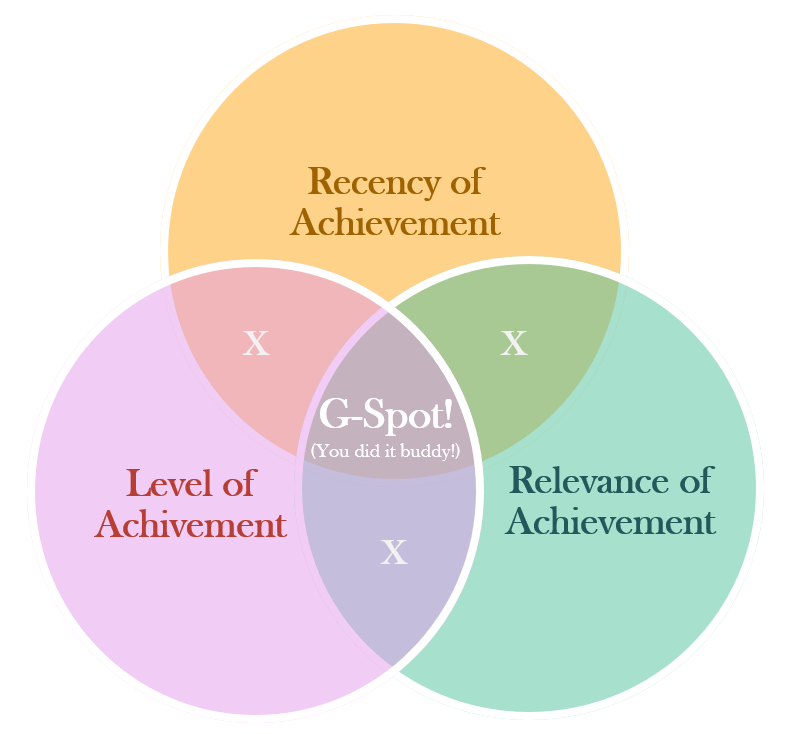
In order to stimulate The G-Spot, you need to have the maximum score on all three parameters. However, before we dwell on how to calculate these scores, let us quickly go through what each of these parameters means:
Recency of Achievement
Ideally, you would want your achievements to be as recent as possible (duh). Sure, it’s awesome that you won an inter-school Physics working model competition but does that achievement from almost 5 years back paint an accurate picture of your skills and strengths now? Perhaps not.
Therefore, in order to appropriately convey to the recruiter that you’re just as skilled (or even more) than you were earlier, try to list your more recent achievements first. But, if you’re still emotionally attached, you can still list that scholastic achievement somewhere towards the end. I understand.
Level of Achievement
Are you a big fish in a small pond or a big fish in a…big pond? While all of our achievements shape us in some way or the other, there are some that simply carry more weight on a resume. Higher the level at which the event is held, higher the quality and intensity of competition. A National level achievement may carry more weight than a District level or a Zonal competition, as it shows that you have proved your mettle among a more competitive and diverse group of people.
Relevance of Achievement
I have to admit that this parameter is highly subjective. Some achievements may not seem directly relevant to the position that you are applying for but in hindsight, they may have had a huge influence on who you are today, or in some cases, even provided the inspiration for you to pursue a certain career field. However, if you decide to put an achievement on your resume that might not seem even remotely relevant to the position that you are applying for, you must ensure that you are able to defend why you have put it in your resume during the follow-up rounds of your application.
Calculating The G-Spot
Scoring the Parameters
Now that we know what each parameter encompasses, let us try to understand how to calculate The G-Spot index for maximum stimulation. (Also, I could not think of an appropriate unit for the G-Spot index. So, for convenience, we will use a fictional unit and we will call it ‘Gee’. Plural would be ‘Geez’.)
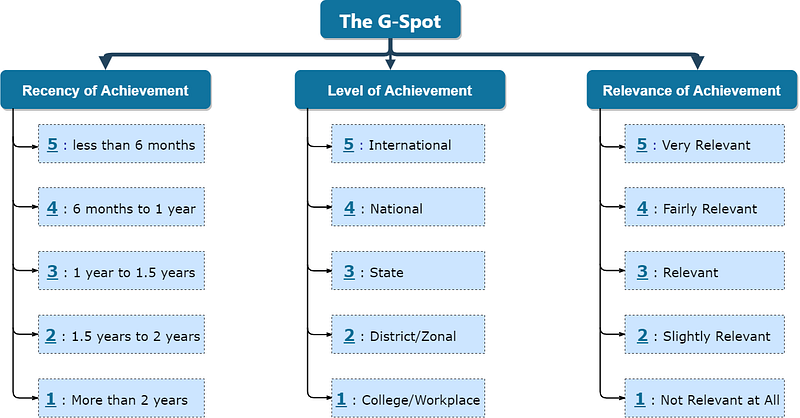
The first step is to give your achievement a score of 1–5 w.r.t to each of the three parameters (using the table below), with 5 Geez being the highest and 1 Geez being the lowest.
Adding the Scores
Once you have extracted the respective scores for the three parameters, you simply have to add these scores and voila, you have The G-Spot index. Ideally, you would want to have the highest score on each of the parameters (5 Geez), which would result in a maximum score of 15 Geez.
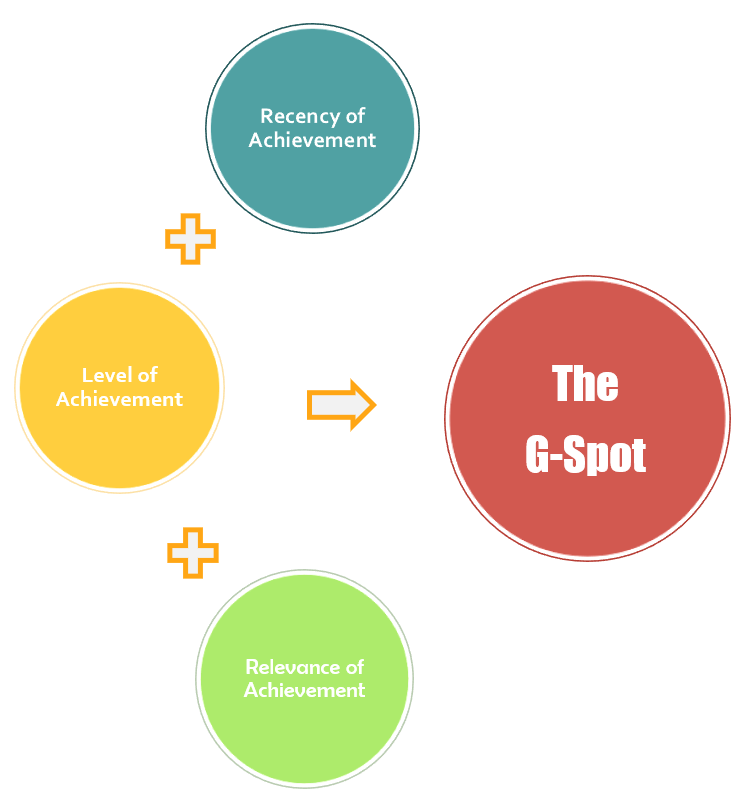
Scores of the 3 components-Recency of Achievement (1–5) Level of Achievement (1–5) Relevance of Achievement (1–5)
The G-Spot = (Recency of Achievement) +(Level of Achievement) +(Relevance of Achievement)
Simba: An Example
Let us take Simba’s example. Simba is currently a Computer Science undergraduate student in his final/Senior year of college. He wants to be a Data Scientist and will be applying for the same in the coming months. Not only is he adept with the core competencies and technologies of Data Science such as Programming, Data Analysis, Statistics, Machine Learning, etc. but he has also participated and won in many case competitions, debate competitions, spelling competitions and hackathons.
Let us see how some of his achievements have scored on the G-Spot Index:
- International Sustainable Development Case Competition Runners-Up, May 2019
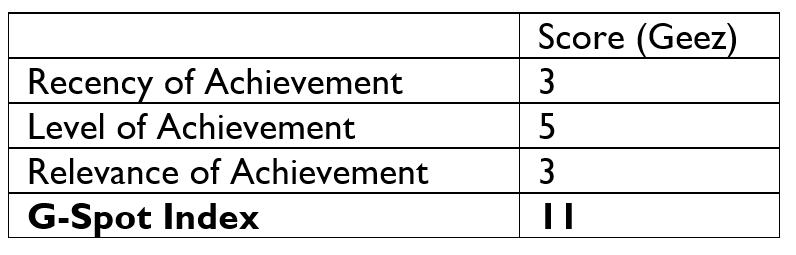
As stated previously, ‘Relevance of Achievement’ is highly subjective and you decide what score you want to take and the criteria for that score. In this case, I have taken the score of 3 Geez considering the skills and qualities that must have been used during the competition — analytical thinking, decision making, leadership, etc. — all qualities that are relevant to Data Science.
2. National English Spelling Bee Competition (Top 10), August 2018
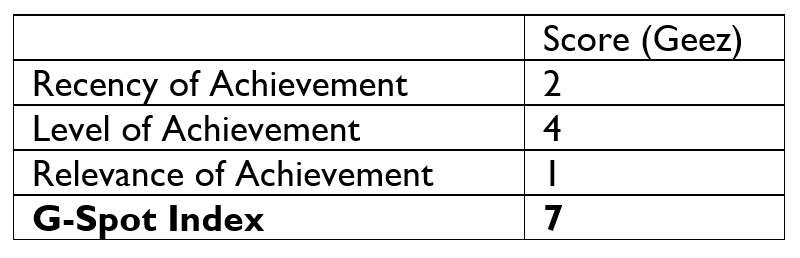
3. International Data Science Hackathon Winner, March 2020
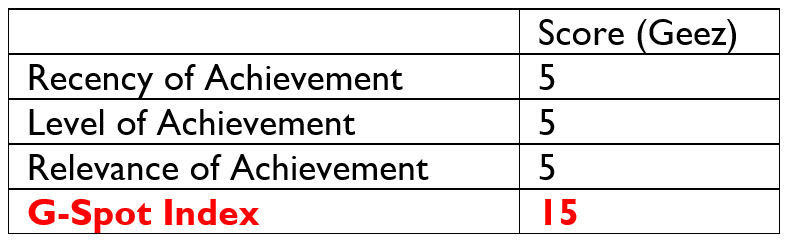
MAXIMUM G-SPOT STIMULATION ACHIEVED!!!
And that’s it, buddy! You did it. You know exactly what achievements to list in your (now perfect) resume. Congratulations, you have been officially selected for the job and pre-approved for a promotion within six months or less of your joining.
End Remarks
Now that I’ve written this article, I’m starting to wonder if I made this G-Spot just as complicated as the other G-Spot. Or if I were to quote my girlfriend when I first shared a draft of this article with her -
Trust a man to make the G-Spot into something so complex. — Girlfriend
Anyway, I hope you take away something from this article and implement the G-Spot index the next time you are writing your resume. If you managed to read till the end without yawning, thank you. If you yawned and STILL read till the end, a bigger thank you. It means a lot and I hope you liked it.
About the Author
Hi, I’m currently working as a Data Scientist at IBM. I also offer career consultancy on a pro bono basis to just about anyone that I can help. In my spare time, I like to listen to music, read books, and draw things that even I sometimes don’t understand. Connect with me: [email protected]/LinkedIn/Instagram


