
What about …. Whataboutism! Part 1
The Power of Comparison and the Chain of Fallacy

I shall get straight away get to the crux of the matter and address the questions that this article will pose. I do this in no small part for one of my good friends who struggles with reading. He advises that I write articles from 6 to 10 minutes long. I, however, struggle to deliver such hallowed texts. In lieu of living up to his expectations, I give him a quick escape route in the form of some quick answers to allow him get back to his meditations on clay and sand (he is a geotechnical engineer of some note).
Why is the comparison of such incalculable importance? Because to understand the universe you need to hold up everything to everything else. Without making comparisons you get no patterns, no types, no generalisations, no concepts, no laws, no universals. Scientific experiment, induction, legal precedent, and really the entire fabric of thought and knowledge all rely on the power of the comparison. For any notion or idea to make any sense and exist in the first place, comparative thought is required.
Is whataboutism a genuine fallacy? Yes, very much so. Whataboutism is a variation of the tu quoque logical fallacy and has clear propagandistic applications.
The Merriam Webster Dictionary defines whataboutism as ‘the act or practice of responding to an accusation of wrongdoing by claiming that an offense committed by another is similar or worse’.
Whataboutism can have the effect of sidestepping accusation, distracting attention from the matter at hand and generally muddying the waters. As such it is easily instrumentalised for the purposes of propaganda.
Is the charge of whataboutism itself dangerous? Yes, very much so. Charging someone with whataboutism is a great way of delegitimating what they are saying and shutting down fair criticism. As such the claim of whataboutism can be easily weaponised, thus making the charge as dangerous as the crime. Moreover, the application of the fallacy has spilled far beyond the banks of the above Merriam definition.
What do I mean by the charge of whataboutism adding a link to the chain of fallacy? Well, whataboutism as defined above is all about distracting from the matter at hand and sidestepping legitimate criticism. The charge of whataboutism distracts and sidesteps legitimate criticism in much the same way.
An example is called for:
A: Nixon had definite ties to the mob
B: What about JFK, he seemed to have some proven connections too?
A: Whataboutism!
B has sidestepped the implications of A’s statement. This is whataboutism if their intentions are to indeed sidestep (more about this below). However, A in levelling their charge has also sidestepped B’s statement, which, I think, most will concede is reasonably connected to the first. This is why the claim of whataboutism merely adds links to the chain of fallacy and is only justified if malicious intentions can be established. Otherwise, we have two wrongs, and two wrongs do not not make a right, which is also a fallacy.
When are you justified in charging someone with whataboutism? Firstly, the context will almost always be the public sphere, be it online or otherwise. Secondly, you are justified in calling whataboutism when a person addresses an issue by introducing a different dimension or point of view for contrast and comparison, but does so, and this is fundamental, in bad faith. That is, they are offering their opinions and making their connections not simply because that’s how they see it but with the express intention of destabilising the conversation, exculpating a particular party and generally muddying the waters.
When are you not justified in charging someone with whataboutism? Luckily for thought and discussion, in the majority of cases where someone seems to say, ‘what about … ‘, whataboutism is not warranted. Whenever you have no reason to suspect the intentions of a person, you should not claim whataboutism for the reason that you do far more bad than good. You shut down thought and dialogue without grounds, and, moreover, you simply add a link to the chain of any existent fallacy. The charge of whataboutism is much like fighting fire with fire and is really only justified where real malice prevails.
Broad Application and the Power of Comparison

The definition for whataboutism I gave earlier says nothing about when it should be applied and this is one of the issues with the fallacy— accusations of whataboutism are wantonly and wildly bandied about, often without any proof that a person’s intentions are suspect. It can also be weaponised as a tool for shutting people up by virtue of delegitimating their opinions. The wider the scope with which whataboutism can be legitimately applied, the more dangerous it will become. Why? For the reason that whataboutism eviscerates the practice of making comparisons to understand issues and this is essential for human thought, dialogue and free speech. As such whataboutery, as it is sometimes called, is only ever justified where malevolent intentions can be reasonably presumed.
Let’s say we give whataboutism the broadest possible jurisdiction and apply it to all situations and spheres of thought, what will happen?
A: Swans are white
B: What about that swan …
A: Whataboutism!
A: Churchill was a pretty good guy
B: What about all those things he …
A: Whataboutism!
A: European languages are non-tonal
B: What about Swedish and Serbo-Croatian, even English …
A: Whataboutism!
The destructive a priori of whataboutism annihilates all comparison, all inquiry, all analysis, all examination. All is rendered null and void by virtue of the fact that the thing being talked about is not the exact same as the second thing introduced for the purpose of comparison. We would be subject to a tyranny of the particular, every single thing would be unassailably its own unique entity with not even a single thread of commonality to look to.
In fact, my dialogues would not even exist under such a dialectical dictatorship. Were whataboutism to be universally applied, there would be no swans to speak of, no humans to assess according to their moral content, no white, no black, no, good, no bad, no language. To get to be able to talk about swans in the first place, you have to be able to compare living beings together, notice similarities and differences, codify these in the form of categories, compile these categories into further categories and systems, develop concepts from and for these processes, and use these ever-expanding sets of categories, systems and concepts to continually repeat the process.
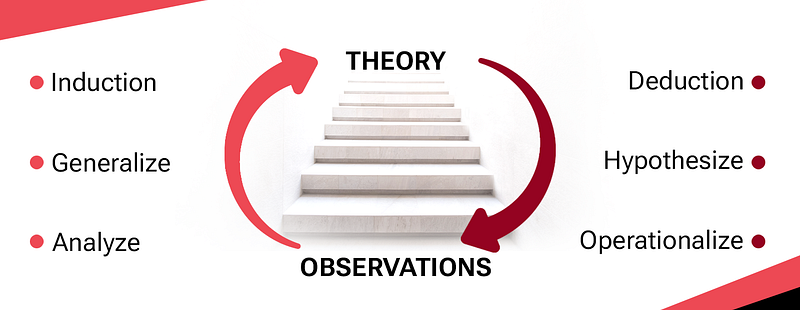
This is called induction, going from the small to the big, from the particular to the universal. These universals come in the form of laws, general principles, discrete categories and immutable concepts. From here we get deduction, and with this we can say a whole a lot about everything without observing it first-hand. The two work together and allow humans understand the world amazingly well compared to any other creature we know, and our knowledge grows ever deeper as we continue to compare, observe, experiment and examine, revising as we go because many things turn out be little or a lot different than was previously held.
Human knowledge is vast. It is equally self-reliant, self-buttressing, with everything bound up with so much else for anything to be intelligible — to know one thing, you need to know many things.
An illustration of what I mean:
A has just seen a rock. He reports this to his friend, B.
A: I have just seen a rather heavy, hard, inanimate, non-uniform, somewhat sharp igneous rock.
B: Ok. Why have you given me this long list of qualities to explain what a rock is?
A: I thought you may need some qualification of the rock
B: No. Most of what you have said is implied by what a rock is. It is intrinsic to the rockness of the rock
Any single thing, quality or phenomena naturally implies a multitude of other things, qualities and phenomena, without knowledge of which the first element cannot be known or understood in any meaningful sense. These grow in number and are continuously being recalibrated, adjusted and even done away with according to how our understanding evolves.
Let’s look at the rock. When I think of a rock I doubtless picture something not quite the same as any other human. It’s also doubtful that anybody will picture something very different in terms of the specific set of qualities relating to rocks and stones. For instance, it’s unlikely that someone will see in their mind’s eye a mother or father rock rearing little baby rocks. This is a quality that cannot belong to a rock. However, a person may picture something rounded or sharp, igneous or sedimentary, for these variations belong to the natural diversity of stone.
Qualities grow in number and are expanded on in terms of content whilst wholly new dimensions can and do develop. It is likely that what past and future humans meant and will mean when they say the word rock or stone will be somewhat different than what we mean, and this can also be true across cultures. The further we go backwards, forwards or across our present world, the chances become greater that things will be understood differently. For instance, some past humans may not agree that rocks are not living as we understand it, and the Japanese identify umami as one of the five basic tastes which science has now come to recognise. However, there’s far more sameness than difference for many concepts, and this is especially true for the humans of any one time or group: they observe, compare, see patterns, systematise this knowledge and then pass it on to others.
Rocks are hard, inanimate, heavy or heavyish, dense, tough, durable or durable enough comparatively. They can be sharp or round. They can be different colours and textures. They are formed in different ways — there are igneous, sedimentary, volcanic (although this may not mean a huge amount to the eyes and mental images of the average person). To understand all this, one must have an understanding of hardness, the living and the non-living, weight, texture, durability, shape, colour, stratification. And to understand hardness, one must naturally know about softness. To understand roundedness and bluntness, one naturally possesses a knowledge of sharpness. So much is connected on such a fundamental level that it is all but impossible to pinpoint where ground zero lies.
The most essential cornerstone of this vast epistemological lattice is the unrelenting urge to sort through everything we can get our eyes, hands and minds on and compare it with everything else so as to draw out the ever-unfurling truth of the world as it is for our species. What it means for something to be true can be debated, but the power of comparative thinking cannot.
Returning to whataboutism, and suffice it to say that one should tread carefully when employing any instrument that vitiates the sanctity of comparative thinking. There is a time and place to call whataboutism, but its legitimate jurisdiction is and should be rather quite limited because of the danger it represents to all thought and dialogue. This jurisdiction is governed by context and intention.
Context

The only yardstick we have to measure the world is the world itself and our own imaginations. To educe the overarching patterns and underlying forces, to essentially come to be at home on the planet we live, we must hold up a light to everything we come in contact with and measure it against everything else. In service of this, all things can and should be compared, but all things cannot and should not be compared all the time. Context is king.
An example for illustration:
Let’s imagine a person is watching a lower-division football game and remarks that one of the players is really quite outstanding,. Everyone will get his or her meaning: in comparison with his or her peers it is my opinion that this player shines. Few people will turn to the maker of the assertion and retort, ‘actually, he’s pretty awful … in comparison to Lionel Messi’, or ‘actually, I believe you’re doing the player a complete disservice. His skills are truly transcendent relative to those of a greater long-nosed armadillo.’
Why are my comparisons absurd? Well, the comparisons being made are wholly unfitting to the context. If I were to say something like, ‘Messi’s pretty short’, everybody would know that I was casting my net wide and talking about the human species and relative to Homo sapien averages, he is on the short side. And casting the net ever wider still, we find that armadillos and humans are both mammals and despite appearances, share a number of behavioural and morphological characteristics and so can be compared and contrasted. And we can go on ad infinitum.
Context is king. One must compare like with like to draw more meaningful distinctions between things and phenomena, but really, given the right context and application, anything can be compared with anything. And as I have effused at length, humans are master comparers. To get the humour and absurdity of my little imagined exchanges you will have on some level, however briefly, however unconsciously, made use of your stellar comparative skills and the vast body of knowledge born of these same skills.
So the context and comparison must fit, there must be a certain appropriateness between what’s being discussed and the comparison put forward. But who decides this and how?
It will be rather easy for a group of likeminded friends talking together in real life to decide and regulate their discussions accordingly. The group will more than likely simply laugh if something doesn’t fit and make fun, hopefully not too harshly, of the poor offender. They’re friends in the first place so we can reasonably surmise a high degree of trust and closeness. This trust in one’s essential decency, their closeness, the immediacy of their interactions and their friendly background will mean the intentions behind any remark or commentary are generally not in doubt, and if they are, can and will be quickly interrogated.
The above elements make for a very high level of group self-regulation and very effective conflict management. In short, whataboutism doesn’t really apply to this sort of social dynamic because there is far too much trust and closeness. Whataboutism requires social space for intentions to be sufficiently in question for it to apply.
What about to matters of science? Does whataboutism have any jurisdiction or application here? Rather unlikely for two reasons, with some large exceptions. Firstly, many scientific pronouncements are beyond debate, whole bodies of evidence exist that vitiate doubt in all but the most stubborn, contrarian or stupid of minds. This can be an issue as this air of invincibility can infect areas where things are really not clear. Nonetheless, as expatiated above, there are few who will take such a violent tool as whataboutism to the broad canvas of hard science.
Secondly, large swathes, but definitely not all, of the territory of science are simply non-controversial. People don’t get their backs up against the wall when the dish of the day is sub-atomic particles, or the tensile strength of various soils, or the mindboggling stats for VY Canis Majoris. These are neutral valueless topics, devoid of commentary on human society. Unless, of course, you question the entire structure of science, which small smatterings of people do. I’m not talking here about diverging on certain matters somewhat, I’m talking about a position that is in direct contravention of the quintessence of science. Few adopt such a position.
There are a number of very notable exceptions to the non-controversial character of science — race, gender, God, sexuality, evolution, nature in connection with the human animal and human society. Elements of these are highly controversial for certain groups of people, meaning that with these subjects some folks will be quite motivated to make use an instrument such as whataboutism to discredit or cancel a commentator for the right or the wrong reasons.
Thus far, we have 3 characteristics that can invalidate a comparison and potentially legitimate a claim of whataboutism.
Firstly, we have the absurd. But this is more funny than anything. Few will have strong incentives to call whataboutism when most will be laughing. The non-sensical invalidates itself in essence.
Secondly, we have social space. There is a high degree of trust and closeness when people know each other well. As a consequence, intentions and the essential moral goodness of a person are not in doubt. There is an inverse relationship between social space and trust in a person. The more social space between actors is amplified, the more likely a person will genuinely distrust the intentions behind anything said.
Thirdly, controversial subject matter. Whataboutery is a blunt force weapon something like a mace which crushes commentary and comparison. People don’t bring such weapons to fights when there are no fights. You have to care to want to squash something in such a way. And much like a weapon it can be used for good or for bad, but there must be some sense of something to fight for and uphold or something to attack and kill.
Where are these conditions met coterminously? No prizes for venturing the public sphere. Large social and physical distances between people, either online or in traditional media, strong doubts apropos intentions, and a fecund abundance of divisive subject matter. Accordingly, whataboutism is extremely prevalent online and in the media. I see examples of it rather often on Medium, most especially scrolling through the comments to articles on the Russian invasion of Ukraine.
That there will be large emotional distance between people even with the great equaliser of the internet and social media is inevitable. That some topics will spur humans to argue and debate, and even kill and die for, is a given. That the intentions of the other can be opaque to say the least is also axiomatic. But should one eternally doubt the other to the fullest of one’s capacity? Should you call whataboutism whenever you feel a person’s contribution has moved away from what you see as the central issue?
To these questions and others we move in Part 2.