
What a coffee place on a graveyard taught me about our relationship to death
Sunday morning. My cheeks are being stroked by a surprisingly warm autumnal sun. I allow my curiosity to guide me to a mysterious coffee place that I hadn’t spotted before. I find a chair and a blanket and, as I wait for my coffee to arrive, tune into the soundscape that surrounds me. A delicate collage of energetic birds, finely-tuned wind accords and a rich collection of voices.
I hear teal-haired women dream about potentially applying to art school. I listen to a young couple plan the very complex logistics of managing their children’s schedule — finding a recipe to balance English homework, Tuesday’s piano lessons and scarce lunch breaks. A quite large group is debating the political atmosphere of their respective countries. Ambivalence in their words and a sense of gravity in the air.
We are looking onto a graveyard.
Yes, my dear reader, this coffee place is located in the middle of a graveyard. What a wonderful, radical idea. A container for life and death to coexist. A space that invites us to experience graveyards — and maybe death — differently. We are surrounded by gravestones and we are alive, sipping cappuccinos and freshly pressed orange juices.
Suddenly, the conceptual division between life and death — between the mundane and the sacred — is blurred.
Was there ever a clear division to begin with?
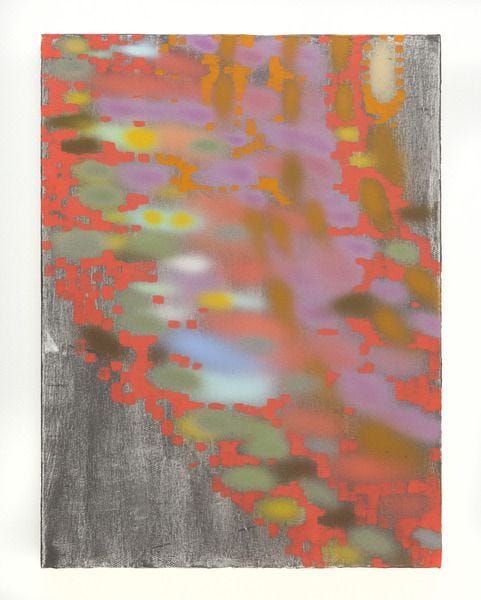
It is a deeply human trait to divide and categorize. We adore creating beautiful, clean-cut models and use them to make sense of our complex, often messy and paradoxical realities. Frameworks are understandably seductive. They give us a sense of control. Our analytical brains value the precision that having clear conceptual demarcations enables us to exert. We can name and isolate stages of processes that we imagine we understand. Knowledge is power — we have learnt.
Yet death is maybe the ultimate challenge to our desire for clarity and control. It resists simplistic approaches and definitive answers. Instead, it invites us to sit with the wisdom and depth of uncertainty. Death poses questions. It invites us to a state of productive doubting.
Do not now seek the answers, which cannot be given you because you would not be able to live them. And the point is, to live everything. Live the questions now. Perhaps you will then gradually, without noticing it, live along some distant day into the answer. (Rainer Maria Rilke, Letters to a Young Poet)
And maybe, as poet Rainer Maria Rilke perceptively suggested, loving and learning to live the questions themselves might paradoxically contain the answers we seek.
Death is a wonderful invitation to dance with uncertainty. Let’s dance?
You are writing an article about death? Eyebrows rise. A mix of surprise and worry appear on the facial expression of my conversation partner. Her feet start slowly rotating away from me. Death makes us uncomfortable.
Why? Our predominant cultural narrative in the West isolates death from our everyday experience. This is by design. Death is not part of our day-to-day conversation menu because we intentionally want to exclude it. It is tempting to believe that, if we push it deep enough into our unconscious, it might disappear from our awareness.
Death as the undesired Other. Death as Taboo.
In this view, we treat dying as an outlier - something that doesn’t happen frequently, that doesn’t usually affect us, that doesn’t belong to us, to our experience. Something extraordinary — and extraordinarily challenging to talk about. Distancing is a known coping mechanism.
And yet, the illusory nature of this thought is never as clearly revealed as in autumn. The fallen leafs mock our desire to escape the truth of our mortality. We can take this season as an invitation to consciously explore our relationship to death, to endings. An opportunity to develop a richer sensitivity for the beauty that lies in endings.
We don’t want beautiful endings, we don’t want endings — full stop. We want to constantly flourish, perpetually grow, never decay. Capitalism expects us to do so. In a context in which endings are often equated with failure, it is not surprising that we would want to avoid them at all cost. And yet we can choose to act differently.
This is why I was drawn to writing this piece. I believe in the power of awareness. Of illuminating what already is here, but isn’t seen or talked about. I believe something changes, loosens, by naming it clearly. Challenging our perceptions creates space. And it’s in these often unexplored corners of our personal and collective beliefs where space for different perspectives and ways of being can emerge. And so, intentional transformation can occur.
This is relevant not only for internal, personal changes — these are also the foundations of awareness-based social change. The individual and the collective are perpetually intertwined. Like life and death.
I am curious to collectively explore what a world in which death is reclaimed as a deeply human experience would look like. What would change if we accept — and even celebrate— endings as an integral part of every transformation process.
And I believe in the power of language as a tool for social change. I am interested in discovering if apparently subtle shifts, such as writing, reading about or openly speaking about death could lead to deeper transformations. What would happen if we removed ‘death’ from the box of taboos? If it were integrated it into our everyday vocabulary? Would our relationship to life also shift?
Our disconnection from death also hints at a deeper disconnection from our cyclical nature — and possibly nature altogether. I have an invitation for you, a question for you to dance with: What do you consider ‘nature’ to be? Do you include yourself as part of nature?
The way you answered these questions is probably influenced by the environment and set of ideas you have been exposed to. If you, like me, grew up in a Western cultural context, you might have familiarized yourself with the ‘nature/culture divide’, which is a widespread anthropological theory that clearly separates both concepts.
There are alternative perspectives that we can choose to access and embody, like the lens of Deep Ecological Awareness, as articulated by Fritjof Capra in his book The Web of Life, which recognizes the fundamental interdependence of all phenomena and the fact that, as individuals and societies, we are embedded in (and ultimately dependent on) the cyclical processes of nature. Because we are part of nature.
No matter which lens resonates more with you, observing how other species co-exist with each other and with death can be a great source of inspiration in the art of perspective shifting. I’m particularly inspired by fungi, who convert the organic matter of deceased organisms back into soil from which new life will spring. They create new life from death. This approach invites us to perceive death as a creative force — a perspective that enriches the frequent associations of death as an exclusively destructive phenomena.
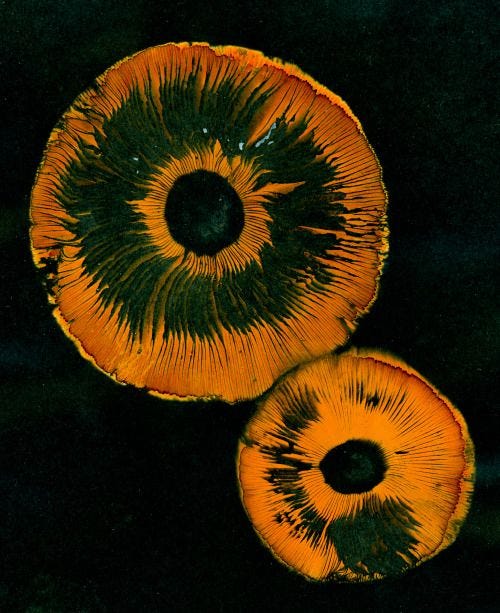
Fungi also challenge our often linear perspective on death. They provide a helpful reminder to recognize all life-forms as processes not static things. The ‘you’ of five years ago was made from different stuff than the ‘you’ of today. Nature is an event that never stops — Merlin Sheldrake, states in his book Entangled Life.
Death becomes not a one time occurrence, but ‘only’ one stage of an endless process. Part of a cycle. Yet in order to access this perspective, an expansion of our perception of self is needed. Zooming out and seeing ourselves as part of a planetary collective, enlarging the meaning of ‘us’ to include more than the confined idea of the individual self.
This skill might lie at the core of creating meaningful attempts to engage with the multiple crisis we are currently facing — which undoubtedly will require us all to find creative ways to cooperate beyond existing boundaries and dualisms.
Beginnings and endings can not exist in separation.
When my flat white arrives, the waiter carefully rotates my cup so I can observe his foam-art creation upright. This tiny act of care moves me. It feels profoundly meaningful, a reminder that how we choose to invest our energy matters.
Meaningfulness is a more fluid and rich and variable concept than we tend to imagine. And so is death.
Would you agree?
I’m curious to hear how your relationship to death is now and how a you envision a society that fully accepts death to be.
In the spirit of completing the full cycle and including both consumption and creation, my invitation to you is to take time to sit with these questions — feel free to also share your answers in the comment section below.
For more invitations to dance with different perspectives and questions, you can join my newsletter here.