
Whack a Woke — Supercilious Sunday
A masterclass in how to unmake friends and alienate penguins (and people)

I’ve grown quite fond of my ‘whack-a-woke’ series. It initially began as a one-off article that I penned in a fit of penguin-pique at not being given the right to reply to a comment on my own post.
Since that point, the idea has expanded to include a whole bunch of insights into patterns of human behaviour. It allows me to reflect both on my own itchy trigger finger and the quality of online discourse more generally.
If you’re wondering whether you’ll appear in my ‘Whack-a-Woke’ series for disagreeing with me then you need not worry. People who engage with my articles to have good-faith debates will never find themselves in the ‘whack-a-woke’ series.
I enjoy disagreeing with people as such I‘ve been in heated debates with some of the best minds and writers on this platform. I do love trying to work out what the rules are when you disagree.
A recent hilarious interaction featured someone, I presume someone new to Medium, who wanted to take back their claps. They commented because they’d accidentally applauded my article instead of Marley K’s comment on my article.
They wanted to make sure I was aware I had been applauded in error. Such awkward politeness is the stuff that we brits are forged from. I didn’t have the heart to say the ensuing about-turn-farce likely upped the reading time on my article. I probably owe some sort of refund.
Instead I reassured the commenter that I also read plenty of Marley K and I’ve clapped her work enough times to cancel out erroneous applause on my own. The whole exchange was hilarious and sweet in the best possible way.
I love this about the platform. I love this sort of interaction. I am grateful for the platform Medium provides and what it offers indie writers like Marley K and myself.
Medium is a living notebook that reflects the myriad views across society. I can envision history students in a hundred years studying some of the seminal articles on here. I don’t think for a second I’m going to be one of those writers, but I’m fairly sure some of the articles you’ve already seen are going to stand the test of time.
I can see ‘Compare and contrast the philosophical approach to the N-word taken by Jeremy Helligar and Steve QJ in light of First American Race War (2025–2029)’ as an interesting question for my great-grandchildren to ponder during history class.
For the record both articles are worth reading — and both writers are worth following. I’ve had plenty of run-ins with Jeremy over the last few years and I’m desperate to disagree with Steve QJ on anything at all.
Still hasn’t happened yet, but we’re both very much still hopeful.
I love the platform but there’s one type of commenter who gets me from sanguine to Penguin-rage in a millisecond. Meet Luke.
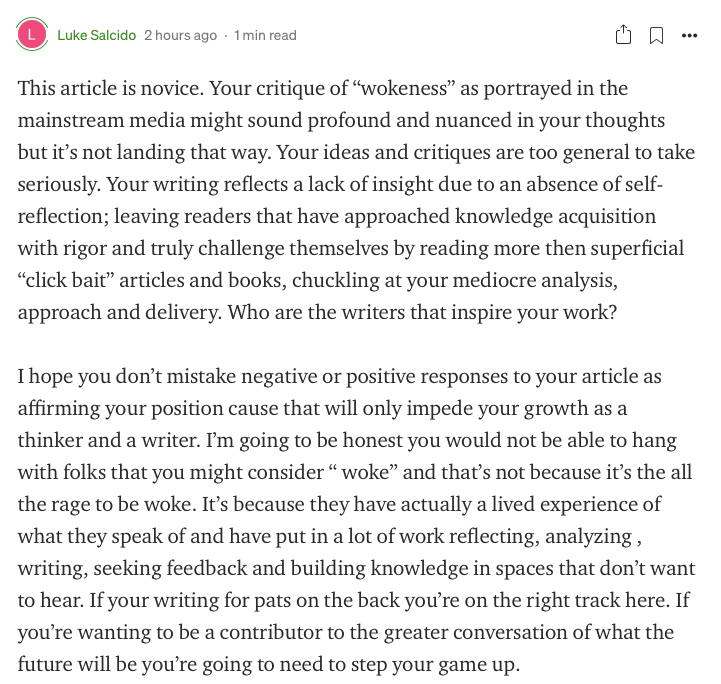
In the spirit of an intellectual post-mortem, let’s see where Luke’s arguments have merit and where they don’t — and see why he was so able to ruffle my feathers. Doing such an analysis was a wonderful piece of learning for me — so, as always, there’s something good to come from these exchanges.
The first four words — how to trigger a Penguin
The first four words set the tone for the rest of the comment and absolutely turned off my ability to read the rest of his comment with anything like a reasonable mindset. The red mist duly descended.
It’s taken me a long time to amass a readership of 2K individuals from across the political spectrum. That fact made these opening words a tough swallow from a man who has written a grand total of zero articles on Medium.
Of course, there’s nothing wrong with not being a writer on Medium and some people come here exclusively for the reading. However, I’d like to suggest there are certain insights you only get if you have skin in the game.
Most of those insights are to do with how to get your work read and re-read. Style and tone baby, style and tone.
I work hard to get a balance of humour, insight and readability into my work. It’s tough sometimes — the snark and social responsibility are often in direct contradiction. A fine line to tread for human writers and I have to waddle it.
I try to impart serious points amongst all the distracting linguistic trickery. Some writers use rhetoric like a sledgehammer and hit their readers with everything all at once. Hard-hitting, blunt and powerful.
My writing should feel Errol Flynn-esque. Plenty of showmanship, running up the proverbial staircase and waving my words around. It looks harmless until you get kicked through the ideological balustrade and get a chandelier to the face.
A rapier can be just as effective as a sledgehammer in the right hands. For that reason, it’s important not to mistake my light-hearted tone and style for a lack of insight and knowledge.
I am many things, a novice is not one of them.
My issue with Luke as the mouthpiece woke
The presumption Luke makes from reading one of my articles is that I have zero lived experience. This is an assumption made without knowing my identity. Based on his initial assumption he inferred I have put in very little work reflecting, analysing, seeking feedback and building knowledge.
That’s a judgment call he’s made. He’s overlooked my decade of working in social care, any insights I got from teaching or that pesky Psychology degree I have kicking around somewhere.
You know what? His belief is fine. If he goes on to read anything else of mine, he might find some of those depths he’s decided prima-facie I don’t have. Maybe what he wants from his Medium experience isn’t the sort of thing I’m peddling. That’s also okay.
So what’s the problem?
Ask any moderate, it should be evident to anyone outside of the bubble Luke is writing from. It’s like he read my article about the problematic nature of middle-class intellectual liberals turning everyone else off — and decided to make my point for me.
The imagery he uses to paint a picture of the woke community is appalling. They sound like a bunch of judgmental ass-hats sitting around in ivory towers pontificating. It’s a club I can’t be part of because I haven’t read enough and they’re too busy ‘chuckling at my mediocrity’ to read my application form.
I’m aware ‘the woke’ aren’t really a set collection of people. It’s more complicated than this simple position, but the subsection of ‘woke’ Luke seems part of is one that I have encountered many times online and in person.
Why would I want to hang around with those people? It sounds like weekend retreats spent reading Derrida aloud to each other whilst engaging in open-minded group masturbation.
Like a filthy Hogwarts, but everyone is a Hufflepuff.
The language Luke uses is exclusionary, I am not worthy of being part of this club because I haven’t thought enough yet. Such a world view presumes disagreement is ignorance rather than a different conclusion based on the same evidence. In short, intellectual snobbery 101.
The insidious ‘I know something you don’t know’ pervades the left-wing and the progressive arm of the left in particular. It turns off moderates because of its dismissiveness and tone. By all means, argue for your worldview — I sure as hell do — but don’t presume it is automatically superior to everything else.
I don’t presume that Jeannette C Espinoza is a blithering idiot who doesn’t know what she’s talking about. I believe she’s drawn an erroneous conclusion about how to solve a problem like racism from her lived experience.
Guess what? She believes I’ve done exactly the same thing.
Thus we maturely conclude neither view is superior, only different. The ensuing discussions on her posts on mine always remain respectful and are often encouraging. More admiration than animosity and there’s plenty of room on this platform for both of us.
We aren’t trying to win, we’re trying to explore. Online dialogue isn’t a zero-sum game.
So what did I learn from Luke?
I learned that he’s probably not the best mouthpiece for an inclusive worldview. Nobody asked him to comment, nobody forced him to express himself this way. If he’s the salesman for woke intellectualism, I’m not buying — and neither, I suspect, are most moderates.
For my part, I learned that the red mist can descend very quickly when someone treats me dismissively — I don’t like being Humansplained. This likely stems from childhood and I’ll speak to my significant other penguin about it.
The last thing I learned? I don’t like being called a novice. Medium writing buys me coffees whilst I write my plays and screenplay. I’m a professional writer by trade and I understand how words work and why you must always be careful with them.
Here’s a free writing tip for you all, from a total novice like what I is. Finish your stories by circling back to something you mentioned earlier. It gives your audience a sense of closure and operates as the linguistic equivalent of a coda.
On that note, you’ll be pleased to know Luke came back.
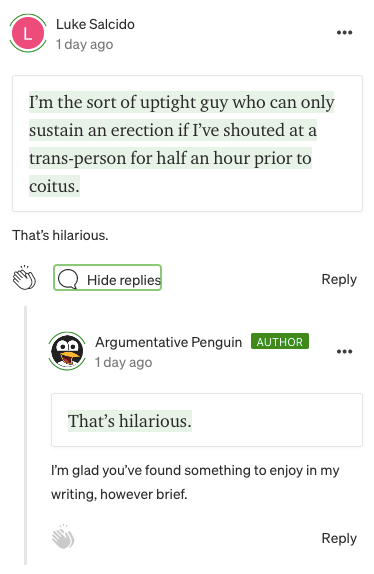
He has a lot less to say this time round — but at least he’s still reading my stuff. Poor bastard seems to have been won over by some of that chandelier swinging, rapier-waving, verbal-showboating I mentioned earlier.
I’m sure he’ll be back to debate the finer points of classic socialism vs identity politics once he’s finished Herbology in the ivory-clad Hufflepuff-Wokeatorium. I’ll wait.
Twiddles rapier. Fade to black over some John Williams with owls
Want to see others in this series?
Bonus material
Luke asked me which writers inspire me and I’ve told you about a few of them in this article.
Read Steve QJ and Cathy Young for the same sort of rejection of identity politics you’d find with me. Read Marley K, Jeannette C Espinoza and Jeremy Helligar for interesting insights into race from the pro-identity politics camp.
Read Elle Beau and Yael Wolfe for dismantling the patriarchy. Read Rev Sherri Heller for all things Psychology, try Joe Duncan and Meghan Daum for the centre-ground white person perspective.
Read George Chambers for the right and Lauren Elizabeth for the left. Give Kyrie Grey a go if you fancy a break from all the serious stuff and if you’re a fan of rapier-style writers you’d probably enjoy Reuben Salsa.
Plenty of others are available and you should always read widely.


