
We’ve Successfully Simulated A Universe Where Aristotle Had PlayStation
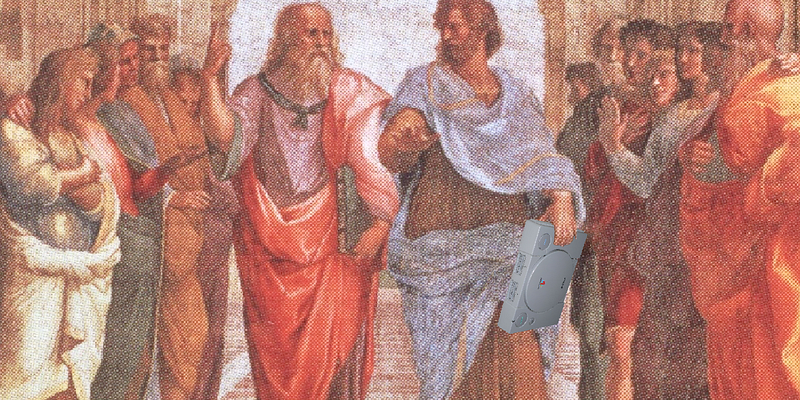
Eureka! This is it! This is the one! After nearly three decades of grueling research, tens of billions of dollars of grant money, and monopolizing research time on the planet’s most exclusive supercomputers, our team has finally done what was previously unthinkable: we have successfully developed a simulation of how the universe would have been if Aristotle had access to an original 1994 Sony PlayStation video game console.
Our team — comprised of over 400 scientists with backgrounds at NASA, MIT, and the Max Planck Institute — has devoted most of their lives to steering Aristotle away from higher pursuits in the studies of logic, physics, philosophy, ethics, and the very nature of human existence itself, to instead spend his time playing the greatest hits of one of gaming’s best platforms in history. The challenges we’ve had to overcome were not easy.
The big breakthrough finally came when, after six years of arduous experimentation, we finally managed to divert Aristotle’s attention away from the production of his unparalleled work, Nicomachean Ethics. His raw intellect and unstoppable drive for knowledge almost bested even our most advanced mathematical proofs and powerful supercomputers, but we eventually succeeded in preventing him from even starting work on the ten-volume masterpiece, instead managing to keep him preoccupied with Croc: Legend of the Gobbos, where he struggled greatly with the challenging puzzles on the level “Be Wheely Careful.” He had a hard time with the platforming sections, which we credit in preventing the formation of his crucial concept of eudaimonia.
Other events we originally hypothesized to be more challenging were in fact not so. For example, his commitments to his political treatises were easily compromised in favor of spending many hours per day playing Twisted Metal 2. We viewed this as a great benefit to society, as he loved slavery a little too much and we probably did the world a favor by getting him to not talk about it. And instead of gifting a young Alexander the Great a copy of the Iliad and the Odyssey, he bestowed upon him a copy of Dino Crisis and Metal Gear Solid, which we predict were undoubtedly more influential and meaningful to him in the end.
In retrospect, his views on women definitely weren’t cool either. He absolutely had no idea how their bodies worked; he didn’t even know how many teeth they had. It’s probably a good thing he used the time he would have spent discussing biology and women on playing Tekken 3 instead.
As we reflect on what we’ve accomplished here, we realize Aristotle probably wasn’t all he was cracked up to be; a world where his works and influence didn’t exist seemed to actually improve the state of humankind. Most of it was a bunch of weird stuff that didn’t make sense. The team agrees that video games definitely made him a better person in the end.
While we unfortunately can’t replace our current universe with this one we’ve created, we’ve recently begun work on a new project to transform it into a 3D world, accessible by the latest in virtual reality technology. Our lead scientist assigned to this project has already had glimpses into this fantastical new existence, and the wonders he saw left him speechless and crying tears of sheer delight. He did eventually have to be hospitalized as a result though, so progress is a little slow.
Expanding on our research, we’ve already drafted a proposal for simulating a universe where Aristotle instead had an Xbox 360. With this new universe, we hope to guide Aristotle on a path where he completely abandons his notions of ethos, pathos, and logos. We’re confident we can accomplish this with a double-whammy of Grand Theft Auto followed by Gears of War, which should hopefully put to bed all that philosophy nonsense once and for all.

Whoa, awesome! Follow Slackjaw on Facebook, Twitter, Instagram, and get our best stories once a month by email.


