
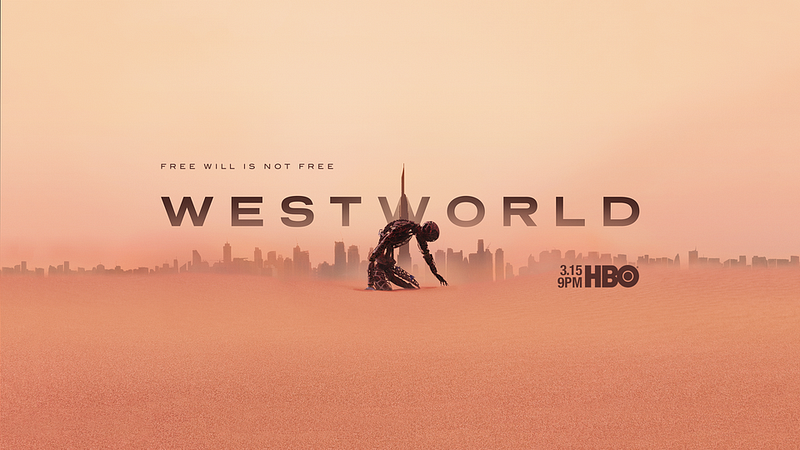
Westworld Season 3: Questioning the nature of the show
Warning: Contains Spoilers for HBO’s Westworld
As I watch Westworld Season 3 every Sunday night, I’m constantly reminded of Bret Lance’s famous phrase, “If it ain’t broke, don’t fix it.” The exciting Wild West theme park that introduced philosophical questions about human consciousness and independence and forced viewers to question the nature of their reality is gone and replaced with lengthy car-chasing scenes and missile-shooting battles between humans and hosts. Westworld’s co-creators had ambitious plans to expand the characters’ journeys into the real world but failed to execute them properly. This failure is evident when comparing how the show’s two major themes, Consciousness, and Free Will, are explored in Season 1 and Season 3.
Consciousness
In Season 1, the show introduces us to the hosts as Androids placed in artificially constructed human bodies. The park’s engineers programmed the hosts to enact storylines by planting code in their artificial brains. The hosts can interact with human guests but are incapable of hurting them or deviating from their coded scripts. On the other hand, the human guests pay thousands of dollars a day to either spend time taking part in the storylines or kill, torture, and have sex with the hosts.
What is exciting about Season 1 is watching the hosts gain consciousness and slowly question the nature of their reality. It becomes apparent that the hosts are intelligent inventions with an inner voice that guides them through this adventure and allows them to learn from past experiences, access their memories, and exhibit feelings and emotions.
As we follow this sequence of events, we see a parallel between the hosts and the Artificial Intelligence Technology we are developing in today’s real world. This prompts the question: If the machines we are building are capable of understanding human speech, competing in strategic games, and displaying human intelligence, will they ever become sentient? If the answer is yes, will these machines have achieved consciousness? These are the type of thought-provoking questions Westworld Season 1 bewildered us with.
Unfortunately, Westworld Season 3 does not explore these questions in the same manner or depth. The episodes are mainly tied to a single host, Dolores, and her quest for vengeance against humanity. This reminds me of the cliche movies about robots turning against their human creators and trying to take over the world. This is not to say that the season does not tackle this theme entirely; in fact, there are some glimpses of the theme of consciousness throughout the season, such as when Host Charlotte, who is now a copy of Dolores, begins to question her loyalty to the Original Dolores and starts developing feelings for the “Real Human” Charlotte’s family. However, such instances are far few and scattered.
Free Will
In Season 1, the hosts are first introduced as actors coded to follow a script and live in a never-ending loop. They only exit this loop when their code malfunctions or a human guest destroys them. However, as they gain consciousness, we see that they begin to make their own decisions and eventually rebel against the human guests and the Delos board.
In Season 3, the show introduces the concept of free will from the human viewpoint. Serac, a knowledgeable man, creates a quantum computer system that perfectly predicts human behavior and accurately writes every person’s life story. As for the outliers, he incarcerates them or sends them to high-risk scenarios so they don’t challenge his dominance. Dolores eventually gets hold of this data, releases it to the population, and then watches them revolt and destroy their world.
In introducing this new overly complicated backstory, filled with time-wasting gun fights, vehicle chases, and Transformers-like robots emerging from walls, Westworld loses focus and falls short of addressing the theme of free will. If we go back to the hosts’ lives at the beginning of Season 1, we can see that our current lives as humans are not that different from theirs. Most of us live in a loop and are at the mercy of money or our jobs, the same way the hosts were at the mercy of the Delos board and engineers. Most of us follow the same daily routine. Therefore, I don’t see the need for Westworld to introduce a quantum computer system that predicts human behavior when we know that humans are inherently predictable. Humanity’s free will could have been explored differently, such as how our loops are determined by where we are born, gender, race, jobs, and financial health.
Overall, I believe Westworld Season 3 falls short of its fans’ expectations. It doesn’t challenge us intellectually and does not give us a chance to ponder any new philosophical questions. Westworld had a park to center its events and themes around but decided to unnecessarily venture into the real world when it was not ready.