
Were You “Designed” by an Artist? What the Sub Atomic Has to Say.
The “building block of life” may hold the key to the concept of a ‘Universe of Design.’

What if your life is more than a random series of disconnected events? What if YOU are more than a mass collective of disparate chemicals and matter? What if, instead, you are actually being “painted” into a grand artistic masterpiece with as much intention as any master painter would evoke into their favorite work of art?
What if you are — a living “masterpiece?”
Now, whether or not you believe in some sort of Providential “painter”, can we all agree that it’s at least an inspiring metaphor?
What if the answer to these “Masterpiece” questions is more than metaphorical?
What if it is a– scientific reality?
WHAT SCIENCE SEEMS TO DECLARE
Science, especially reductionist science, asserts that while we may discover interesting, seemingly “designed” components in the physical makeup of the universe, it is all just random chance. There is no inherent or connected purpose to our world or to human existence.
This not only conflicts with the thought of you being an “artistic” masterpiece, it also often “cheapens” the value of life significantly. At least Christopher Hitchens was honest when he stated:
“I’m here as a product of process of evolution, which doesn’t make very many exceptions. And which rates life relatively cheaply.” Christopher Hitchens
Moreover, so as to completely invalidate inherent “design,” any observable scientific discovery cannot cross from one domain to another. Consider this statement on ‘Scientific Reductionism’ from Wikipedia.
While it is commonly accepted that the foundations of chemistry are based in physics, and molecular biology is based on chemistry, similar statements become controversial when one considers less rigorously defined intellectual pursuits. For example, claims that sociology is based on psychology, or that economics is based on sociology and psychology, would be met with reservations. https://en.wikipedia.org/wiki/Reductionism
To the reductionist, scientific domains do not interconnect. How could they? There is no inherent design, therefore there is no inherent pattern. Now, for the rest of us non-scientists, it shouldn’t be too difficult a stretch. After all, when you were in high school you probably didn’t really care about the difference between chemistry and molecular biology? They were seemingly similar, right? Yet, there is little scientific “support” for their inter-connectivity. And scientists are certainly the smarter ones.
THE CONNECTION OF OPPOSITES?
But what about completely disconnected, nearly opposite domains. Like Physics and Art?
One lies in the domain of structure and order, the other in the ethereal and esoteric. One is predominantly observable (natural physics), the other is completely subjective (the artistic). One is mostly processed through the left side of the brain, and the other through right. They can’t have congruent connected threads, can they?
And…
If there is observable design at the center of existence, what does that say about reductionist science, or “naturalistic” science in general?
For that matter, our forms of art are nebulous in themselves. We can paint, sculpt, film, draw, etc. — use whatever creative outlet we chose. Most every piece of art — and most every artist — is unique. That’s why some people prefer Monet over Pollack, or Roy Lichtenstein over Edgar Degas.
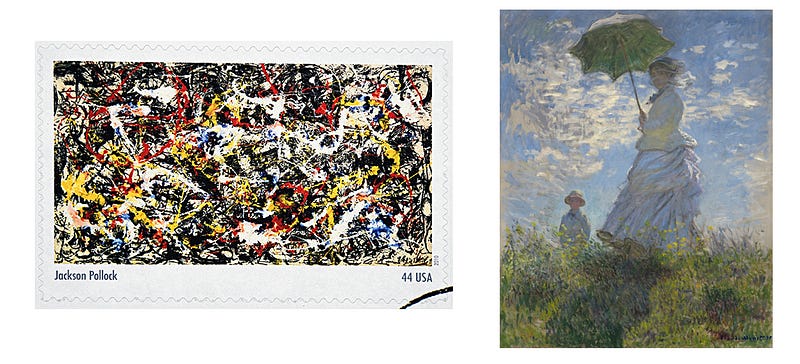
But there is one constant and contiguous thread through all observable art.
COLOR.
From paint, to pottery, to photography — we design, draw, paint and film in color. Even Black and White still operates on the same color spectrum. The baseline component to all observable, esoteric and diverse art is color. All visible color is processed through Red, Green and Blue — or what you might know if you work on computers, as: RGB. The color spectrum looks like this:
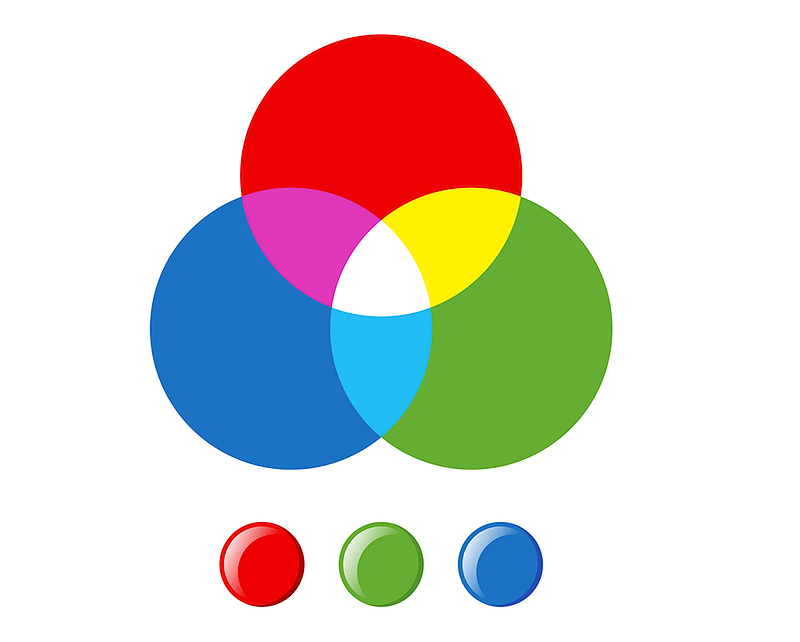
Let’s leave that esoteric, subjective domain for a second and go back to the rigid structure of science.
THE WONDER AND OBJECTIVITY OF PARTICLE PHYSICS
In the same way that the artist crafts everything around color, the universe crafts everything around the atom. Everything you see, touch, and with which you interact: from the last apple you ate, to the chair you just sat on, to the car you recently drove are made of atomic particles. How they combine determines if a substrate is metal, wood or plastic, or any other material or feel. The atomic determines the makeup of everything, from the mountains, to the trees to the oceans — to you.
We could say that as the artist uses COLOR as the foundational starting point to all visual artistry, the universe uses the ATOM as the foundational starting point to all physical matter. It is was an S.A.T. test, it might read:
COLOR is to the artist as THE ATOM is to the universe.
WHAT IF THE ATOMIC COMBINED WITH THE ARTISTIC?
What if at the most fundamental foundation of physical existence, you found design? Not mechanical design, or chemical design. But instead, you discovered the building block of all artistry (COLOR) at the center of the building block of all matter (ATOMIC)? What would that mean?
This highlighted passage on the QUARK is simply from a book on color theory.
The Quark “It seemed the mysteries about the atom had all been uncovered. Then in 1963, the American physicist Murray Gell-Mann finally discovered the basic building block of all atomic nuclei throughout the universe, the quark. The quark has been a particularly important discovery about the atom, especially to color theorists. The smallest of all provable particles resides between the proton and neutron structure as bundles of quarks. Each bundle is referred to as a baryon (baryon wrapper), which contains one quark each of red, blue and green. Just as it is with the additive color primaries, the three quarks when combined together create white light. At last the source of color is found in the smallest particle of the atom…” an excerpt from Color Choreography: Alan McManus Burner
Vocationally, I am a graphic designer and owner of a branding and design agency. As an artist, I work with color all day. You may be an artist as well, or at least have certainly used your phone to shoot a selfie or two. Digital and traditional Photography is processed in red, green and blue (RGB). All of our selfies, our photos of the majesty of the ocean, the color depth of a field of flowers, is processed in red, green and blue. The beauty of all visual art is realized through three colors: red, green and blue, like I showed above. Now, let’s look at both the RGB color spectrum and a visual representation of a baryon wrapper, the smallest known particle in the atom that comprises everything.
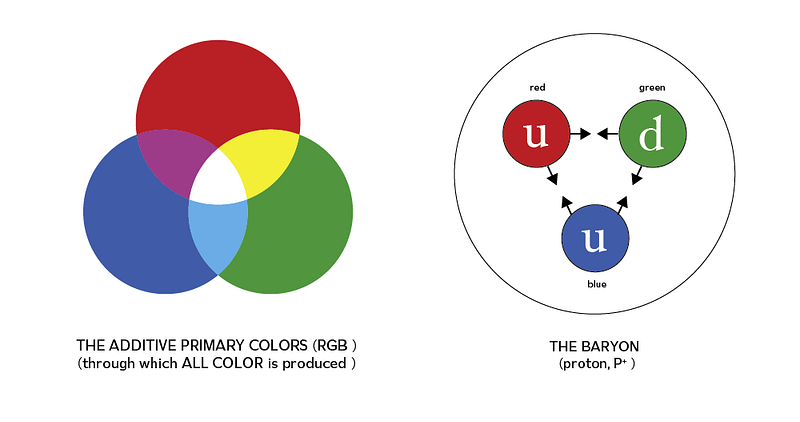
The same three colors that form the basis of art, are the same three colors (which create white light) that formulate all of physical and material existence. Do you see it? At the foundational level of everything that has been created, from the expanse of the universe, to the vastness of the mountain ranges of Yosemite, to the majestic force of the oceans– to you… is…
ART.

BACK TO MY OUTLANDISH FIRST QUESTIONS
Let’s go back to my first, seemingly subjective if not outlandish question:
“What if, instead, you are actually being “painted” into a grand artistic masterpiece with as much intention as any master painter would evoke into their favorite work of art?”
At the most fundamental level of the smallest sub-atomic element to be discovered… is art. The statement above is more than just a great metaphorical question: We could, in conception, conclude that we were “designed” by a Master Painter, not metaphorically, or theologically, but scientifically. Or, more spectacular, we could conclude that your supposedly random existence is being played out inside of a living painting.
Existential design may not be random, chaotic, and devoid of purpose. It may be more than mechanical. It may be far more creative and artistic than previously considered. We’ve been taught to trust science over the philosophies, over the artistic, over the religious. Science claims that there is no cosmic purpose and no inherent design to life, the universe, and even history itself. Science may have proven itself wrong. As my favorite singer songwriter, Jack Johnson, sung:
“We don’t need to find reason, Because out the same door that it came, Well it’s leaving, it’s leaving.” Jack Johnson from the song, ‘No Other Way’
While we still may question the concept in religion and metaphysics, scientifically, now, you can call yourself a ‘living masterpiece.’
Live inspired.
Here a video of this talk: