
APOCALYPSE PORN
We’re On Track For The Global Collapse Predicted By The Club Of Rome In 1972
I love it when a plan comes together

When I was in grade school, some tie-dyed tree-hugger of a teacher thought it would be fun to teach little kids about the infamous 1972 Club of Rome report The Limits To Growth. The report predicted the upcoming end of human civilization and scared the shit out of pre-pubescent me, who’d previously only had to worry about nuclear annihilation.
If you’re not familiar with the report, MIT researchers used data modeling to predict a high probability that if society continued to pursue unrestricted economic growth, pollution and over-exploitation of resources would lead to economic and social collapse by around the mid-21st century.
You know, the century we’re twenty percent of the way through right now.
Now there’s been an update to this report, and it’s not good news.
In the new research (published in Yale’s Journal of Industrial Ecology), Gaya Herrington, Sustainability and Dynamic System Analysis Lead at KPMG, leveraged previous updates and current empirical data to determine the accuracy of the original modeling, and where we stand today.
It turns out the original models were shockingly accurate, and where we stand today is at the edge of the environmental abyss shouting “Fuck you!”, then giggling when the echo comes back.
Scenarios — from worst to best
BAU: The original report postulated a number of scenarios, including business as usual (BAU), where economic growth continued as it always had. Under this scenario (bolding mine):
If the present growth trends in world population, industrialization, pollution, food production, and resource depletion continue unchanged, the limits to growth on this planet will be reached sometime within the next one hundred years. The most probable result will be a rather sudden and uncontrollable decline in both population and industrial capacity.
Population growth is finally halted by a rise in the death rate due to decreased food and medical services. The Limits to Growth
Herrington’s analysis found that a modified version of this scenario is one of two with which our current trajectory is best aligned. BAU2 doubles the amount of available resources versus BAU but predicts a collapse due to pollution/climate change instead of resource scarcity. It looks like this:
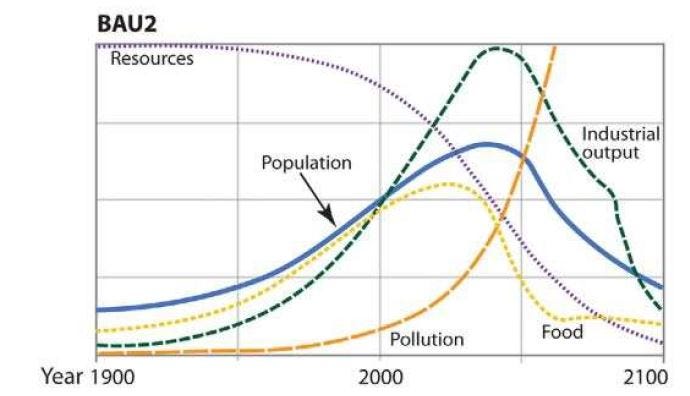
Note the direction of the population curve from around 2040 on.
Whoops.
CT: The other scenario we’re tracking closest to is comprehensive technology (CT) which “assumes a range of technological solutions, including reductions in pollution generation, increases in agricultural land yields, and resource efficiency improvements that are significantly above historic averages.“ (The Limits to Growth)
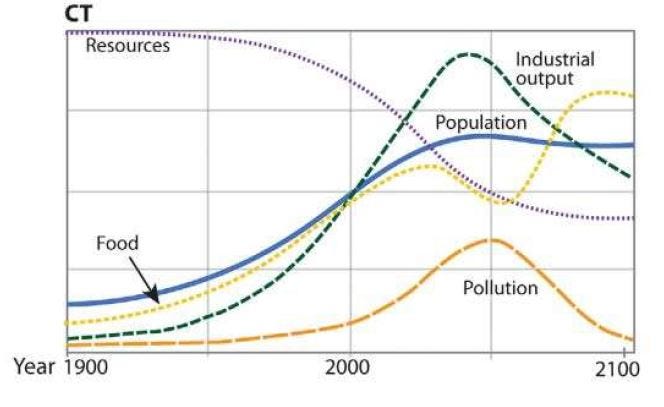
In this case, the graph shows a large decline in industrial output, i.e. economic decline and possibly collapse, but not mass death. So glass half-full, I guess.
SW: The only scenario which didn’t show a likely collapse is stabilized world (SW), which assumes that in addition to magical technologies, we see “a change in values and policies translates into, amongst other things, low desired family size, perfect birth control availability, and a deliberate choice to limit industrial output and prioritize health and education services.” (The Limits to Growth)
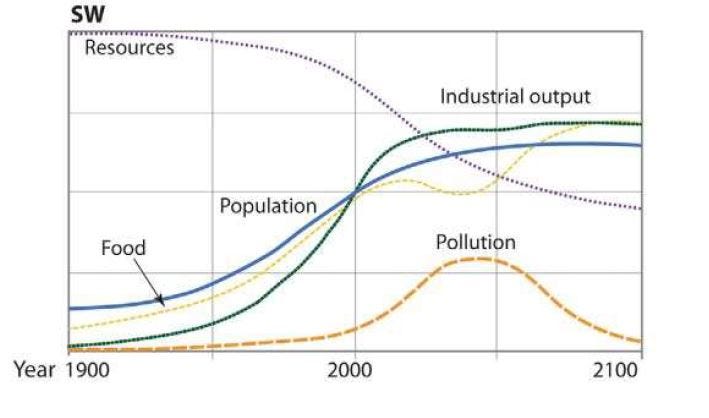
Since Covid has demonstrated that a sizeable percentage of people in the world’s largest economy refuse to contemplate even the slightest inconvenience to save their own and their neighbor's lives, we can probably take this option off the table.
Climate change
Where’s the climate crisis in all this? It was barely a glint in Al Gore’s eye in 1972, and the original LtG report only makes one brief reference (bolding mine): “If man’s energy needs are someday supplied by nuclear power instead of fossil fuels, this increase in atmospheric C02 will eventually cease, one hopes before it has had any measurable ecological or climatological effect. (The Limits to Growth)
Whoops again.
As noted above, the BAU2 assumes that pollution is a key driver for societal collapse, and greenhouse gases are an element of that. Herrington uses CO2 concentrations, along with plastic production, as proxies for overall pollution data. Whether this will accurately reflect the vast unknowns surrounding climate change and its potential tipping points remains to be seen.
Endgame
Herrington states it pretty clearly when she says “both scenarios (BAU2 and CT) thus indicate that continuing business as usual, i.e., pursuing continuous growth, is not possible.”
Not something we shouldn’t do, but something we literally we will not be able to do. If we don’t make the choice to stop being the planetary cancer, the decision will be made for us.
While Herrington projects the mandatory optimism at the end of the report, saying that we can still avoid decline by prioritizing social change rather than relying on technology, she notes that “the window is closing fast.”
I’m personally skeptical that we can pull ourselves out of the literal and figurative fire. What’s needed now is a global scheme of unprecedented scale and cost, to reduce not just carbon emissions but all types of pollution. People have done this before — DDT, CFCs — so it’s possible. But right now, it ain’t happening.
Wish us all luck.
Here’s more scary stuff: