

We’re Getting Maslow’s Hierarchy of Needs All Wrong
And it’s crippling our ability to be happy
It’s becoming clearer to me every year that due to the excesses of modern life, our ability to become a happy, healthy, fully actualised human being is going to depend on saying no to a lot of what is on offer in the 21st century. We have to bring ourselves back to the most important things in life, which are foundational to happiness and have nothing to do with what we’ve been told by advertising is important.
I’ve heard experts in the media talk about Maslow’s hierarchy of needs for a long time, and the fact that because of the society we’ve built, we are by default no longer at the bottom because our basic needs are met by farming, manufacturing, supply chain and cities. That we can naturally gravitate to the top because all of those things are handled for us.
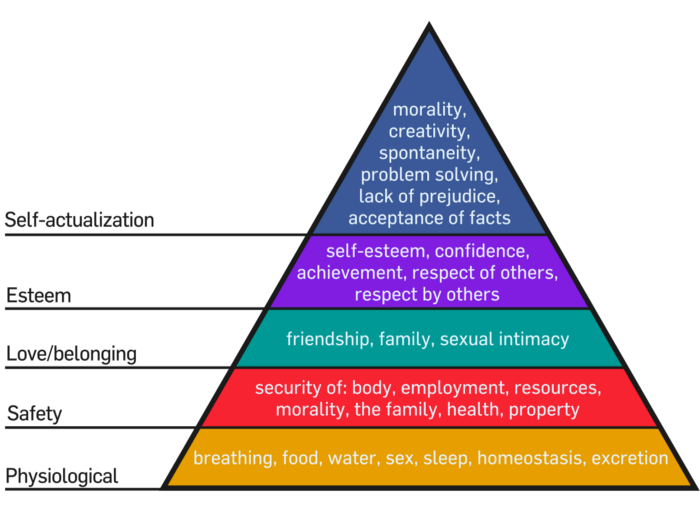
Here’s the thing though, I think that’s actually a false assumption. I say this because the narrative is always along the lines of “because our society can take care of this, that part of the pyramid is fulfilled.” There’s a huge problem with that line of thinking.
Just because those needs can be met by society, it doesn’t mean that they are being met by the individual.
Look at those physiological requirements on the bottom. Sure, they’re easily attainable for anyone living in a developed country, but tell me:
- What percentage of people get enough activity day to day?
- What percentage of people get enough sleep?
- What percentage of people eat enough of the right foods?
- What percentage of people get enough sunlight?
- What percentage of people have a healthy sex life?
Hunter-gatherer tribes are adulting better than many of us
The people of the Hadza tribe, who have no possessions and don’t even have a home, are doing better on the base of the hierarchy than most people in the developed world. The directness of their life means that they don’t overeat, they sleep as much as they need to, they drink water instead of soda, and they have strong, in-person relationships.
Now, they may not have things like food security, resources, property etc, but if you look at that pyramid, the things they do have, they do better than a lot of people in developed countries. Judging by everything I’ve seen of them, they’re quite a bit happier than we are as well. They sure as hell don’t have rampant mental health issues like anxiety and depression.
That’s because their directness of life forces them to take care of those bottom levels. Their lack of technology means that they aren’t concerned with things like social media clout, career progression and keeping up with the Joneses. They eat what’s available to them in nature. They form relationships as humans are supposed to. In short, those bottom two rungs are very well taken care of for the most part.
I don’t say this to romanticise tribal life, because it’s a brutal existence where every meal has to be hunted or foraged, you’re directly exposed to nature all the time and any infection could be death. They don’t have any of the luxuries we do — they can’t even do something as rudimentary as reading because, do you see any printing presses out in the wild?
That said, our problem is that we put those bottom levels on autopilot rather than taking care of them properly. We assume that we can just skip levels and look higher up the ladder, trying to garner attention, recognition and achievement rather than really taking care of the basics first.
I think that’s a tremendous mistake.
The Sunday night crisis
Tell me, how many times have you felt depressed on a Sunday night? You have the typical existential crisis because you don’t want to go to work, you’re so much better than your job right now, you wonder what the hell you’re doing with your life, why you haven’t achieved your goals and so on.
How often does that happen simply because you were out too late on Saturday, you had too many drinks, you barely slept and now you’re hungover as shit. Do you think you’d be having that same crisis if you’d gotten a good night’s sleep, eaten well and had a relaxed (not hungover) Sunday? Not bloody likely.
That’s the issue. We’ve become so accustomed to looking up the pyramid, whether it’s excelling in our career, becoming enamoured of things to buy, trying to gain notoriety or keeping up with the Joneses that we’ve disregarded our basic needs. And when you forget about your basic needs, you become unhappy, because the platform that you run on — your body, isn’t getting what it’s supposed to.
We’re also bad at socialising
It’s ironic that social media has taken human interaction and completely fucked it up. What people in a tribe understand on an intuitive level is that if you want close relationships, you have to put in time. You have to listen to people, you have to show them that you have a stake in their happiness and success (whatever that means to them).
- Friends aren’t followers or likes on a social media page.
- Friends aren’t just people that you get drunk and share good times with.
- Friends aren’t people you just text with all the time.
The amount of people on social media that talk about having social anxiety, that can’t imagine talking over the phone, who resent going to work in an office with other people is absolutely staggering. It baffles me that no one seems to be ringing the alarm on this, because it’s not just something we should accept as the new “normal.”
It’s not your fault
The problem with humanity is that we’re always a double edged sword. We understand so much (and probably so little) of our psychology now, but for every therapist using that to help people, there’s a marketer using it to make you want to buy more stuff. For every software engineer out there programming a surgical robot to improve people’s lives, you’ve got 10 working for Facebook to make you more addicted to their platform.
This is where we come back to my opening paragraph: happiness is going to depend on saying no to most of what is on offer in the 21st century. Everything on offer that turns the bottom of the pyramid into convenience replaces those necessary conditions them with a mere shadow of the real thing. That’s why social media is so unsatisfying compared to real friendships. That’s why fast food doesn’t fill you up compared to fresh food.
I think the reason we put the items at the bottom on autopilot is because we believe that the top of Maslow’s hierarchy will make us happier, when the reality is that it’s the opposite.
I see it as an equation where once you take care of the bottom properly, the top will follow. You’ll move up the pyramid as a natural course. If you don’t, you’re building your house on a foundation of quicksand. Whatever success you have higher up the ladder is going to be sabotaged by the fact that you haven’t taken care of those bottom levels of health and relationships.
Final takeaway: make sure you prioritise your time appropriately
Ensuring the bottom of the hierarchy is taken care of actually takes a lot of time, and we mistakenly think that preparing meals, getting enough exercise, seeing family and so on takes too long. That it’s an inconvenience. We think other things should take priority, so we take shortcuts. Or we think that if we just get that promotion and better pay, then we’ll have more time and we can take care of those things.
That’s the wrong way around. If you spend the time necessary to take care of each level starting at the bottom, every day is going to feel better, and you’ll ascend as a matter of course.
So maybe it’s time for us to stop rushing to the top. It’s time to say no to the distractions and get back to the fundamentals of life, which advertising would have you believe don’t matter because you can buy the latest status symbol instead. When the people in a tribe with few possessions who have to fight for survival every day are happier than people in the developed world with everything, it’s clear that we need to humble ourselves and ask “how can we be more like them, and less like us?”