
We’re All the Same When the Lights Go Out
A national celebration in France’s forgotten South
The days are relentless
Like France, like Canada, like America, I was born in the summer. But I wasn’t born here. The sun is downright hostile in the spire of July, the topmost glittering needle of summer. The ecstatic buzz of the cicadas makes it sound like the sidewalks are sizzling.
In English, we call it Bastille Day. In France, it’s La Fête Nationale. The day when the citizens of Paris stormed the prison that had become the symbol of a despotic king’s power to imprison anyone at any time for any reason. Almost immediately, while the fires of the revolution were still burning, there were plans to make this a national holiday. And now, in the dog days of the Fifth Republic, July 14 is the day when France celebrates her birthday.
Unsurprisingly, the biggest celebrations happen in Paris, where the troops parade under the Arc de Triomphe and the jets roar overhead, trailing plumes of red, white, and blue. It’s Europe’s oldest and biggest military parade, befitting what, jokes about surrender aside, has been Europe’s dominant military power on and off for the last thousand years.
You can’t get much further from Paris than Port-la-Nouvelle without leaving mainland France completely. And it’s Parisians who get the most disdain from the locals when the tourists come every summer to the seaside town.
But the summer sun shines on every French person, and even those of us who find ourselves here almost by accident. Those who can’t speak the language and don’t understand the culture but are at least willing to learn. Today, July 14, we’re all French.
I’ve never been keen on patriotism
It’s never made much sense to me. Maybe because I have a deep loathing for the country where I was born. Maybe because I can’t believe in being proud of anything you had no control over. The line between patriotism and nationalism is perilously thin. It doesn’t take a great leap of logic to go from thinking your country is great to thinking it’s better than any other.
And in France, they do. Cultural chauvinism is a national trait. The stereotype of French people being rude is absolutely untrue and unfair and reflects more on the people who make the claim that it does on the people they say it about. But the French do genuinely believe that every other country is doing it at least slightly wrong.
Grudgingly, in a moment of vulnerability, you may get them to admit that Italians make some pretty decent wine. In the multiple cheese aisles of any hypermarket, you may find a tiny half-shelf devoted to English cheddar. Everybody knows that the Japanese and the Germans make the best cars. But that’s about as far as it goes. When it comes to food, language, literature, music, and of course wine, no one else quite measures up. And after all, these are all the things that matter.
And no matter my own feelings on patriotism, I will concede the superiority of the French Fête Nationale. England, the country where I was born, has a national day that commemorates some bullshit saint who may have never existed and certainly never set foot in England. We’re just lucky it’s also Shakespeare’s birthday.
Canada, a country I have far more affection for than England, commemorates the signing of some boring treaty. I like that France’s national day is based on storming a prison. I like living in a Republic won by blood, the best kind of blood. Someone else’s blood.
The nights are a little better
Not cool, by any means. But cooler. The sun takes forever to set, but you know it’s time to head out when the wings of the mosquitoes begin to whirr.
Brake lights glow all the way to the sea. On Avenue de la Mer, unsmiling policeman stand behind temporary concrete barricades, directing traffic away from where the party’s happening. But on a bike, I can whizz right past.
The town’s population explodes in summer. Nine weeks paid vacation each year isn’t uncommon in France, and it needs to be spent somewhere. The restaurants along the beach are packed, the servers running from one table to the next, balancing silver trays piled high with glasses in each hand. The bright lights of a fairground shine out against the encroaching darkness, the deafening rides and rigged games of chance making pupils contract against a wall of blaring neon.
A band has been hired. Several, in fact. The main stage of the town is filled with dancing girls and singers and musicians belting out Francophone songs the crowd can sing along to. But further down the boulevard, other artists sing their little songs to crowds that appreciate the effort.
Everyone smells incredible. No one comes out in this heat without anointing themselves in some kind of potion.
Everyone’s wearing their best. The heat makes it difficult, but France is an etiquette society, and dressing correctly is just good manners.
The young people of the town have appeared, the teenagers to whom this place must seem intolerably dull, and the promise of a fireworks display is a welcome reprieve from the grinding boredom of visiting family. A chance to see and be seen, for the boys to impress with exuberance and physical courage, for the girls to toss their hair and pluck at their dresses and pretend they don’t notice a thing.
Up and down the pavement, the people of the town stroll. Taking in the music and the ever-shifting light, watching the sky change from bright ceramic baby blue through what my Midlands upbringing would call Wedgwood to an oceanic evening shade that lets the stars burn through it.
The same sensations exist here that you’ll find in any crowd. The sense of familiar wonder at the way life passes through us like a wave of the whispering sea. Grandparents fading as grandchildren grow, the whole world moving impersonally and beautifully with no hand to guide it.
But the fireworks will start soon.
I make my way to the beach. The sand is soft and deep, dragged over every morning by bulldozers employed by the town. Families and old couples and young lovers are dotted like shed shells across the sand, each maintaining a distance dictated by etiquette, not law. This is the first Fête Nationale without health restrictions in a couple of years, and everyone is desperate to enjoy it.
In England, there’d be violence. In Canada, they’d charge admission. Everywhere in the Anglosphere, the beach would be littered with overpriced plastic cups of beer and the detritus of drunks. But there’s none of that here. The kids and the teenagers and the middle-aged parents and the white-haired grandparents mingle and mix on the sand, all with the exact same right to be here, all eager to share something innocent, something beautiful, something free.
The palm trees sway in the breeze. On the last street before the ocean begins, the streetlights go dark. The crowd cheers when the lights go out. While satellites sail overhead, we’re still impressed by the dark.
We’re here for spectacle. For the things the TV and the Internet can’t give us. For the unspoken community of seeing something together, the silent anonymity of the movie theater, the communal solitude of church.
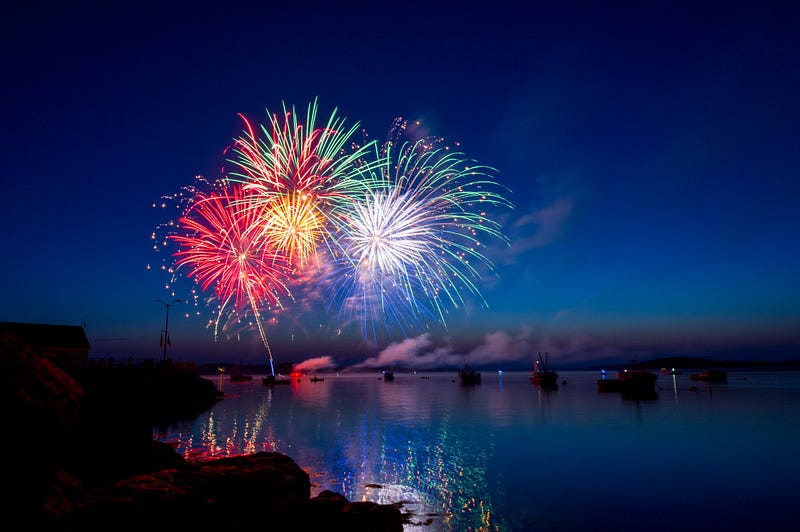
And shortly after the streetlights go out, the fireworks climb the sky.
There’s no music. No Marseillais blasting out of the loudspeakers to make everyone clutch their heart and sing at the sky. The French may be patriots, but they’re not that kind of patriot. Real love doesn’t need to make a show of itself.
But the fireworks explode in the sky the way they’re supposed to, their fading trails echoed by their reflection on the sea. And the crackle and hiss and bang of explosions bounces back to us from the houses and restaurants of the town, half a second too late.
No one holds up a phone to take a photo or video.
We all simply sit, and watch.
And when the display is over, we rise from the sand to return to our homes. Young couples race to bed together. Parents carry sleeping children on their shoulders. Seniors help each other slowly up the sand-strewn steps from the beach, and no one complains that they’re taking too long.
Two hundred and thirty three years since the very first Bastille Day, and now there are no more kings left to topple. No more walls left to storm. Just a shared experience to remind us that as different as we are, we sing the same songs in a different key.
The flags and the kings and the parades change. The toothed wheels of history grind us all into dust. But for now, here we are, shuffling along the sandy sidewalk, exhilarated with the feeling of having shared something after so long apart.
What else is a country for?
© Ryan Frawley 2022
All proceeds from this article will be donated to Doctors Without Borders/Medecins Sans Frontiers.