
We’re All Pieces of Each Other
“Everytime You Go Away” by Hall and Oates
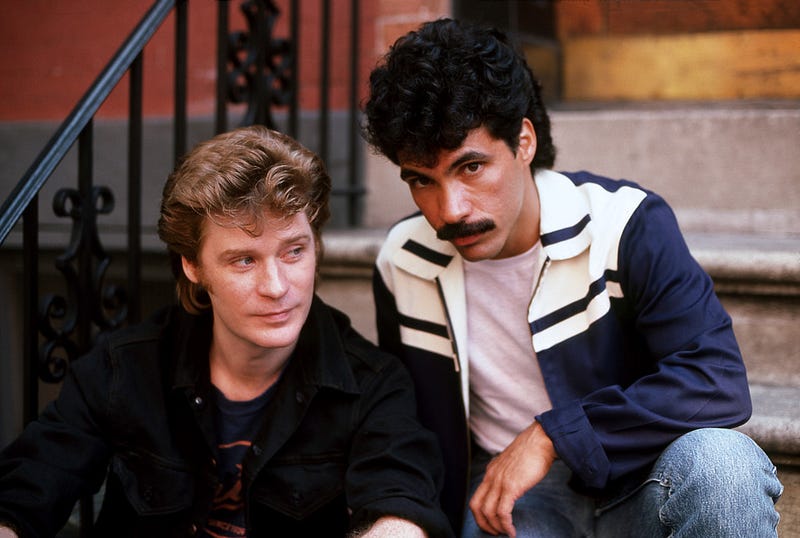
Hall and Oates are one of, if not my favorite artists to this date. They’re an 80s rock & roll duo who prefer to be labeled as a soul group more than anything. Their roots from Philadelphia that boasts the emergence of the blue-eyed soul genre is a testament in itself.
The duo has been named as one of the most prolific in the history of duos, hand in hand with groups like the Everly Brothers and the Righteous Brothers. Unlike those duos, however, this duo has stuck together to this day, briefly parting ways over the years to give space to their respective creativity.
Their songs are filled with so much depth and context that it could take ages to sit down and hear the story behind creating each one, from lyrics to melody to production. They’ve always been experimental.
More than their songs, however, when one comes to study their personalities through interviews, they’ll appear as nothing less than humble and kindred spirits, which would explain the low profile they’ve usually kept. No extreme publicity, headlines or gossip. Just pure, unfiltered talent for their fans to enjoy.
One of my favorite songs of theirs, as hard as it is to choose, is called “Every Time You Go Away.” This is a song that was originally written by Daryl Hall of Hall and Oates, but later pursued by Paul Young, another prominent 80s singer. While Young’s version is well-known, Hall and Oates’ original version might be less so. This isn’t a surprise as songwriters tend to be underrated when it comes to their own songs.
But the original version has a certain level of personal touch to it that you can’t bypass. You can hear the hurt and longing in Hall’s voice, which is present in almost every song he sings. Rarely do you get artists who open up themselves so vulnerably; so raw. Part of what makes artists connect to their fans are their stories, and those that we can relate to the most are the songs that eventually stick to our playlist.
The story of “Everytime You Go Away” is one of a person in pleading. He’s pleading for the return of a partner who appears to be leaving him often, whether it be physically or emotionally. At least that’s how I interpret it.
So, as I lay there in the dark hours of night, with nothing but the crickets putting on their own show in the background, I skim through the songs on my playlist and click on this one. I close eyes as I usually do when indulging in my favorite music and start drifting off.
Hey! If we can solve any problem Then why do we lose so many tears
Love is one of the most complicated feelings to exist, ever. I think the main reason we treat it as such is because it’s easy to forget that we are, after all, the embodiment of love. Whatever we do in life, we are actively taking part in loving those around us. Whether we realize it or not, we live for, and therefore love others, on a constant basis.
I can’t go on sayin’ the same thing ’Cause baby, can’tcha see, we’ve got everything goin’ on and on and on
Love, to me, seems to be this loop that we unknowingly take part in. But sometimes, just sometimes, we remove ourselves from the image of that loop. We view the loop from an external viewpoint and thus feel we don’t deserve to be in it; all whilst still being in it.
Before we love others, we must love ourselves. It is the only way to keep that loop going. The same way we can’t expect a wheel to spin without us turning it, we can’t expect love to turn up for us when we haven’t turned up for it.
So when we do enter a relationship with another person, and are forced to offer away some of that love, we have to give a piece of ourselves to them. They do the same with us, and when we’ve depended on giving for so long, we start to feel as if we are losing ourselves. Then come feelings of confusion, disagreement, and eventually breaking that bond.
Throughout my life, I’ve been infatuated with various people. I’ve felt surges of connection, ecstasy and just about every feeling that comes along with taking a liking for someone. But would I call that “falling in love”? I don’t know.
None of the people I’ve felt an immense level of liking for has stuck along, which may say something about the nature of love. When we like someone, we want to receive every good aspect of them we can pinpoint, and when it’s time to deal with the reality of their character that may not have been present earlier, we may not be so interested.
It isn’t shocking, therefore, when people say that love is blind. Because it literally is immune to every aspect we would get turned off or run away from at the first instant if it weren’t for it. If it weren’t for wanting to genuinely give, rather than receive. When two people who are willing to give on an equal basis click, that may be what I call magic.
Every time you go away you take a piece of me with you
Each time I’ve fallen in “liking” with someone, I’ve offered parts of myself that were not met with equal parts from their behalf. This led to an imbalance and feeling that someone quite literally owned a piece of me, that was eventually taken when they left.
When you’re in a relationship with someone, it’s almost as if one part of your heart meshes with one part of their heart, forming a new heart. The remainder part of your heart should be spent loving yourself, while also being accompanied by the other’s remainder part. Two hearts combined.
But when one half of your heart (the one that needs to be loved in turn) is not being loved by the other half of your partner’s heart, then it cannot be love. Love on one part, perhaps, but still unrequited.
Looking at the pieces (Every time you go away) Be careful (You take a piece of me with you)
Love is as sensitive, vulnerable and emotional as no other sentiment. I am confident enough to admit that I have not experienced love as what it should be — as what I know it should be — for a heart that loves deserves to be loved just as equally. That is the great balance of love.
When people say that true love is loving another without expecting anything in return, I agree, but to a certain point.
Going back to the example of the two halves of one heart, if you spend one half loving another and one half loving yourself, then what part remains for the other person to love? It’s almost as if you’re giving yourself without offering the other person the chance to love you; those parts of us that we need others to pinpoint and appreciate in us. For it makes us human, and if anything, makes us feel that love is worthy of being loved back.
Thank you for reading.
Angelina Der Arakelian


