
We’re All Just Diamonds In The Rough
Imagine you’re going to an art gallery. The exhibition is called “Unfinished.”
In the lobby, Schubert’s Symphony №8 of the same name swells in the background. You get your ticket and enter the first room. The strings mount into their first crescendo, and there she is: The Mona Lisa. Well, the Mona.
Because Lisa is still kinda missing. You can see her shape, her arms, and her hair, but only half her face. Only half of that mysterious, enchanting smile. The backdrop isn’t done either. A blurry mix of blue, brown, green, and grey.
In the next room, van Gogh’s Starry Night feels off too. There’s a town and a tree, but where are the stars? Where’s the brightly lit crescent moon? Where are the swirls and the clouds that make you feel dreamy and moved?
A little confused, you continue to make your way through the exhibit. Dalí, Monet, Picasso, they’re all there, but…their paintings aren’t done. Slowly, it dawns on you. This isn’t about up and coming artists. It’s about you.
The sole purpose of the exhibit is to show you: Once upon a time, everything was unfinished. Even the world’s greatest masterpieces. And so are you.
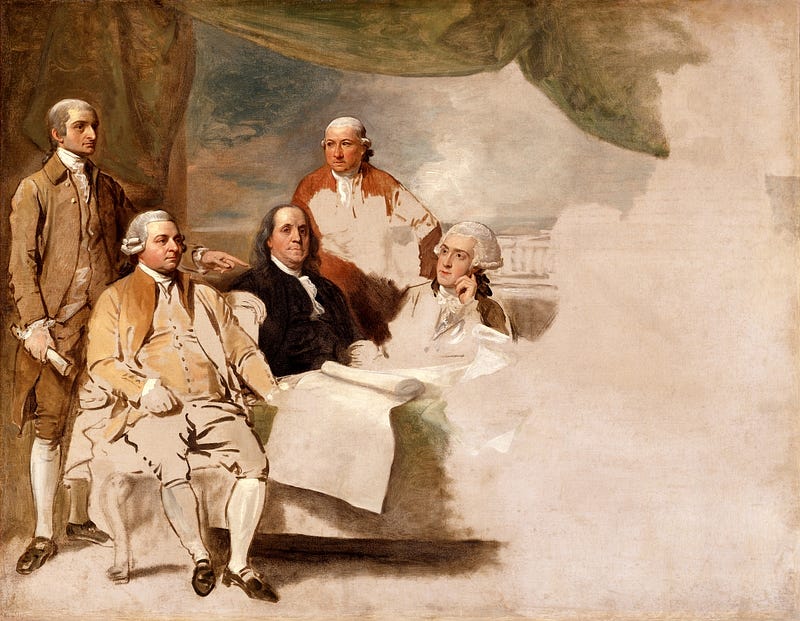
On September 3, 1783, the United States finally signed a peace agreement with Great Britain that recognized American independence.
Contemporary painter Benjamin West aimed to capture the moment on canvas. After he’d sketched the American commissioners, however, the British delegation refused to pose. The painting remains, to this day, unfinished.
Right in the middle of the incomplete action sits none other than Benjamin Franklin. In his biography of the man, Walter Isaacson calls him “the most accomplished American of his age.”
But Franklin himself would never have accepted that kind of praise. After all, ‘accomplished’ pretty much means ‘done,’ and with Ben, that was never quite the case. He treated his life like a perpetual work in progress.
Towards the end of his career, he was elected as the governor of Pennsylvania, a position he held for three years — longer than any other — and well into his 80s. Even in his last year of being alive, he wrote essays about the cruelty of slavery and lead the local society supporting its abolition.
This is a trait he shares with many historic figures we call genius today. Einstein scribbled equations on his deathbed, Schubert completed 50 works in his last year, and Dante barely finished the Divine Comedy before he died.
Some might look at these people and see an addiction to work, delusional grandeur, and exaggerated feelings of self-importance. I see quite the opposite, actually. A laissez-faire approach to life that surrenders to the fact that we’ll never feel like we’re finished. Because there’s always more to do.
At just 20 years old, Franklin wrote down 13 virtues he committed to keep practicing throughout his life. Again, what might seem like strict rules at first turn out to be rough guidelines. In his autobiography, Franklin noted that he focused on just one value each week, leaving the others up to chance, and admitted to failing many times.
But he wholeheartedly believed the mere attempt of following them made him a better, happier, more successful person. What a forgiving approach to self-improvement.
He also penned the following quote, recognizing what a tough job it was:
“There are three things extremely hard: steel, a diamond, and to know one’s self.”
When a diamond emerges from the earth, it looks bland at best and is impossible to recognize at worst. Without the long refining process — the cutting, the shaping, the polishing — no one would want to buy one. It may have been created under pressure, but now it needs a softer treatment.
I think our lives are the same. We’re all just diamonds in the rough.
The hardest part of being human is to be born in the first place. That’s where we need the pressure. That’s where we defy the incomprehensible odds.
But now that we’re here, applying more of it won’t help. It’s time to stop beating ourselves up. No matter what we do, we’ll always remain a work in progress. We’ll always be ‘unfinished.’ But we’re still diamonds.
Once we let go of negative self-talk and accept this, we can focus on what we really need: Refinement. Incremental progress. Polish.
Polish is sticking to your values in the chaos of everyday life. It’s letting go of the big picture to take the next stroke of the brush. Polish is rolling up your sleeves and saying: “What good can I do today?” It always feels small in the moment, but in hindsight, you’ll see it’s what makes your life shine.
Most of all, when we accept our roughness, we’ll learn to enjoy life regardless. Because if you never arrive, celebrating the journey is the only way.
I wish we could visit the houses of history’s greatest artists. The Da Vincis and Dantes and Franklins. If we rummaged around in their attics, I bet we’d find tons of partial works. What’s true for all of them is that, somewhere along the line, they figured out how to live with that burden. How to go on despite never being finished. At least some of them enjoyed what they did anyway.
I also wish we could ask them to show their drafts in an exhibition. Because knowing all of this, first they would laugh, and then they would agree.


