
We’ll Never Live Like This Ever Again
In a time of so much pain, how can one not miss a past life?
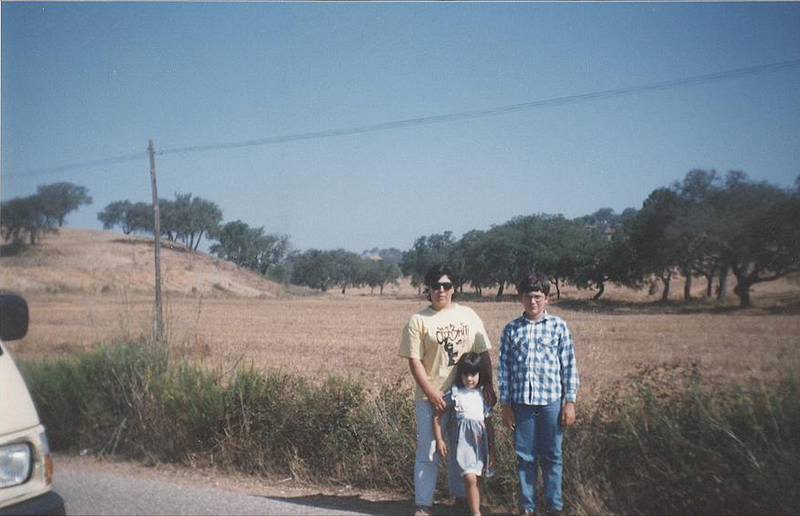
We didn’t know it back then, but the movie Forrest Gump eternalized the fame of a t-shirt that my mother used to wear. This is noticed in a scene where everyone is running. A car passes them and fills them with mud.
A guy following him gives Forrest a yellow t-shirt to wipe his face with, saying nobody likes that color. And as he notices Forrest’s face on the shirt, he has an idea for a t-shirt. I believe they meant my mother’s shirt, even if they meant the smiley thing…
Or so I want to believe.
Of course, at the time, none of us had any idea that that yellow color and a face were kind of famous everywhere. But famous or not, we didn’t care.
Life was good without us knowing it. That’s how happiness almost always is. My brother wore big glasses, was chubby, and I was the tiniest little princess in the house, wearing a haircut I’d stuck to all my life.
My father was the only one who worked because life made it possible and because even though we were in the nineties, Portugal still had an extreme mentality that women had to be confined to the domestic space.
My mother found herself caught in that kind of life.
But she always worked, don’t be mistaken. She was reserved for the domestic space, the farm, and being a partner in my father’s construction company.
No wonder you see in the photograph a woman with strong stature. She did the same work as the men, carrying cement, stirring concrete, and doing everything like the others.
In this photo, you can also see our old Toyota Hiace van, the family van that became strangely a part of the family. When it was stolen in 2014, it was an unfortunate day for all of us.
At that time, the world seemed much bigger than it is today, and my little country Portugal seemed to be our whole world. And we, a family living in the center north of the country, driving to the other end of the country, towards the south, was something not everyone could do.
I am fortunate to say that I had that privilege.
For us, people from the interior north, doing that was almost as if we were rich. We were not.
I never went into a hotel as a child; we always carried our house, let’s say, on our backs. In that van, we could fit everything. Mattresses, the big family tent, blankets, and even our mini TV, which we had at home in our small dining room, but always took with us.
We headed for the Algarve, the only place in the country that brought me into direct contact with English speakers. The British have long chosen the Algarve as their second or primary home. And the nineties were no exception.
As a child, I used to say that I wanted to live in the Algarve when I grew up. But I didn’t know that what really wanted was to live forever in those summer vacations, whether in 1993 or 1996. I didn’t realize then how much I would like to be able to freeze that time.
No!
I didn’t want to live in the Algarve; I wanted to live in that happiness and innocence when my parents were young, full of energy, and my brother and I were too little innocent kids without wives or husbands or our kids.
At that time when, although there were no highways, I really felt that happiness did not lie in reaching the destination, but in that trip that took us almost two days. Today the same trip would take just over five hours.
The south of the country was and is very different. I didn’t know, though, that the Algarve, which gave me so many beautiful memories, was only happy in the summer.
In winter, the place is frozen in silence. There are no people, or nothing really happening.
But not in summer. And not back then.
No!
Back then, there was music played by some people pretending to be Indians (there were yet no concepts of cultural appropriation) and people who played statues on the streets, who moved and made me laugh.
My birthday in August was often spent at that campsite, where you could hear foreigners singing loudly in strange languages while beating drums. A campsite with a bar, a mini disco, and a pool table where my brother and father constantly played.
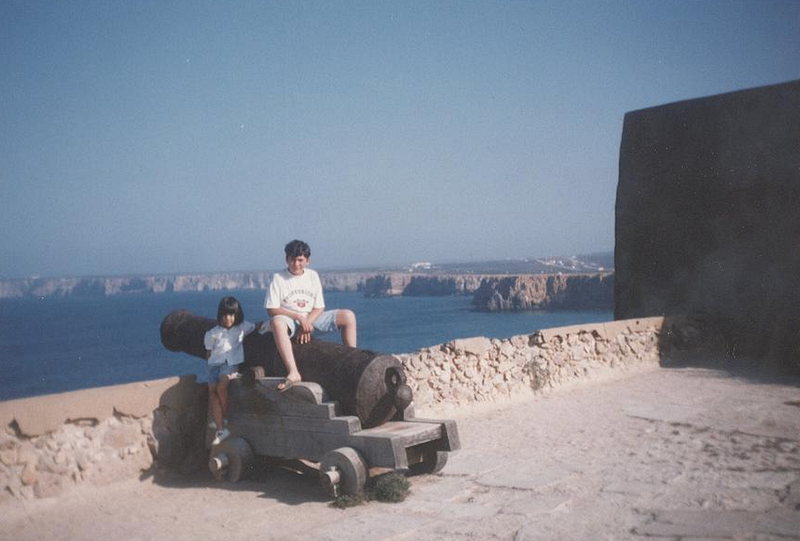
Did I wish my father had taught me to play that too? Of course, I did.
But not everything in those days was roses. Those things were not for girls either. But I don’t know if it had to do with my gender, if not more with my age. But despite my four, five, or seven years, I always wanted to be taught everything, something I kept with me.
The campsite had those typical changing rooms where my mom would take us to have showers. There, without any shame of their bodies, foreign women circulated naked in front of us, which caused my mother significant discomfort.
Portugal had (and has) soft customs, shy people, and few exhibitionists.
As a child, going into that place and seeing blonde women (also so different from me), tall, with loose breasts and pubic hair showing through to everyone else, perplexed me. Not in some negative or positive sense, but something that showed me a different reality than the one I was used to.
Toilets were also non-existent. There was only a hole in the ground, which I only saw again in Italy in 2016.
That campsite was great. And those summer vacations were even better.
We would go to the beach, bring food, or return to the campsite where my mother (never my father) would prepare lunch for all of us. We also took a small gas cylinder connected to a mini stove where we cooked.
We sometimes sat on the blanket, sometimes on the little cooler with our plates in our hands, eating beans, meat, or whatever my mom prepared.
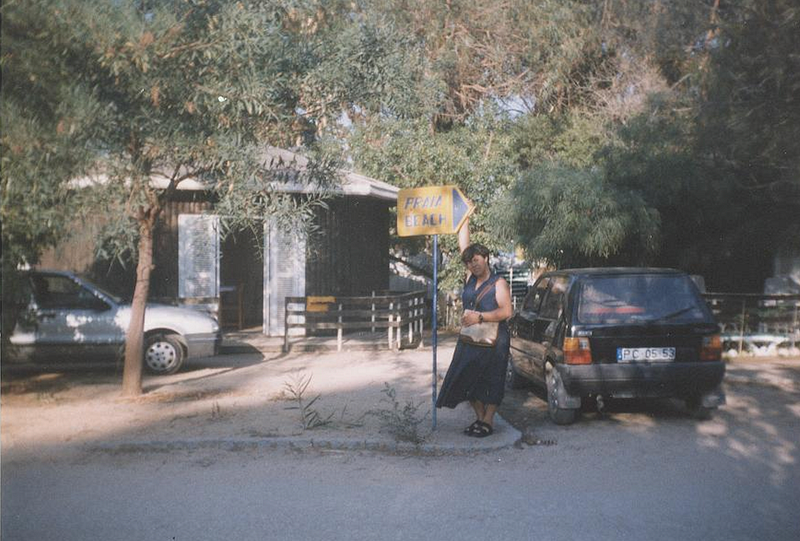
Sometimes our van was used as a backrest to put the TV, connected by lots of electric cables to some electricity station in the park. Does it sound bad? It wasn’t! It was the best vacation ever.
But then something happened. Time passed. We grew older, my parents included. The world changed. Our perception of comfort as well.
One of these days, my parents put the old tent back up in their backyard. Its fabric smelled musty and was torn in some parts, possibly gnawed by some mice. Still, they managed to put it up again. And then, when it was up, suddenly, that huge tent seemed to have shrunk exponentially.
My brother and I stared at it, and we immediately wondered how four people could fit in back then: two adults and two children.
Now, adults, it would never cross our minds to have a vacation like that. We entered the tent and almost felt claustrophobic, unable to imagine being cozy there.
And I know there was, almost telepathically, a sadness that warned us that maybe we didn’t allow ourselves to know how to be happy like that anymore. Happy in a simple, beautiful way.
I know everyone romanticizes their childhood and the time they lived in them. But I know that the nineties, the first part of the decade when I experienced pure childhood, had a lot of things wrong with it.
We lived without conscience, as many still clearly do.
We lived extorting from the planet its resources as if everything was going to regenerate magically.
And then, in the summer of 1998, we were in shock when the campsite started undergoing renovation. No, it was not for the better.
The campsite, one of the few places with trees in the town of Lagos in the Algarve, began to be shortened.
First was the access to a beautiful beach. That year the supermarket was no longer there. I remember going to the new boundary and seeing the house where we went shopping the year before. But now there were only walls, a roof, cut trees around, still lying with their branches crying, and a desert land. An unfortunate scene that perhaps interrupted my childhood innocence.
And every year when we returned, the park shrank until what we expected happened: its total disappearance. That whole green area was annihilated to make way for a resort for millionaires.
I saw it with my own eyes in 2009 when I went alone to the Algarve and walked under the torrid sun, magically knowing by heart the way there.
I never found the campsite of my childhood anymore. But I knew I was in that place where before my eyes, what was once a beautiful park, had become a private condominium that was being built for anonymous millionaires.
I continued my long walk.
I wasn’t happy, as you can imagine.
Actually, I cried the whole time as I looked to the floor, leaving my past behind. I then headed to the beach of my childhood, Dona Ana. But on my way there, the sadness just kept coming.
Reasonably priced hotels from my childhood were now abandoned. Perhaps those who have lived long enough know how painful it is to have the image of something full of life in your mind and suddenly see a building that looks like it was taken from a horror movie. All abandoned, in ruins, with old curtains being torn apart.
It was so sad.
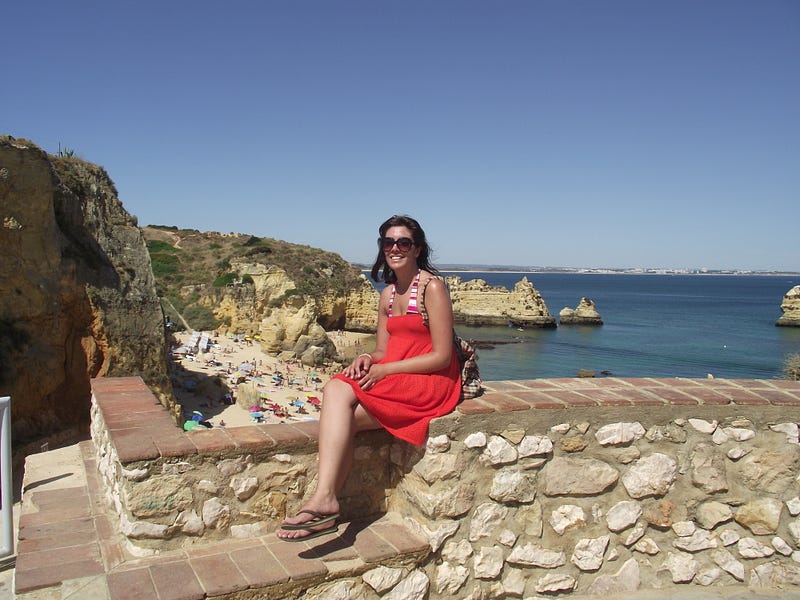
In 2009 I was right near Dona Ana’s beach, once one of the most beautiful beaches in the world. You read it right, ONCE, not anymore.
I still found the white stairs, the shells on the walls, the paintings of sardines, and the white restaurant that displayed the seafood in aquariums.
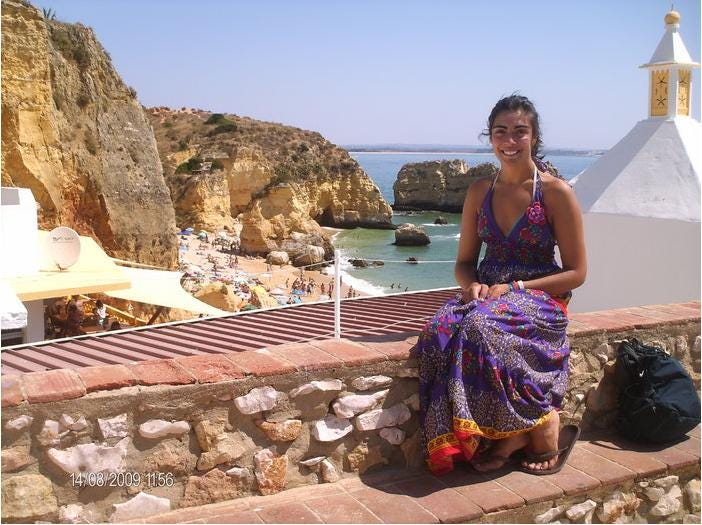
“At least they still have this,” I thought to myself. And with my long flower dress, I went downstairs and stayed on that tiny beautiful beach.
But in 2013, the last time I went to the Algarve, I found the beach ruined. The cliffs were destroyed, and the sand stretched out, covering the sea to widen the space for more tourists.
Dona Ana’s beach is dead. See this:
It died because it was murdered by greed and ignorance.
The beach was widened to receive more people. But the reason why people would want to go there in the first place was killed. It was so beautiful, that’s why we went there.
I have one VHS tape showing a summer when we took my grandparents with us. We were on that beach. We were so joyful. I was eight years old, about to turn nine.
I appeared walking, jumping from rock to rock, while fish of a thousand and one colors were passing underneath us.
We walked a long way, sometimes having to swim for a good few minutes until we reached a large rock where crabs, seaweed, clams, and starfish, among other species whose names were and are unknown to me, would follow us.
In 2013 with the beach widening, sand was added until that rock.
I cannot understand how humans have managed to beat the sea. As a result, the fish died, the crabs were killed, the seaweed and mussels were gone, and the beauty and all our joy went with them.
The small town of Lagos also suffered from the stupidity of politicians and their engineers.
In the old days, the town center had a garden, followed by the typical Portuguese sidewalk built of black and white stones, forming maritime designs.
There were also trees, flowers, and a market that used to take place there in the center. The vendors sold whelks, dolls, dried fruits, or typical southern handicrafts. Life was beautiful, nature collaborated with us, and we took advantage of her kindness.
The few trees were valuable. The South, almost touching North Africa, is unbearably hot. The shade of those trees was a blessing.
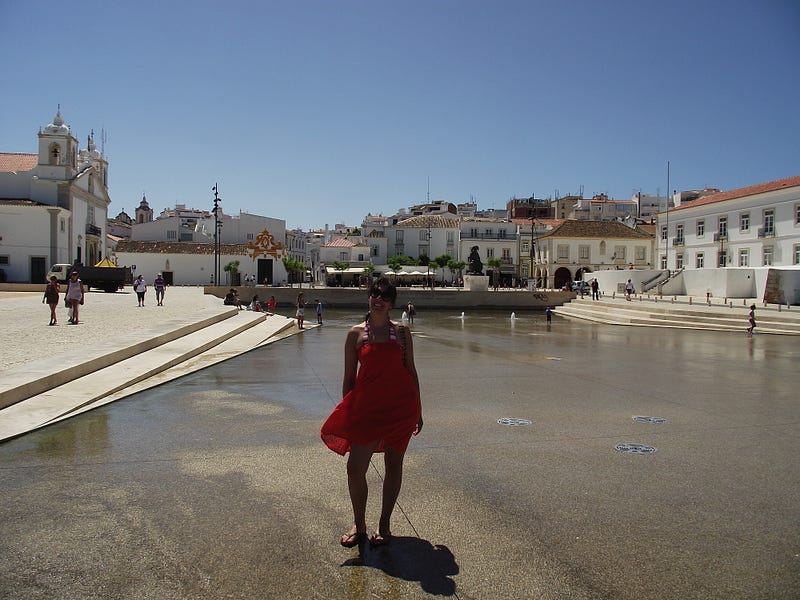
In 2013, when I looked downtown, I saw the calamity. Not a single tree, plant, or flower was there. In its place, there was an architectural work of concrete, with water pouring out of its walls.
Something as dystopically futuristic as well as very retrograde.
Uneducated people associate progress with this. They cut nature, destroy it, and think this is evolution. They are dumb. They know nothing.
We, humans, have this strange capacity of not knowing how to defend ourselves from our enemies: ourselves. We go about ruining things, and we adapt to this reality, almost forgetting how we once had other, simpler, and, therefore, happier lives.
Now there is every reason to be unhappy because we have been built this way.
Yes, here is the climate again, because how couldn’t it be?
Another COP27 was held, with the alarming words of the UN Secretary-General, saying that we are on a highway to hell.
We really are! But as he said, we have our foot on the accelerator.
One of these days, trying not to go crazy definitively, I looked up for how many thousands of years have human beings existed.
The answer? More or less, we have been here for three million years.
Our planet has been around for a lot longer, about fifty million years.
So, oh well. We will all disappear, and the planet will regenerate by itself. It will take a long time, but maybe that will happen. The thing is, no one will be here to tell the story.
It’s now beyond sad all this, isn’t it?
One of the latest news stories told how the temperature will increase by eight degrees Celcius by the end of the century. The scientists wanted to limit this to one and a half degrees.
If I had a daughter now and if she lived a few good years, she would be eighty years old by the end of the century.
In historical terms of our existence, eighty years is nothing.
The question now is: would she even make it as an adult? What about me? What about us? Will we ever grow old?
Will I ever be the figure of my grandmother smiling at me while I counted crabs on the beach?
Will I ever be the figure of my mother, wearing a T-shirt, standing in a meadow in Alentejo while the heat was not yet killing us?
Will I even be me?
Whatever the answer, one thing is for sure: we will never have that beautiful life again, which is enough to make anyone crazy.
Hello, I’m Araci, a female writer from Portugal. I like to write about my country, Portugal. But I also enjoy pop culture, American culture, and cultural differences. I hope you’ve enjoyed this article!
You can also find more about me here:
If you have enjoyed this article, maybe you would like to buy me a coffee here https://ko-fi.com/joanaaraci. I don’t drink coffee that much, but food is getting ridiculously expensive, and I need to put it on the table.
There are other ways to help me out:
Are you considering joining Medium for only 5$ a month? Your membership fee directly supports me. This way, you are helping me out while you’ll also get full access to every story on Medium.
If so, consider doing it through my referral link.
Thank you for reading me.