
GEOLOGY, HISTORY, AND RESPONSIBILITY
Welcome to the Anthropocene
Complete With a Clear Boundary in the Geological Record
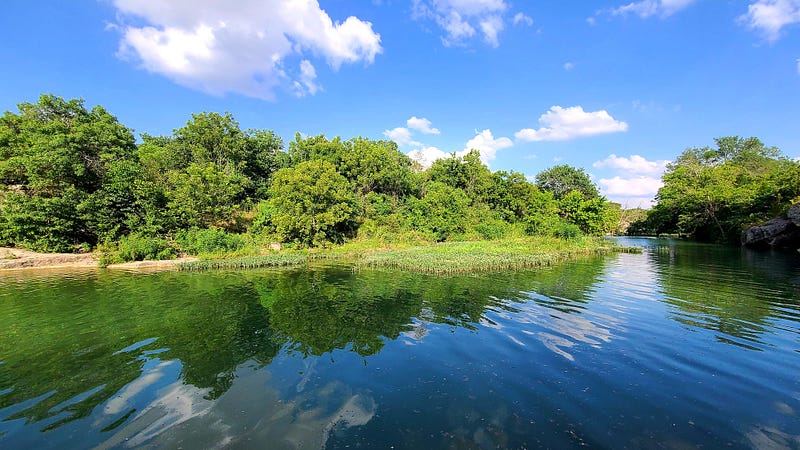
The Anthropocene Working Group (AWG) of the International Commission on Stratigraphy (ICS) has voted to proceed toward a formal golden spike (GSSP) proposal to define the Anthropocene epoch in the geologic time scale (GTS). This month, the Anthropocene Working Group chose Crawford Lake in Ontario, Canada as the site best representing the beginning of the proposed new epoch. The calm, deep lake has a floor that remains relatively undisturbed by currents in the lake, allowing the sediments on the bottom of the lake to reflect in its layers whatever lands on the lake’s surface.
If approved, the official declaration of the new Anthropocene epoch will take place next month, and its first age may be named Crawfordian after the lake.
The sediments in that lake show a spike in levels of plutonium from hydrogen bomb tests, a key marker chosen to place the start of the Anthropocene in the 1950s, along with markers including carbon particles and nitrates from the burning of fossil fuels and the doubling of nitrogen caused by the widespread application of chemical fertilizers.
The Boundary Layer
Our trash has left a mark since the industrial revolution, which degrades and compresses. Perhaps someday some future civilization will tap our landfills for needed materials, much as we tap the decayed and compressed vegetable matter of millions of years ago to supply our desires for petroleum. But with time, it will be more difficult to recognize what was metamorphosed plastic particulates and banana peels in the overall sediments of the era. There was no clear break corresponding to the Cretaceous–Paleogene boundary (K–Pg boundary) and its concentration of iridium was hundreds of times greater than normal, which marks the extinction of large dinosaurs and other animals after a large asteroid strike in the Yucatán Peninsula, at Chicxulub, Mexico.
Until 1945.
In July 1945 “the Gadget” detonated in the desert of New Mexico. In August atomic weapons had been detonated at Hiroshima and Nagasaki. By the 1950s, atomic testing had increased the background radiation for the planet as a whole.
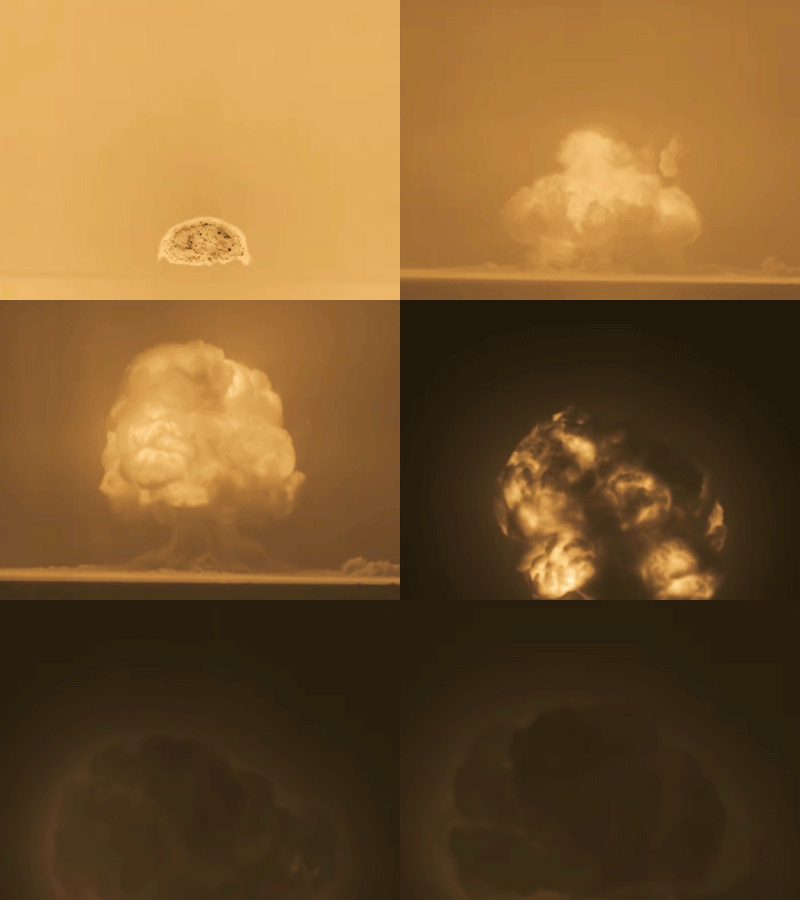
So there is a clear break, a “Holocene-Anthrocene” boundary marked by a concentration of long-lived radioactive materials related to the detonation of hundreds of atomic and nuclear weapons above and below the surface of the earth, maxing out (but not ending) in the decade of the 1950s.
Add to that the fallout from events like Chernobyl (and the looming disaster at Zaporizhzhia, if it happens) and the normal products (including transuranic wastes) from nuclear activity since 1942, and we’ve marked the geologic record with products with half-lives ranging into hundreds of millennia.
We’ve left a mark.
Compared to the other contaminants related to industrial civilization — oil, coal, and natural gas — the immediate threat from nuclear power to human life is negligible. Far worse for living things is microplastics, where natural resources have been transformed by chemical engineers into something may endure past our civilization. But in all the mess we’ve made, the nuclear pulse provides a clear boundary for the transition from a world where humans are moving things around to one where we are creating new elements. This is geological era, first detectable in the sediments of the mid-twentieth century, when human activity is sufficient to leave a permanent mark in the planet’s crust.
The Biological Boundary
There was a relative doubling in the level of carbon-14 (14C) in the Earth’s atmosphere due to the hundreds of above-ground nuclear bombs tests that continued until 1963, when the Limited Test Ban Treaty was signed. This “bomb pulse” is seen in the bones and teeth of anyone born in the 1950s and 1960s.
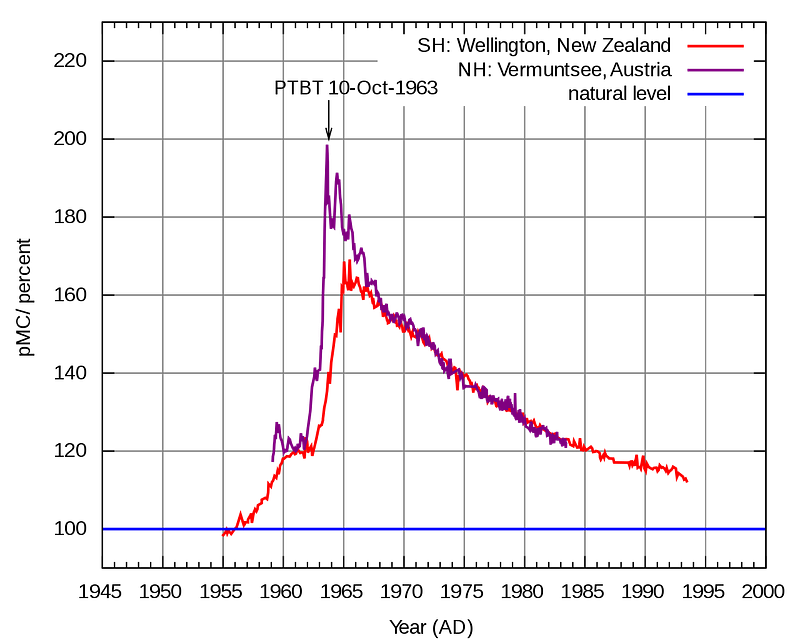
I am a child of the Anthropocene. Born during the spike, the accumulation of Carbon-14 will remain in my bones until I die, and endure long beyond.
An Extinction-Level Event
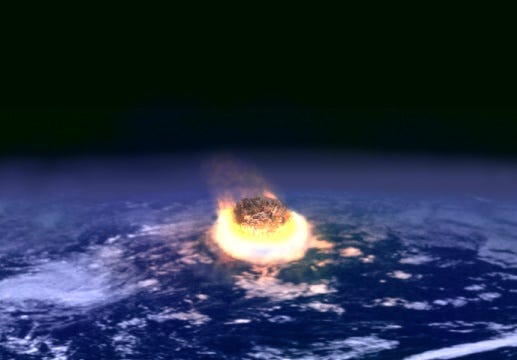
The Anthropocene also has all the traces of an extinction-level event. Prior to us, at least five extinction-level events can be found in fossil record over the past 500 million years.
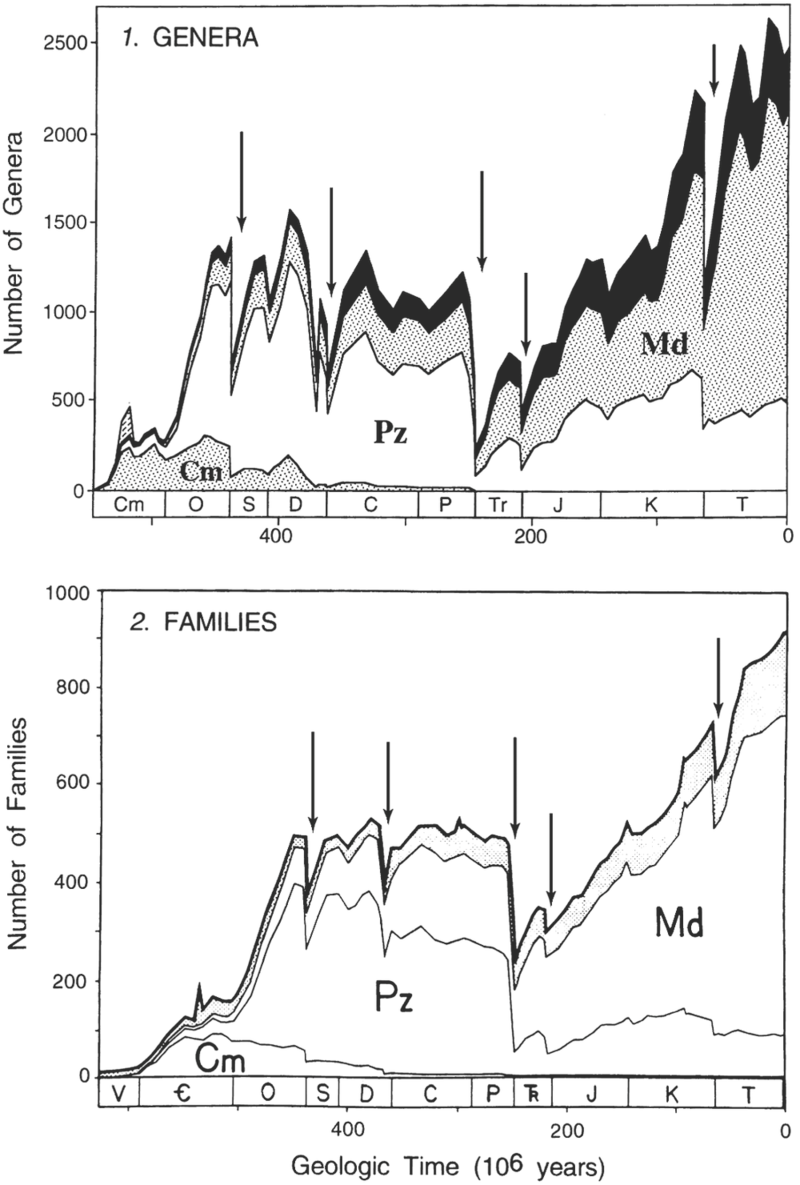
These have each left a mark on the fossil record:
- The Ordovician–Silurian extinction events: 445–444 million years ago, marking the Ordovician–Silurian transition, which killed off 85% of all species. Studies suggest that the causes of the mass extinction were global warming, related to volcanism, and oxygen depletion in the oceans.
- The late Devonian extinctions: 372–359 million years ago, a pair of events that began with the annihilation of coral reefs and numerous tropical seabed-living animals (including trilobites), soon followed by the end of armored fish the near-extinction of the ammonoids, and at least 70% of all species.
- The Permian–Triassic extinction event: 252 million years ago which killed about 81% of all marine species and an estimated 70% of terrestrial vertebrate species.
- The Triassic–Jurassic extinction event: 201.3 million years ago, when between 70% to 75% of all species became extinct. Most of the large amphibians were eliminated, leaving dinosaurs with little terrestrial competition.
- The Cretaceous–Paleogene extinction event: 66 million years ago, in which 75% of all species became extinct. In the seas, all the ammonites, plesiosaurs, and mosasaurs disappeared. All non-avian dinosaurs died. Although there were multiple contributory factors, the tipping point was the impact of a mountain-sized asteroid in the Yucatán Peninsula, triggering tsunamis that swamped vast areas of the coastlines and triggering firestorms that may have raged across the entire globe. The asteroid strike also blasted huge amounts of dust and vaporized rock into the air, which, along with the soot from all those fires, blocked the sun for decades. Worse still, much of that vaporized rock was rich in sulfur, which rained back down on Earth and acidified the oceans. The combination led to global climate change and deposited a layer of iridium that can be detected around the world today.
The Sixth Great Extinction
Beginning just before the official start of the Anthropocene, human activity has been responsible for the sixth global extinction event, the ongoing “great dying” we witness today. Since 1900, extinctions have occurred at over 1000 times the background extinction rate, and the rate is increasing. There is clear causal link to our population growth. As a result, a 2019 global biodiversity assessment by the United Nations found that out of a known 8 million species, 1 million plant and animal species are currently threatened with extinction. In late 2021, the World Wildlife Fund Germany suggested that over a million species could go extinct within the next few decades in the “largest mass extinction event since the end of the dinosaur age.”
After the Trinity test, J. Robert Oppenheimer recalled his reaction to what he had done:
We knew the world would not be the same. A few people laughed, and a few people cried. Most people were silent. I remembered the line from the Hindu scripture, the Bhagavad Gita; Vishnu is trying to persuade the Prince that he should do his duty and, to impress him, takes on his multi-armed form and says, ‘Now I become Death, the destroyer of worlds.’ I suppose we all thought that, one way or another. — J. Robert Openheimer
But it’s more than nuclear weapons. Like it or not, humans as a whole now have the power to reshape life on Earth. We have become a geological force. In a famous line in Amazing Fantasy number fifteen, the first appearance of Spider-Man, Stan Lee wrote a line that defined the character but applies just as well to each of us:
“With great power comes great responsibility”
Now, as a species, we all have a calling that transcends individual noblesse oblige. Perhaps ecologist and author Stewart Brand made the point best of all:
“We are as gods and might as well get good at it.”
― Stewart Brand
Thank you so much for reading. If you liked this story don’t forget to press the clap icon as many times as you want. If you like my work and want to support me then you can become a medium member by using this link, subscribe to my work, or buy me a coffee ☕️. Keep following for more.


