
Welcome to Medieval Painting 303: How to Depict Beasts You’ve Never Seen Before with Confidence
It’s 10% skill and 90% imagination
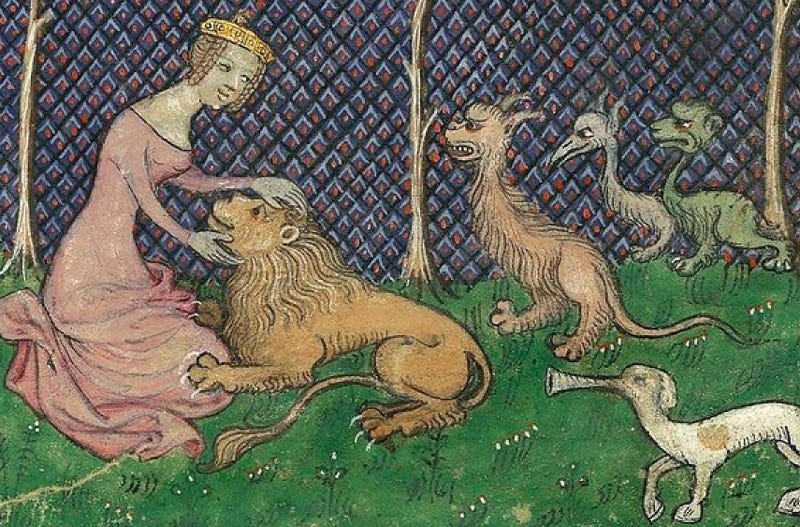
Hello clever orphans and third sons from noble families. Welcome to Medieval Painting 303. Presumably you’ve all picked up proper pigment-making procedures and lettering from your previous classes. If you can’t illuminate an “S” you won’t be able to properly convey what you believe a sea serpent might look like based on hearsay.
As you know, our duties include cataloguing all the beasts the Lord saw fit to create. It is not for us to question their bizarreness, but to capture their image for future generations. There are no hard and fast rules and no wrong choices in this class.
Today we shall start with a mysterious creature, the elephant. What do we know about it? Allegedly the animal is quite large. It has big ears, is able to transport people on its back, has a long nose, and possesses big horns on its face.
Then there is conjecture. Does it have horses hooves? Is the nose snake or pig-like? And would it win in a fight with a dragon? That’s where you come in, my young students. Using what you know and what you hear you must draw the animal.
First take a look at some of these examples.
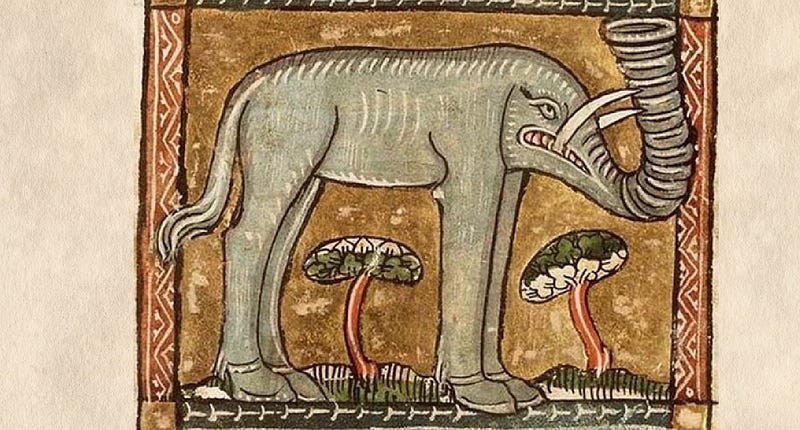
This one is big. It towers over trees. The artist believed that the height comes from the legs and drew the animal accordingly. The nose also opens wide at the end , like a horn, which makes sense considering the noise it is rumored to make.
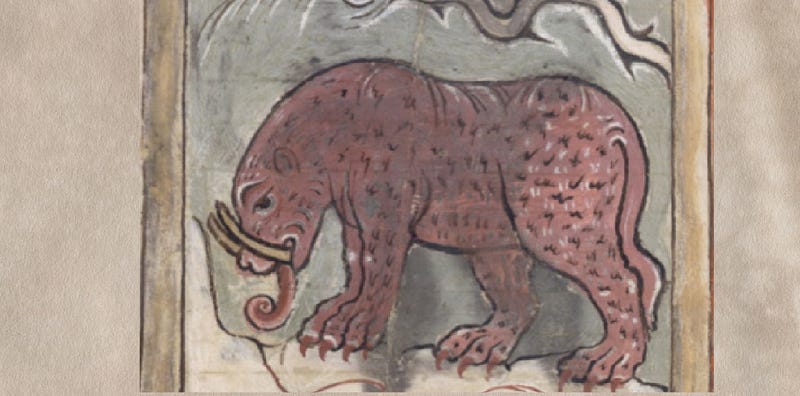
This portrayal really shows the cleverness of man’s mind, even when we know so little. We know the elephant comes from the same lands where spotted beasts roam. So perhaps the elephant would resemble its brethren? This is a classic example of the phrase, “Choose strong even if it’s wrong.”
Now it’s your turn. Show me what you got.
Time’s up! Thomas, what have you produced?
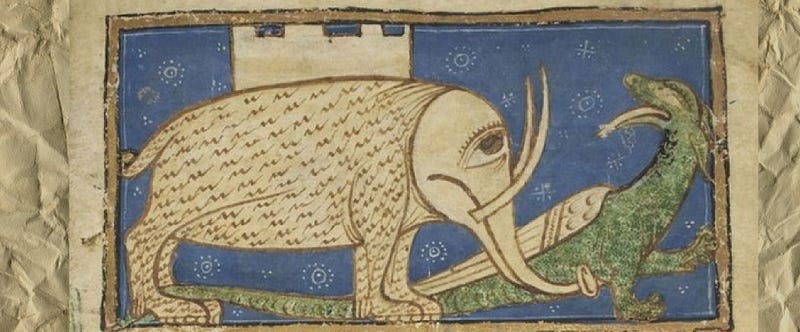
This is not bad. I see you decided to forgo the ear theory. In fact it has no ears. Perhaps the horns are longer to compensate? You’ve even answered the dragon fight question. Killing two dragons with one stone, wonderful work Thomas. As I’ve said before, there are no wrong answers when we are painting creatures we’ve never seen.
This one though is quite good. Everyone take a look at Geoffrey’s piece.
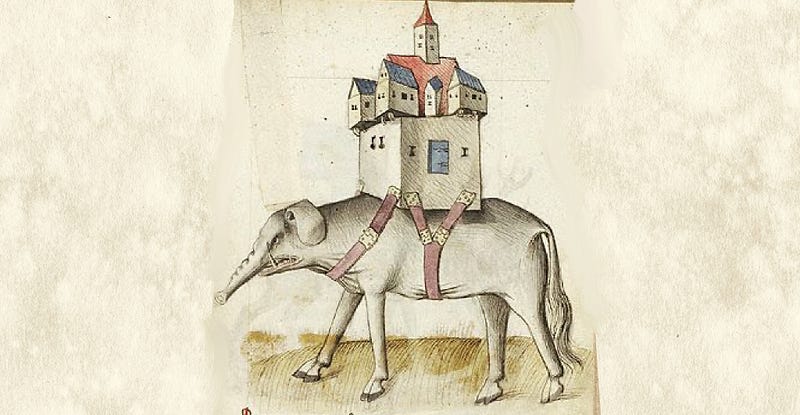
Not only did he go above and beyond, showing the elephant’s uncanny rumored ability to carry a whole city on its back, but the emotion of this beast will really connect with readers. Or those who glance at the pages. Most people only want to look at the pictures in the manuscripts anyway. Though that may be due to the low literacy rate rather than a lack of desire for knowledge.
I’m also impressed by the detail of the feet. Great work Geoffrey.
William?
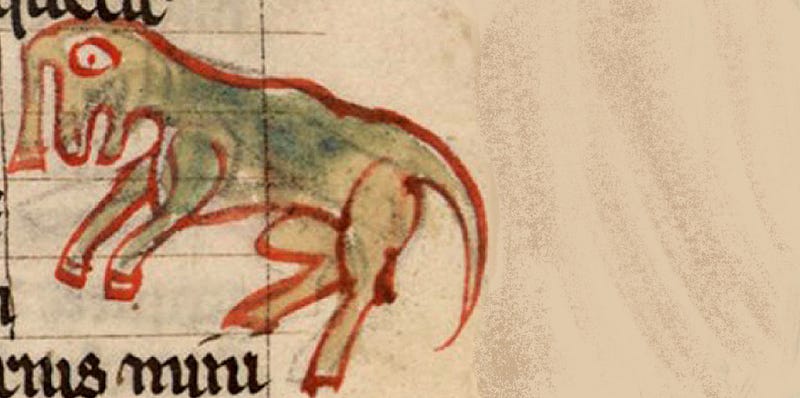
I see…
This is good teaching moment. I’m patient by my fellow monk’s standards and won’t beat you for being creative. But I will for laziness. This isn’t a joke. We can’t forget how important our job is. We must record these natural wonders however we see fit AND to the best of our ability. That’s why God sent you here to our monastery. That is why you are taking this class.
Enough for today. Tomorrow we will examine the unicorn. I also must point out, based on past experience teaching this class, that I know the difference between a horn and a penis. So please be mature.
Thanks for reading!


