
Welcome 2 America: Prince’s Moment of Clarity or Fentanyl Fever Dream?
Thoughts about Prince’s posthumous meditation on a crumbling mythology
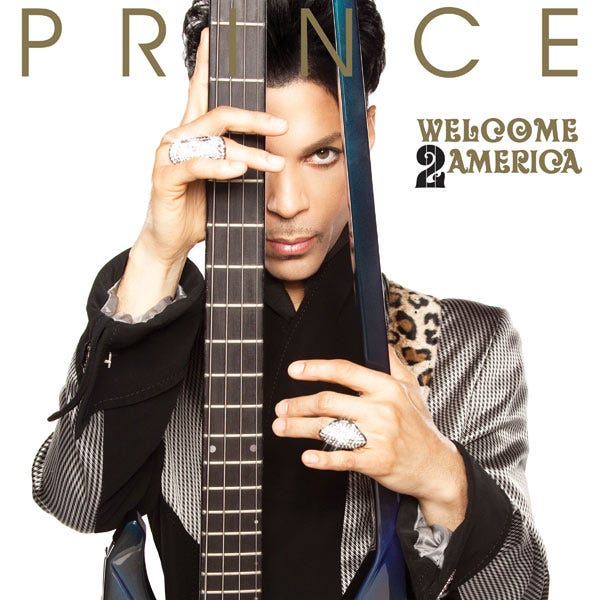
I’m not sure how to say this tactfully. I apologize in advance if it comes across as insensitive or makes any of my fellow Prince fans uncomfortable. Frankly, it makes me a little uncomfortable. Yet, I can’t authentically speak on my initial reaction to Prince’s first posthumously released album of new material without addressing the elephant in the room. In each of my three listens thus far, it has become increasingly integral to how I process the project.
Welcome 2 America is Prince’s fentanyl album.
It was conceived, recorded, and ultimately shelved in 2011. That’s roughly a year into the addiction that reportedly began with painkillers prescribed after Prince’s 2010 hip operation and eventually claimed his life in 2016.
Drugs have always been part and parcel of popular music, both in its creation and the lens through which we view it. The Beatles’ late ’60s musical experimentation is inseparable from their corresponding experimentation with psychedelics. Ganja courses through the veins of Bob Marley’s catalogue. The entire subgenre of hair metal feels like the unclaimed love child of power chords and cocaine. It would be naive not to allow that Prince’s addiction likely influenced his creative output, particularly since Welcome 2 America doesn’t quite feel like anything else in Prince’s 40+ album catalogue.
While Prince incorporated countless genres, instrumentations, and sonic textures into his music, the common denominator has always been the indomitable presence of the man himself. He was always fully there, seemingly living and breathing the passion, pain, rage, and resentment of every piercing vocal note, relentless LinnDrum pattern, or guttural guitar solo.
Welcome 2 America, in contrast, unfolds at a surreal remove. Prince often seems to float above a nation in decay, looking on in despair, like Ozymandias’ traveler. That’s not a criticism. In fact, it gives Prince’s analysis of America’s crumbling facade the quiet power of even-handed matter-of-factness.
Based purely on the title and what little I had read, I expected a strident rebuke of our uniquely American brand of injustice with a chaser of the spiritual reckoning which became increasingly common in Prince’s later work. Instead, Welcome 2 America feels like equal parts meditation and elegy.
The album doesn’t do that in Prince’s typical explosive fashion (think “Let’s Go Crazy,” “1999,” or “Endorphinmachine”). Instead, the opening song suite mesmerizes, slowing the adrenaline. Extended notes and loose drums seemingly soften the very air around you like an opioid haze.
The title track creeps in with a tentative upright bass reminiscent of The Stylistics’ “People Make the World Go Round.” The open space is gradually filled by ambient synths and barely perceptible percussion, creating a trippy jazz soundscape. Liv Warfield, Shelby J, and Elisa Fiorillo serve as a Greek gospel chorus of sorts, their harmonies spelling out the themes laid down by Prince in a sardonic spoken-word thesis:
[Prince] Welcome to America Where you can fail at your job Get fired, rehired And get a seven-hundred billion dollar tip
[Chorus] Come on in, sit right down, and fill up your pockets, yeah
[Prince] Mass media, information overload Welcome to America
[Chorus] The following message brought to you by Datacom
[Prince] Distracted by the features of the iPhone
[Chorus] Got an application for each of situation
[Prince] In other words, taken by a pretty face
[Chorus] Somebody’s watching you
With an economy of language, Prince provides a snapshot of a world mired in the cynicism brought on by an endless parade of bank bailouts, government surveillance, and technologically facilitated desocialization. P-Funk acolyte that Prince was, the structural similarities to Parliament’s “Chocolate City” are surely deliberate. But where George Clinton’s Black empowerment anthem was fueled by optimism for an egalitarian future (“gainin’ on ya!”), “Welcome 2 America” imagines a country destined for collapse.
“Running Game (Son of a Slave Master)” thrusts Shelby J to the forefront to rhythmically render Prince’s surgical dissection of slavery’s legacy and its omnipresence within America’s systems of economic exploitation. (Did somebody say “Critical Race Theory?”) Instead of righteous indignation, it’s delivered as meditation, the track’s easy mid-tempo funk flowing like time itself, underscoring the inevitability of cycles repeating.
“Born 2 Die” rounds out the opening trifecta, by far the album’s most exciting section. It’s the first time Prince truly puts his vocals center stage, unfurling an allegory about a girl turned out by the machinations of capitalism, quickly descending from church to prostitution to pimping. It’s hard not to read the track as a metaphor for America itself, as Prince repeats, “born to die, born to die.” When the track rides out with a plaintiff coda lamenting how she’ll “getcha, getcha so high, so high,” it’s even harder not to suspect the lyrics are, at least in part, self-referential.

Prince’s lyrics have always carried an awareness of his own mortality, but were deployed as a metaphor or poetic abstraction. Whether due to addiction or simple aging, Welcome 2 America’s Prince treats the specter of death with greater immediacy. Musically, “1000 Light Years from Here” offers a joyful respite from the melancholia of the earlier tracks. However, lyrically the utopia it imagines exists on a subsequent plane of existence, seemingly reachable only after the earthly one has concluded. It’s certainly a far cry from the mid-80s Prince, who assured us all that Paisley Park was in our hearts.
For me, the album’s most powerful moment is “Stand Up and B Strong,” not so much for the affirmations it offers to a world in turmoil, but for the internal dialog Prince seems to be having with himself. Once again, Prince leans on his sirens to carry much of the vocal load. The relative scarcity of his voice gives his words added resonance whenever he takes the mic, so it hits like a roundhouse to the gut when he sings:
If you live in the hills Take too many pills ’Cause you’ve lost the thrill Against your own will Stand up and be strong
Prince never worried much about concealing his ego. Whenever he stepped onto a stage or into a recording booth, it was with the unwavering certainty that he was the baddest man on the planet. He wasn’t wrong.
Perhaps the only thing more grandiose than his self-regard was the outsized mythology that developed around him. He wasn’t simply a musical genius, he was a prophet, a priest, and a shaman, with a wicked jump shot to boot. We worshiped him to outlandish proportions akin to the way Americans have come to revere their country. Just as America was crumbling under the unsustainable weight of its mythology, so too was Prince.
The early 2010s may well have been the first time since Prince Rogers Nelson emerged as “Prince” that he found himself at the mercy of something greater than himself. Welcome 2 America feels like Prince realizing that he, like his country, was buckling at the knees.
“Stand up and be strong,” he seems to be imploring himself through the voices of his Greek chorus. “Sing a brand new song, before they’re gone, stand up and be strong.”
For Prince, such a frank acknowledgment of the finite nature of his creative powers, of which he perhaps felt the fentanyl robbing him, had to have been even more difficult than the recognition of his encroaching mortality. As the track shifts from pop power balladry to a psychedelic blast of gospel catharsis, it’s hard not to feel simultaneously inspired by the resilience that he manages to summon through music and saddened by the exercise’s ultimate futility, given that we already know the outcome.
Perhaps that very vulnerability is why Prince chose to shelve the album in 2011. He may not have been ready to expose his frailties to the world, even couched beneath the pretext of a social critique. It’s potentially telling that the maniacally prolific Prince didn’t release any new albums between mid-2010 and late 2014, the longest dry spell of his career.
Notorious perfectionist that he was, it’s also possible Prince wasn’t pleased with the finished product. Welcome 2 America begins to stray from its concept in the second half, and aside from the immaculate falsetto on the show-stopping ballad “When She Comes,” his vocals lack punch. Whether it’s due to diminished capacity or disengagement, we’ll never know for sure. Either way, it’s likely the drugs played a role.
Still, I’m glad the project was released posthumously. Overall, it’s an arresting listen that occupies a unique space in Prince’s discography. It’s also a testament to Prince’s prescience that the societal fissures he called out in 2011 are now gaping fractures in a nation that seemingly grows more divided by the day.
Maybe America can’t be saved. Ultimately, Prince couldn’t be. But receiving such a salient statement from him, five years after his passing, is oddly reassuring.
In his iconic tradition of starting songs with dream lyrics, Prince begins the closer, “One Day We Will All B Free”:
You go to bed just to learn It was all a dream
The deceptively simply track builds steadily, with Prince coming to terms with the worldly woes lamented throughout the album.
Prince was okay with going to bed. And the dream he left behind seems just a little less bleak with Welcome 2 America in it.