avatarSelena Routley

Free AI web copilot to create summaries, insights and extended knowledge, download it at here

10426

Abstract

t ALL possibilities when we ask the question: what are the geodesically complete two dimensional smooth, flat (<i>i.e. </i>Euclidean) manifolds (roughly: 2D surfaces)? The other two possibilities, the Real Projective Plane and the Two Dimensional Sphere have <a href="https://en.wikipedia.org/wiki/Euler_characteristic">Euler Characteristics</a> of one and two, respectively, and thus cannont be given a flat, Euclidean embedding because the Gaussian curvature always has to be nonzero somewhere <a href="https://en.wikipedia.org/wiki/Gauss%E2%80%93Bonnet_theorem">to fulfil the Gauss-Bonnet theorem</a>.</p><p id="c130">As discussed in my curvature article, a flat surface is one whose distances are described by a Euclidean metric, or, alternatively, one for which the geometry of lines and figures drawn on the surface fulfill all of Euclid's geometry postulates, including the parallel postulate.</p><div id="0974" class="link-block"> <a href="https://www.cantorsparadise.com/what-does-curvature-mean-setting-the-scene-for-general-relativity-a8accb5050f1"> <div> <div> <h2>What Does Curvature Mean? Setting the Scene for General Relativity</h2> <div><h3>General Relativity is concerned with the “curvature of spacetime”, a term that invariably leaves people mystified…</h3></div> <div><p>www.cantorsparadise.com</p></div> </div> <div> <div style="background-image: url(https://miro.readmedium.com/v2/resize:fit:320/0*CWqp1jQrUmPMYTK0.png)"></div> </div> </div> </a> </div><p id="a8de">Geodesically complete means that if we begin and any point and follow any straight line, we can do so indefinitely without meeting a singularity.</p><p id="d6a0">Smooth means infinitely differentiable at every point — all derivatives, pure and mixed in all directions, are defined. <a href="https://en.wikipedia.org/wiki/Analytic_function">Analytic</a> is an even stronger adjective, meaning that for every point geodesics can be calculated in a (nonzero) neighborhood of any point from all those derivatives alone. That is, generalized Taylor series converge and are correct in that neighborhood. Smooth two dimensional, orientable surfaces are also analytic Riemann Surfaces owing to the <a href="https://en.wikipedia.org/wiki/Isothermal_coordinates">existence of isothermal co-ordinates</a>. This makes the non-orientable Klein Bottle, Projective Plane and open (with edge deleted) Möbius Strip a little bit pathological in the two dimensional manifold world. Analytic co-ordinates still exist (<i>e.g.</i>, the parameterization on the Wiki page here), so they're not too pathological, but analytic continuation of a local analytic structure around closed paths can flip the unit normal to the surface, giving the manifold a <a href="https://en.wikipedia.org/wiki/Fiber_bundle#Structure_groups_and_transition_functions">non trivial structure group</a> (the notion of <a href="https://en.wikipedia.org/wiki/Fiber_bundle">fiber bundle</a> has been studied to do calculus on manifolds, particularly non-orienatable ones like the Klein Bottle and Projective Plane).</p><p id="6423">"Pathologies" in mathematics actually lead us to richer notions that are more general than that of manifold with certain, fascinating singularities such as the <a href="https://en.wikipedia.org/wiki/Algebraic_variety">Algebraic Variety</a>. This is a very typical phenomenon — wrinkles and shocks leading to deeper understanding — in the history of mathematics.</p><p id="4596">Amazingly when we make a Möbius strip, as long as the aspect ratio of the piece of paper we begin with is greater than √3, as we make a half twist in the strip and glue the short sides together, the two dimensional figure remains <i>developable</i>. That is, it has <i>zero Gaussian curvature</i> because the paper can be bent without stretching, so any figure drawn on the paper remains undistorted when the paper is glued into the Möbius band. Angles, distances and all geometric properties of lines and triangles drawn on the Möbius strip fullfil ALL the Euclidean geometry axioms. Thus the Möbius strip is indeed flat. One can see this by squashing the figure down into a flat folded, origami Möbius strip. Draw, say, several right angled triangles at different rotated orientations on a strip of aspect ratio, say four or so and then make the Möbius band. Make the triangles of significant size relative to the strip so you can see that their shape truly is preserved and that there is not some subtle distortion going on. If you make the Möbius strip big enough, with an aspect ratio of greater than two, you should be able to get a protractor in to the spaces to confirm experimentally that the angles have not changed.</p><p id="19ea">This is quite a visceral and mindblowing experience to see that the triangles stay perfectly undistorted and you notice that you can curl the strip into the band without sideways shearing or wrenching stress, and that the paper <i>has no tendency to crease (as it would if the surface were curved)</i>. I will return to this in the next article with an evocative dressmaking experiment that, to my mind, affords vivid insight into the notion of developable and Euclidean two dimensional surfaces, their non-Euclidean counterparts and the notion of Gaussian curvature.</p><div id="4470" class="link-block"> <a href="https://www.cantorsparadise.com/non-euclidean-dressmaking-and-flounce-forms-in-natures-frilly-hyperbolic-geometry-2aded01cee44"> <div> <div> <h2>Non-Euclidean Dressmaking and Flounce Forms in Nature's Frilly Hyperbolic Geometry</h2> <div><h3>Dressmaking, the fitting of garments to the non-Euclidean shape of the Human Body Surface as well as exquisitely…</h3></div> <div><p>www.cantorsparadise.com</p></div> </div> <div> <div style="background-image: url(https://miro.readmedium.com/v2/resize:fit:320/1*AbiJIN3jG3Ecr1r5JXeNEQ.jpeg)"></div> </div> </div> </a> </div><p id="2b72">The creation of flounces and frills and other beautiful ornaments in dressmaking is the result of deliberate measures to introduce Gaussian curvature into flat fabric. This is also functional, as the human body's surface is not Euclidean either. The device of a dart is well known as a means of bringing both comfort and showing off one's curves by introducing Gaussian curvature through the principle of gathering — which is also the trick that makes gorgeous flounces and frills run. Curves. Wish i had 'em. I have tiny boobies and a little Po with subtle curves. I like my understated curves, but i often dream of being a pear! <a href="https://www.youtube.com/watch?v=VMnjF1O4eH0">Fat Bottomed Girls You Make The Rockin' World Go Around</a>! Okay, Sapphic Selena, take a deep breath and get back on topic!</p><figure id="6b76"><img src="https://cdn-images-1.readmedium.com/v2/resize:fit:800/1*vpRpTH_ol8fYk0WZ6dJpNQ.jpeg"><figcaption>A Flounce Uses the Principle of Gathering to introduce Gaussian Curvature to flat fabric. Contrariwise, creases and flouncing in shear-stressed paper betoken the presence of Gaussian Curvature. A paper strip with an aspect ratio greater than √3 can be bent into a Möbius Strip with only pure bending forces and zero distortion of its Euclidean surface. Fair use of under the generous terms of the website of <a href="https://anicka.design/">Anicka Design</a>, who shares her creativity if given attribution. Please do <a href="https://anicka.design/">visit her website if you have any interest in dressmaking</a>.</figcaption></figure><p id="bd2a">To make the Möbius strip and cylinder into geodesically complete figures, <i>i.e.</i> so that geodesics won’t crash into either the two edges of a cylinder or the one edge of a Möbius strip, we must “delete” the edge(s) and make the direction orthogonal to the edges infinitely long. Think of something like mapping the interval -1</p><figure id="b122"><img src="https://cdn-images-1.readmedium.com/v2/resize:fit:800/1*-rwiSax3GR6rb-NCs2cKLw.gif"><figcaption>Creating a developable Möbius Strip by sweeping a line segment orthogonal to a circular loop along that loop, whilst rotating the line about the tangent to the loop through half a turn. Own work, created with Wolfram Mathematica</figcaption></figure><p id="8df7">Then, we replace each finite line segment along the loop with an open segment.</p><p id="d4e0">So the infinite plane is a Euclidean surface that requires two dimensions for an isometric embedding. It's kind of trivial — there is no embedding, the plane itself <i>IS </i>the whole Euclidean embedding space as well as the the embedded two dimensional surface.</p><p id="427e">Next come both the cylinder and Möbius band — as we have seen, they can both be embedded isometrically as Euclidean two dimensional surfaces in three dimensional space.</p><p id="5dab">Next we consider the torus. This requires three dimensions for a smooth embedding, as shown in the animation below. We begin with a square. The first stage is to roll a square (section of a flat plane) around an axis parallel to two of its sides to make a cylinder by suturing two edges together. This is an isometry, because a figure drawn on the paper inside the square is not distorted in any way — all lengths measured in the figure stay the same, as do angles between lines. The metric and the geometry remain identical. A similar example is how a disk with a sector cut out of it can be sutured together along the edges of the sector to form a conical shape; again, with no distortion of any images drawn on its surface.</p><p id="0b9f">The second stage is the interesting one. Here we must imagine our sheet's being made of rubber — the first suture makes a hosepipe and now we must bend the hosepipe around an axis orthogonal to the first rollup axis to make a torus embedded in three dimensions. This action stretches on its outer rim and shrinks on its inner rim, thus distorting a square checkerboard pattern drawn on its surface along the “standard torus”. Thus we can see the checkerboard undistorted after the first stage, but distorted after the second wraparound.</p><figure id="b78d"><img src="https://cdn-images

Options

-1.readmedium.com/v2/resize:fit:800/1*URMtYL5x1MrimG3KQdEKpA.gif"><figcaption>A plane being sutured into a torus; the first stage, suturing it into a cylinder, by rolling it up along an axis like a newspaper, is isometric and non-distorting. Thus the cylinder, from a mathematician’s viewpoint, is flat. In contrast, the bending around the orthogonal axis to connect the ends of the hosepipe together works a severe distortion of the checkerboard. <a href="https://en.wikipedia.org/wiki/Torus#/media/File:Torus_from_rectangle.gif">Many thanks to the creator of this video Lucas Vieira for his granting of creative commons license through Wikipedia</a></figcaption></figure><p id="59da">So this is not a Euclidean surface. One can embed a torus in three dimensions, but not isometrically with the square sheet that it is made from smoothly. To achieve zero distortion smoothly, one must use four dimensions: <a href="https://en.wikipedia.org/wiki/Clifford_torus">the Clifford Torus, leaves the checker pattern undistorted</a>. This magical beast is flat, in the sense that Euclidean geometry holds on its surface and its Gaussian Curvature is nought. If we drop the requirement for smoothness, we can use the Nash embedding to achieve isometric embedding in three dimensions, as i discuss in the next section.</p><p id="56ae">The Klein Bottle needs the maximum four dimensions required by the Whitney Embedding Theorem for a smooth embedding of a two dimensional manifold without double points. The same applies to the Projective Plane.</p><p id="f198">But, unlike the other four — Plane, Cylinder, Möbius Strip, (Clifford) Torus, neither the double point free Klein Bottle nor the Projective Plane in four dimensions is flat. The Whitney theorem, although extremely general, says nothing about preserving flatness. The embedding in the Whitney theorem does not necessarily preserve the metric of the surface.</p><h1 id="035e">John Nash Finds Isometric Homes for the Weirdest Bottles</h1><p id="ef13">To find out how many dimensions we need for an isometric embedding, and therefore a flat Klein bottle, we need the <a href="https://en.wikipedia.org/wiki/Nash_embedding_theorems">Nash Embedding Theorems</a>. <a href="https://en.wikipedia.org/wiki/John_Forbes_Nash_Jr.">John Nash</a>, incidentally, was the mathematician depicted by Russel Crowe in the film "A Beautiful Mind".</p><p id="fd28">There are three Nash theorems. Co-incidentally, the first and second give the same result: the Nash-Kuiper Theorem can be applied to the known, non flat four dimensional Klein Bottle Embedding to show that there is a flat embedding in five dimensions, because it says that, if you have any smooth embedding in <i>n</i> Euclidean space (in this case, we know we can embed the Bottle in four D), then there is a flat embedding in <i>n+</i>1 dimensions. So this tells us we need five dimensions to embed the flat Klein Bottle in Euclidean space.</p><p id="319d">The second Nash Theorem tells us that for any <i>n </i>dimensional Riemannian manifold, there is an isometric embedding in 2 <i>n</i> +1 dimensions. Again, our flat Klein bottle is two dimensional, so this tells us we need, again, five dimensions.</p><p id="83fa">But these are strange embeddings. Nash embeddings from these two theorems have pathological behaviors, such as discontinuous second derivatives everywhere. This is fractal like behavior. The first derivatives are continuous everywhere though. Nash embeddings by the first two theorems are defined as the limits of a convergent infinite sequences that begin with a non isometric embedding and then add waves and corrugations to a manifold of decreasing amplitude and increasing frequency to alter distances anisotropically, <i>i.e.</i> with a preferred direction in the manifold to "straighten" deviations from isometry out.</p><p id="88e9">Some idea of this process can be gotten by studying the <a href="http://www.hevea-project.fr/ENIndexHevea.html">Hévéa Torus</a>, an isometric embedding of the Torus that requires only <a href="http://hevea-project.fr/pdfTore/flatTorusAbstract.pdf"><i>three</i> dimensional Euclidean space for an embedding</a>, instead of the four needed for the flat Clifford Torus. Whether or not you accept these constructions as "Flat" is questionable, as they are not smooth, but, by the basic definition through the metric, the geometry of triangles and figures drawn on their surface (good luck doing that literally!) most certainly fulfil ALL of Euclid's axioms, and so, to a mathematician, they are most certainly flat. Mathematics yields the most surprising results when concepts are probed deeply.</p> <figure id="2200"> <div> <div> <img class="ratio" src="http://placehold.it/16x9"> <iframe class="" src="https://cdn.embedly.com/widgets/media.html?src=https%3A%2F%2Fwww.youtube.com%2Fembed%2FRYH_KXhF1SY%3Ffeature%3Doembed&amp;display_name=YouTube&amp;url=https%3A%2F%2Fwww.youtube.com%2Fwatch%3Fv%3DRYH_KXhF1SY&amp;image=https%3A%2F%2Fi.ytimg.com%2Fvi%2FRYH_KXhF1SY%2Fhqdefault.jpg&amp;key=a19fcc184b9711e1b4764040d3dc5c07&amp;type=text%2Fhtml&amp;schema=youtube" allowfullscreen="" frameborder="0" height="480" width="854"> </div> </div> </figure></iframe></div></div></figure><p id="81e3">Now, this all sounds abstract until you think of the physical implications: since acceleration cannot be defined for any being moving on the surface of a Hévéa Torus (since the directional derivatives on the surface are everywhere discontinuous):</p><p id="c444" type="7">The Hévéa Torus is a perfectly Euclidean World, where ALL the laws of Euclidian Geometry hold, yet Newton's Laws of Motion Cannot Have ANY Meaning!</p><p id="6096">To get a smooth, isometric embedding keeping the smoothness, we need the last, highly pessimistic Nash theorem. This tells us that, to keep smoothness, an <i>n </i>dimensional compact manifold needs <i>n</i>(3<i>n+</i>11)/2 dimensions for embedding. So we need 17 dimensions for our poor little two dimensional Klein bottle if we want to give it a smooth Euclidean surface! Likewise for the projective plane.</p><h1 id="19cb">Conclusion</h1><p id="29e6">Before moving on with our study of the five basic flat two dimensional surfaces let's summarize what we know:</p><ol><li>If one does not require an isometric embedding, then the Whitney Embedding theorem guarantees a smooth embedding for all these figures in at most four dimensional Euclidean space. Indeed, the plane (tautologically) requires two dimensions, the cylinder, Möbius strip and torus require only three dimensions, and only the Klein bottle requires the full four dimensional Whitney bound;</li><li>The Plane, Cylinder, Möbius Band, Torus and Klein Bottle exhaust the universes of possibilities for a flat, geodesically complete two dimensional surface (although we've yet to prove this), respectively requiring 2, 3, 3, 4 and <17 dimensions for a smooth AND isometric embedding in Euclidean space. I could not find a definitive dimension number for a smooth isometric embedding of a Klein Bottle or Projective Plane less than the Nash upper bound of 17, so i don't know whether small dimensional Euclidean embeddings exist. I intend to ask this on Math Overflow or Maths Stack Exchange;</li><li>Isometric means that they are indistinguishable from a flat plane by a creature living in that plane that can only take local distance measurements;</li><li>Flat means that all the axioms of Euclidean geometry hold for the construction of geometric figures and behavior of lines and their intersections in the surface;</li><li>Although local, metric measurements cannot tell any of these surfaces apart, a long range wandering creature on any of these surfaces aside from the plane will return to their beginning point if they follow a geodesic (shortest line between points) for one critical direction of travel in the case of the cylinder or Möbius strip. For the flat Torus or Klein Bottle, closed paths are achieved for any geodesic that makes an angle with a critical direction such that the angle's tangent is a rational multiple of the space's aspect ratio (i.e. the aspect ratio of the rectangle that is isometrically sutured into the figure);</li><li>If this angle's tangent is an irrational multiple of the aspect ratio, our poor wandering creature's path will never close on the Torus or Klein Bottle. However, their wanderings will take them arbitrarily close to any point in space, including their beginning point, quasi periodically. We'll look at that more in the next article;</li><li>If one requires an isometrically embedding but not smoothness, then the Nash-Kuiper and second Nash embedding theorem show that that the Torus can be isometrically embedded in three dimensional space, but its surface has first derivatives that are everywhere discontinuous. This is a quasi fractal behavior. Likewise, both the Nash-Kuiper second Nash theorem show that the Klein Bottle can be isometrically, but not smoothly, embedded in five dimensional Euclidean space;</li><li>The third Nash theorem, concerned with smooth (infinitely differentiable) isometric embeddings, shows that we need up to seventeen dimensions to embed a Klein Bottle both smoothly AND isometrically. The same applies for the Projective Plane</li></ol><h1 id="dfc2">References</h1><p id="c5bd"><a href="https://www.researchgate.net/publication/224811730_Flat_tori_in_three-dimensional_space_and_convex_integration#fullTextFileContent">Vincent Borrellia, Saïd Jabranea, Francis Lazarus, and Boris Thibert, "<i>Flat tori in three-dimensional space and convex integration</i>", Proceedings of the National Academy of Sciences (PNAS (France)) 2021</a></p><p id="34d2"><a href="https://link.springer.com/book/10.1007/978-81-322-2104-3">Rajnikant Sinha, "<i>Smooth Manifolds</i>", Chapter 7 "Whitney Embedding Theorem", Springer, 2014</a></p><p id="3687"><a href="https://www.amazon.com.au/Geometry-Surfaces-John-Stillwell/dp/0387977430/?_encoding=UTF8&amp;pd_rd_w=CXZVc&amp;content-id=amzn1.sym.3d6c6878-a04d-4b91-ba39-79050b3d3bb8&amp;pf_rd_p=3d6c6878-a04d-4b91-ba39-79050b3d3bb8&amp;pf_rd_r=357-6069864-3139656&amp;pd_rd_wg=8DwMx&amp;pd_rd_r=bafee3ba-9d87-437a-be84-da790ed06f49&amp;ref_=aufs_ap_sc_dsk">Stillwell, J:, “<i>Geometry of Surfaces</i>”, Springer, second edition 1995</a></p></article></body>

Weird and Divine, O Wondrous Bottle of Klein!

The Klein Bottle, Möbius Strip, Curled Up Dimensions in the Universe and the truly weird and beautiful topology and geometry of these wonders!

IN MEMORIAM: Tricia Allen, whose beautiful work will always mesemerize me; how lovely it was to visit your Stithy in Metung, and to have some of your art made for me — i shall always treasure it.
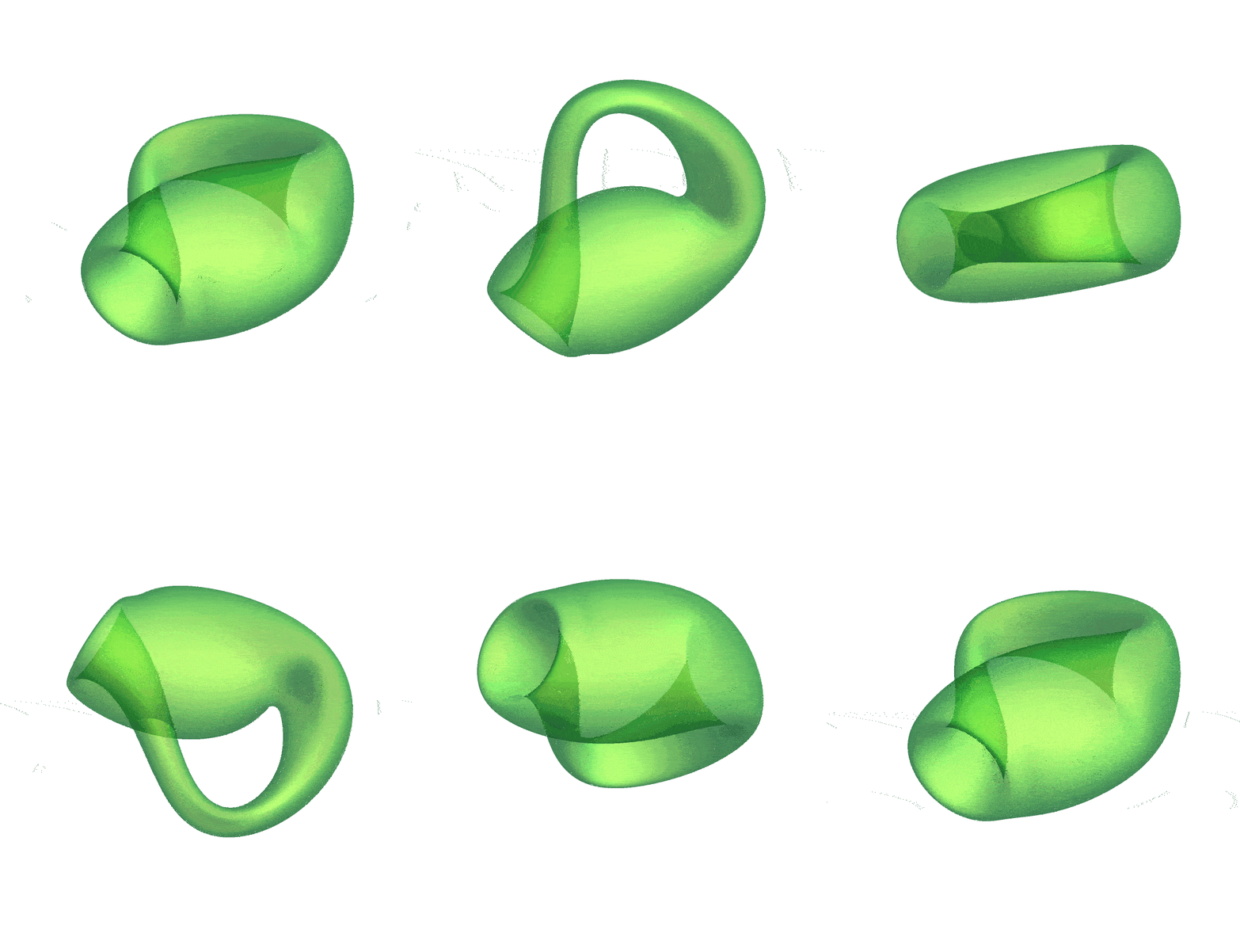
The famous immersion of the Four-Dimensional Klein Bottle in three-dimensional Euclidean Space. Own Work, created with Wolfram Mathematica

The Klein Bottle Sex Talk: Explaining To The Uninitiated How Klein Bottles Get It On!

In this article i will try to explain the "real", full Klein bottle, and also the confusing topological terminology around it. My title is, of course, inspired by the lovely little limerick by the Austrian-US Mathematician Leo Moser:

A mathematician named Klein Thought the Möbius band was divine. Said he: “If you glue together edges of two, You’ll get a weird bottle like mine.”

The Klein Bottle was discovered in 1882 by the German non-Euclidean geometer and educator Felix Klein. Weird and most wonderful it is indeed. And the limerick, above, as we shall see, is one precise description of its topology. But it is not the simplest, as a single Möbius strip can suture itself into a Klein Bottle, which can then split into two Möbius strips — this is like "asexual" Möbius Band reproduction! Or two Möbius strips can get it on "sexually" as in the Moser Limerick to produce a Klein Bottle, which splits into two Möbius bands which suture themselves into two copies of the Bottle!

Okay, i'm simply being weird and obtuse here, of course there isn't any relationship with biology, but sexual Möbius band coupling followed by asexual bottle splitting into two Möbius strips suturing themselves into two copies of the bottle is rather like alternating asexual and sexual sporophyte and gametophyte generations in plants — and especially in ferns (my fave plant), whose alternating generations look radically different. And Klein bottles definitely look biological to me, like weird and wonderful ovaries or wombs! Or little hatchling creatures! I almost expect them to make cute little chirps like a baby crocodile!

Please indulge Selena Ballerina's Weirdohood for a paragraph! Indeed in a flight of my fancy, a four dimensional Klein Bottle Womb might evolve in an alternative universe! Perhaps the Unsquidgable Gandanglious Space Cats of the Seventh Senfonian System bear their kittens from Klein Bottle Wombs, so that the kittens can be pushed into the higher embedding dimension when the mother is heavily pregnant and thus keep Mum more comfortable in those last weeks (you see, Mum interacts socially with other Gandanglious Space Cats through her three dimensional projection!) With gestation done, a Senfonial Egg Timer goes "Bing" and the little ones then know that its time to slide down the bottle's vagina (throat) and back into their three dimensional projected day-to-day Universe where their Mum usually lives! Hi Mum!

Cute Gandanglious Space Cat kittens being born from a Klein Bottle Womb in Manga Style

The Klein Bottle is undoubtedly the most famous object in topology, outside professional mathematical circles. It is an example of a two dimensional surface that requires four dimensions for a faithful, smooth embedding. The three dimensional object, which is often made by glass blowers, is actually an immersion — it’s not the full Klein bottle. This is because it intersects itself, so that points that are distinct in the real, four dimensional Klein bottle are double points at the self intersection in the three dimensional immersion. An immersion is a weaker, less stringent idea: an immersion is allowed to have double points where the bottle intersects itself as in the drawing below.
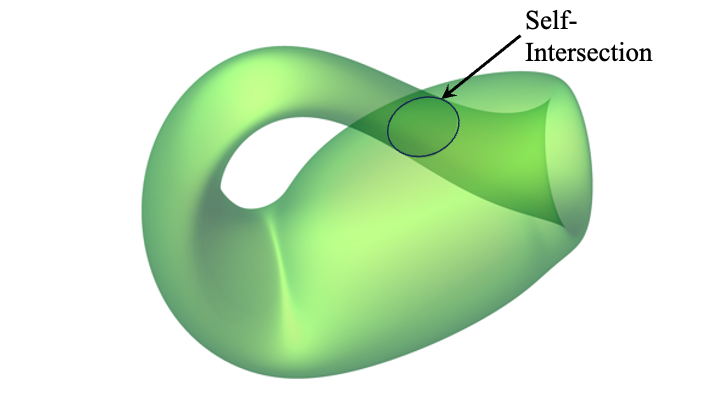
The three dimensional object beloved of glass blowers is an immersion, because it has double points at the self intersection. Own Work, created with Wolfram Mathematica

We know the Klein Bottle cannot be embedded in three dimensional Euclidean space, because such three dimensional embeddings of a compact, geodesically complete smooth surface (i.e. a compact smooth two dimensional manifold — we’ll come to the meaning of these words, but a Klein bottle is most definitely so) are always orientable, whereas the Klein Bottle is not. Lack of orientability does not count alone, for see the example of the flat (i.e. developable, having zero Gaussian curvature) Möbius strip, whose surface is perfectly Euclidean as long as it is thin enough (the aspect ratio of the paper strip we begin with must be greater than √3). I'll try to give you an idea of what non-orientable means in the next article.

Here's a Möbius Strip curling itself to suture itself along its edge to become a Klein Bottle, and then splitting into two Möbius strips asexually. The Klein bottle really does look like a yeast cell or some other primordial asexual life form! Two Möbius Bands get it on sexually by fusing into a Klein Bottle, whose surface can then mix their genetic material, then split back into two genetically mixed offspring, as in reverse process shown in the latter half the video below!
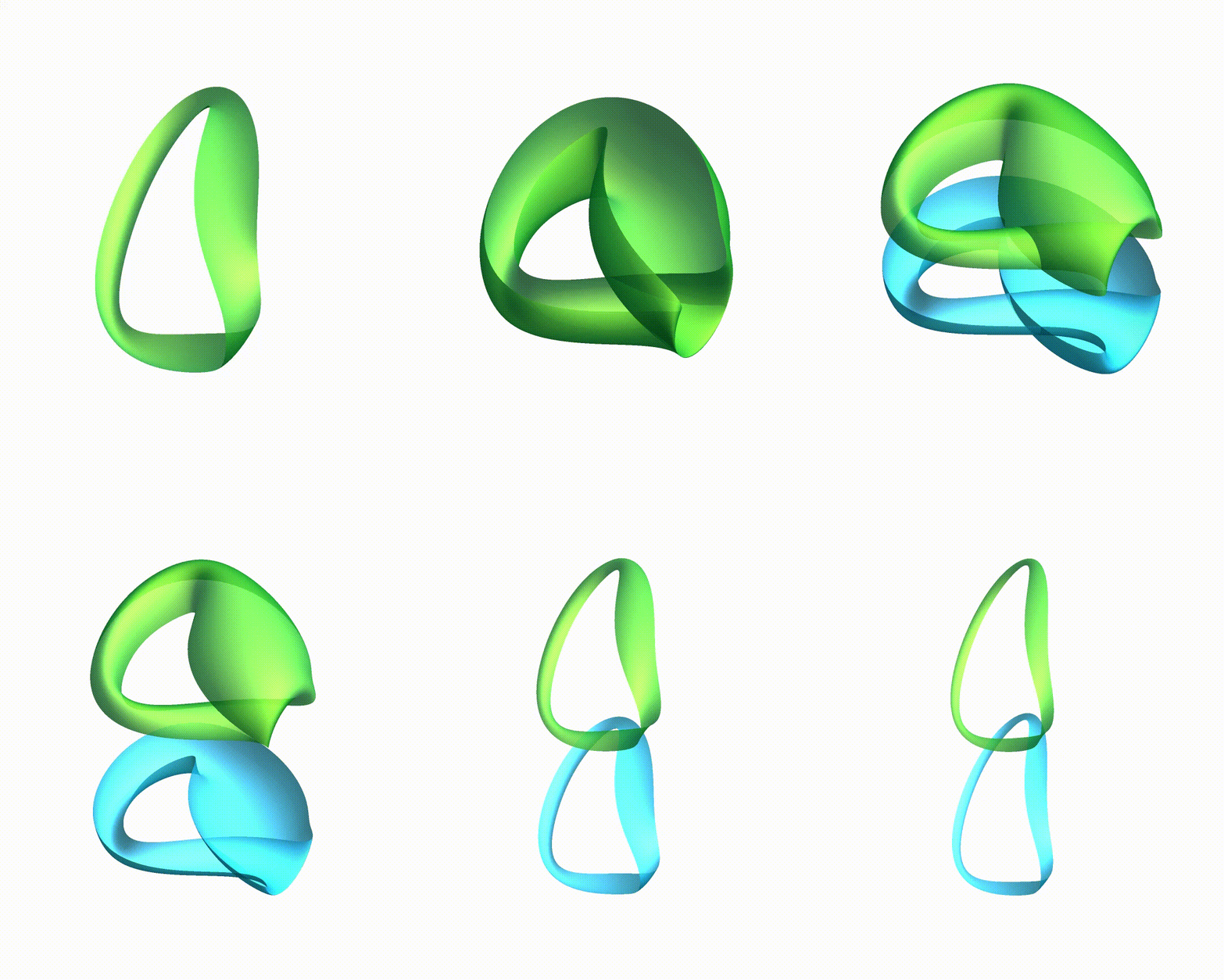
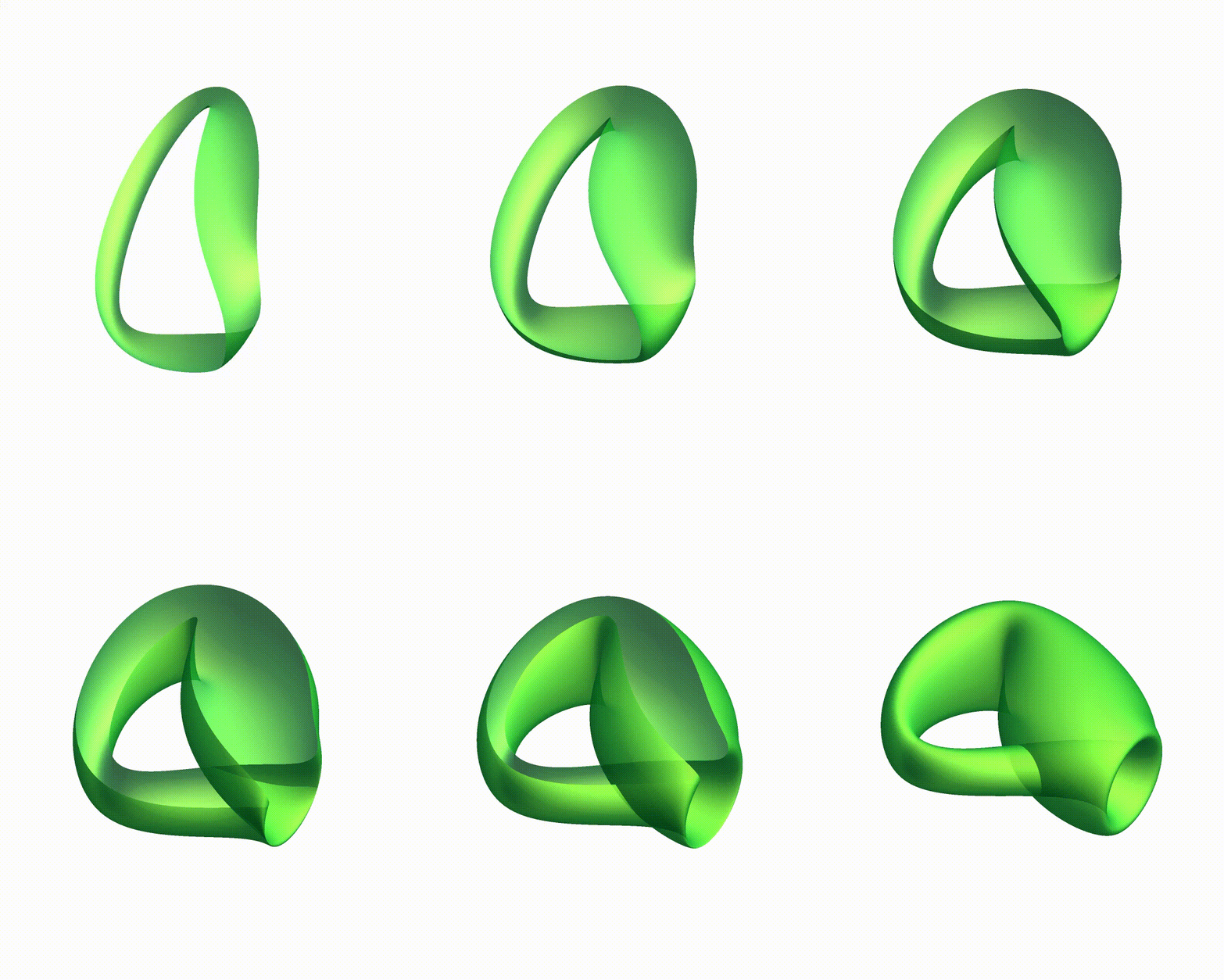
Asexual Möbius Strip Repoduction through self suturing into a Klein Bottle, then split ("Meiosis") into two Möbius Strip Offspring! Own Work, created with Wolfram Mathematica. In reverse, it could be a pairwise "sexual" coupling of two Möbius strips into a Klein bottle, that mixes genes and then splits!
Details of the Self Suturing of a Möbius Strip along its edge to form a Klein Bottle. I pause the morph at several points and rotate the image, so that you can see that the beginning point is indeed a Möbius Strip and ends up as a Klein Bottle. Own Work, created with Wolfram Mathematica

As a scuba diver, i find the Klein Bottle is particularly evocative of sponges and cnidarian lifeforms for me, so i really can imagine all this Klein Bottle sex happening in an underwater environment, like the magnificent vast and dazzlingly colorful cold water sponge gardens of the Southern Coasts of my birth land, Australia. These temperate and subtropical seascapes are even more dazzling and beautiful than Australia's famous Great Barrier Reef. Check the exquisite shapes and colors in this environment.

All Weird Bottles Can Find A Home In Higher Dimension Euclidean Space

A famous theorem, the Whitney Embedding Theorem, proven by the American mathematician and mountaineer Hassler Whitney tells us that we can always find a smooth embedding of a n dimensional smooth manifold in at most 2n dimensional Euclidean space. Many two dimensional surfaces can be embedded in three dimensional Euclidean space, but the Klein Bottle requires four to get rid of the double points in the three dimensional green glass bottles i have shown above. Indeed the main engine in the proof of the theorem is the so called “Whitney Trick”, which explicitly shows how to get rid of double points in higher dimensional embeddings and it is precisely these double points in our green bottles above that necessitate the Whitney trick and force the full requirement of four dimensions. As well as the Klein Bottle, the so called Real Projective Plane forces the full 2n dimensions required by the Whitney Theorem if the number n of dimensions is a power of two. The impossibility of embedding in a Euclidean space of dimension 2n — 1 can be explicitly proven in these cases, thus showing that the Whitney Theorem is not “Overconservative”.

Klein Bottle and Möbius Strip as Basic Building Blocks of Two Dimensional Reality

Far from being mere mathematical curiosities, the Klein Bottle and Möbius Strip are extremely basic to the geometry and topology of two dimensional surfaces. Together with the more familiar plane, cylinder and torus (doughnut shape), they exhaust ALL possibilities when we ask the question: what are the geodesically complete two dimensional smooth, flat (i.e. Euclidean) manifolds (roughly: 2D surfaces)? The other two possibilities, the Real Projective Plane and the Two Dimensional Sphere have Euler Characteristics of one and two, respectively, and thus cannont be given a flat, Euclidean embedding because the Gaussian curvature always has to be nonzero somewhere to fulfil the Gauss-Bonnet theorem.

As discussed in my curvature article, a flat surface is one whose distances are described by a Euclidean metric, or, alternatively, one for which the geometry of lines and figures drawn on the surface fulfill all of Euclid's geometry postulates, including the parallel postulate.

Geodesically complete means that if we begin and any point and follow any straight line, we can do so indefinitely without meeting a singularity.

Smooth means infinitely differentiable at every point — all derivatives, pure and mixed in all directions, are defined. Analytic is an even stronger adjective, meaning that for every point geodesics can be calculated in a (nonzero) neighborhood of any point from all those derivatives alone. That is, generalized Taylor series converge and are correct in that neighborhood. Smooth two dimensional, orientable surfaces are also analytic Riemann Surfaces owing to the existence of isothermal co-ordinates. This makes the non-orientable Klein Bottle, Projective Plane and open (with edge deleted) Möbius Strip a little bit pathological in the two dimensional manifold world. Analytic co-ordinates still exist (e.g., the parameterization on the Wiki page here), so they're not too pathological, but analytic continuation of a local analytic structure around closed paths can flip the unit normal to the surface, giving the manifold a non trivial structure group (the notion of fiber bundle has been studied to do calculus on manifolds, particularly non-orienatable ones like the Klein Bottle and Projective Plane).

"Pathologies" in mathematics actually lead us to richer notions that are more general than that of manifold with certain, fascinating singularities such as the Algebraic Variety. This is a very typical phenomenon — wrinkles and shocks leading to deeper understanding — in the history of mathematics.

Amazingly when we make a Möbius strip, as long as the aspect ratio of the piece of paper we begin with is greater than √3, as we make a half twist in the strip and glue the short sides together, the two dimensional figure remains developable. That is, it has zero Gaussian curvature because the paper can be bent without stretching, so any figure drawn on the paper remains undistorted when the paper is glued into the Möbius band. Angles, distances and all geometric properties of lines and triangles drawn on the Möbius strip fullfil ALL the Euclidean geometry axioms. Thus the Möbius strip is indeed flat. One can see this by squashing the figure down into a flat folded, origami Möbius strip. Draw, say, several right angled triangles at different rotated orientations on a strip of aspect ratio, say four or so and then make the Möbius band. Make the triangles of significant size relative to the strip so you can see that their shape truly is preserved and that there is not some subtle distortion going on. If you make the Möbius strip big enough, with an aspect ratio of greater than two, you should be able to get a protractor in to the spaces to confirm experimentally that the angles have not changed.

This is quite a visceral and mindblowing experience to see that the triangles stay perfectly undistorted and you notice that you can curl the strip into the band without sideways shearing or wrenching stress, and that the paper has no tendency to crease (as it would if the surface were curved). I will return to this in the next article with an evocative dressmaking experiment that, to my mind, affords vivid insight into the notion of developable and Euclidean two dimensional surfaces, their non-Euclidean counterparts and the notion of Gaussian curvature.

The creation of flounces and frills and other beautiful ornaments in dressmaking is the result of deliberate measures to introduce Gaussian curvature into flat fabric. This is also functional, as the human body's surface is not Euclidean either. The device of a dart is well known as a means of bringing both comfort and showing off one's curves by introducing Gaussian curvature through the principle of gathering — which is also the trick that makes gorgeous flounces and frills run. Curves. Wish i had 'em. I have tiny boobies and a little Po with subtle curves. I like my understated curves, but i often dream of being a pear! Fat Bottomed Girls You Make The Rockin' World Go Around! Okay, Sapphic Selena, take a deep breath and get back on topic!
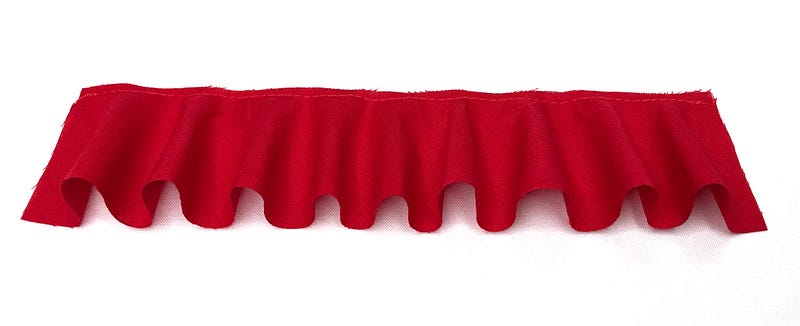
A Flounce Uses the Principle of Gathering to introduce Gaussian Curvature to flat fabric. Contrariwise, creases and flouncing in shear-stressed paper betoken the presence of Gaussian Curvature. A paper strip with an aspect ratio greater than √3 can be bent into a Möbius Strip with only pure bending forces and zero distortion of its Euclidean surface. Fair use of under the generous terms of the website of Anicka Design, who shares her creativity if given attribution. Please do visit her website if you have any interest in dressmaking.

To make the Möbius strip and cylinder into geodesically complete figures, i.e. so that geodesics won’t crash into either the two edges of a cylinder or the one edge of a Möbius strip, we must “delete” the edge(s) and make the direction orthogonal to the edges infinitely long. Think of something like mapping the interval -1

Creating a developable Möbius Strip by sweeping a line segment orthogonal to a circular loop along that loop, whilst rotating the line about the tangent to the loop through half a turn. Own work, created with Wolfram Mathematica

Then, we replace each finite line segment along the loop with an open segment.

So the infinite plane is a Euclidean surface that requires two dimensions for an isometric embedding. It's kind of trivial — there is no embedding, the plane itself IS the whole Euclidean embedding space as well as the the embedded two dimensional surface.

Next come both the cylinder and Möbius band — as we have seen, they can both be embedded isometrically as Euclidean two dimensional surfaces in three dimensional space.

Next we consider the torus. This requires three dimensions for a smooth embedding, as shown in the animation below. We begin with a square. The first stage is to roll a square (section of a flat plane) around an axis parallel to two of its sides to make a cylinder by suturing two edges together. This is an isometry, because a figure drawn on the paper inside the square is not distorted in any way — all lengths measured in the figure stay the same, as do angles between lines. The metric and the geometry remain identical. A similar example is how a disk with a sector cut out of it can be sutured together along the edges of the sector to form a conical shape; again, with no distortion of any images drawn on its surface.

The second stage is the interesting one. Here we must imagine our sheet's being made of rubber — the first suture makes a hosepipe and now we must bend the hosepipe around an axis orthogonal to the first rollup axis to make a torus embedded in three dimensions. This action stretches on its outer rim and shrinks on its inner rim, thus distorting a square checkerboard pattern drawn on its surface along the “standard torus”. Thus we can see the checkerboard undistorted after the first stage, but distorted after the second wraparound.
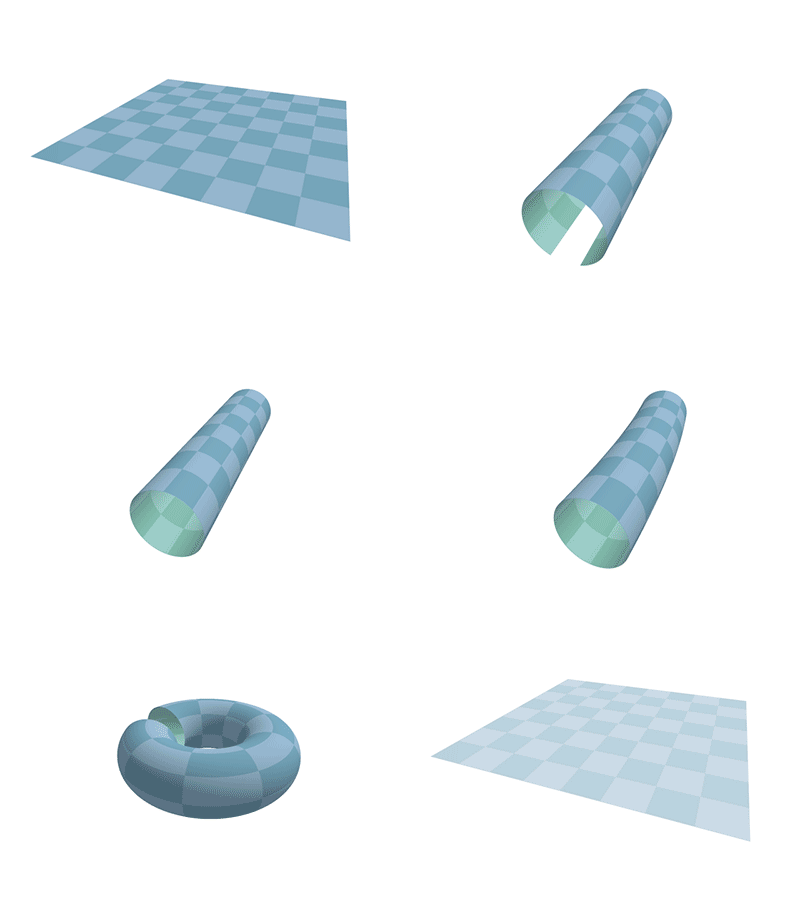
A plane being sutured into a torus; the first stage, suturing it into a cylinder, by rolling it up along an axis like a newspaper, is isometric and non-distorting. Thus the cylinder, from a mathematician’s viewpoint, is flat. In contrast, the bending around the orthogonal axis to connect the ends of the hosepipe together works a severe distortion of the checkerboard. Many thanks to the creator of this video Lucas Vieira for his granting of creative commons license through Wikipedia

So this is not a Euclidean surface. One can embed a torus in three dimensions, but not isometrically with the square sheet that it is made from smoothly. To achieve zero distortion smoothly, one must use four dimensions: the Clifford Torus, leaves the checker pattern undistorted. This magical beast is flat, in the sense that Euclidean geometry holds on its surface and its Gaussian Curvature is nought. If we drop the requirement for smoothness, we can use the Nash embedding to achieve isometric embedding in three dimensions, as i discuss in the next section.

The Klein Bottle needs the maximum four dimensions required by the Whitney Embedding Theorem for a smooth embedding of a two dimensional manifold without double points. The same applies to the Projective Plane.

But, unlike the other four — Plane, Cylinder, Möbius Strip, (Clifford) Torus, neither the double point free Klein Bottle nor the Projective Plane in four dimensions is flat. The Whitney theorem, although extremely general, says nothing about preserving flatness. The embedding in the Whitney theorem does not necessarily preserve the metric of the surface.

John Nash Finds Isometric Homes for the Weirdest Bottles

To find out how many dimensions we need for an isometric embedding, and therefore a flat Klein bottle, we need the Nash Embedding Theorems. John Nash, incidentally, was the mathematician depicted by Russel Crowe in the film "A Beautiful Mind".

There are three Nash theorems. Co-incidentally, the first and second give the same result: the Nash-Kuiper Theorem can be applied to the known, non flat four dimensional Klein Bottle Embedding to show that there is a flat embedding in five dimensions, because it says that, if you have any smooth embedding in n Euclidean space (in this case, we know we can embed the Bottle in four D), then there is a flat embedding in n+1 dimensions. So this tells us we need five dimensions to embed the flat Klein Bottle in Euclidean space.

The second Nash Theorem tells us that for any n dimensional Riemannian manifold, there is an isometric embedding in 2 n +1 dimensions. Again, our flat Klein bottle is two dimensional, so this tells us we need, again, five dimensions.

But these are strange embeddings. Nash embeddings from these two theorems have pathological behaviors, such as discontinuous second derivatives everywhere. This is fractal like behavior. The first derivatives are continuous everywhere though. Nash embeddings by the first two theorems are defined as the limits of a convergent infinite sequences that begin with a non isometric embedding and then add waves and corrugations to a manifold of decreasing amplitude and increasing frequency to alter distances anisotropically, i.e. with a preferred direction in the manifold to "straighten" deviations from isometry out.

Some idea of this process can be gotten by studying the Hévéa Torus, an isometric embedding of the Torus that requires only three dimensional Euclidean space for an embedding, instead of the four needed for the flat Clifford Torus. Whether or not you accept these constructions as "Flat" is questionable, as they are not smooth, but, by the basic definition through the metric, the geometry of triangles and figures drawn on their surface (good luck doing that literally!) most certainly fulfil ALL of Euclid's axioms, and so, to a mathematician, they are most certainly flat. Mathematics yields the most surprising results when concepts are probed deeply.

Now, this all sounds abstract until you think of the physical implications: since acceleration cannot be defined for any being moving on the surface of a Hévéa Torus (since the directional derivatives on the surface are everywhere discontinuous):

The Hévéa Torus is a perfectly Euclidean World, where ALL the laws of Euclidian Geometry hold, yet Newton's Laws of Motion Cannot Have ANY Meaning!

To get a smooth, isometric embedding keeping the smoothness, we need the last, highly pessimistic Nash theorem. This tells us that, to keep smoothness, an n dimensional compact manifold needs n(3n+11)/2 dimensions for embedding. So we need 17 dimensions for our poor little two dimensional Klein bottle if we want to give it a smooth Euclidean surface! Likewise for the projective plane.

Conclusion

Before moving on with our study of the five basic flat two dimensional surfaces let's summarize what we know:

  1. If one does not require an isometric embedding, then the Whitney Embedding theorem guarantees a smooth embedding for all these figures in at most four dimensional Euclidean space. Indeed, the plane (tautologically) requires two dimensions, the cylinder, Möbius strip and torus require only three dimensions, and only the Klein bottle requires the full four dimensional Whitney bound;
  2. The Plane, Cylinder, Möbius Band, Torus and Klein Bottle exhaust the universes of possibilities for a flat, geodesically complete two dimensional surface (although we've yet to prove this), respectively requiring 2, 3, 3, 4 and <17 dimensions for a smooth AND isometric embedding in Euclidean space. I could not find a definitive dimension number for a smooth isometric embedding of a Klein Bottle or Projective Plane less than the Nash upper bound of 17, so i don't know whether small dimensional Euclidean embeddings exist. I intend to ask this on Math Overflow or Maths Stack Exchange;
  3. Isometric means that they are indistinguishable from a flat plane by a creature living in that plane that can only take local distance measurements;
  4. Flat means that all the axioms of Euclidean geometry hold for the construction of geometric figures and behavior of lines and their intersections in the surface;
  5. Although local, metric measurements cannot tell any of these surfaces apart, a long range wandering creature on any of these surfaces aside from the plane will return to their beginning point if they follow a geodesic (shortest line between points) for one critical direction of travel in the case of the cylinder or Möbius strip. For the flat Torus or Klein Bottle, closed paths are achieved for any geodesic that makes an angle with a critical direction such that the angle's tangent is a rational multiple of the space's aspect ratio (i.e. the aspect ratio of the rectangle that is isometrically sutured into the figure);
  6. If this angle's tangent is an irrational multiple of the aspect ratio, our poor wandering creature's path will never close on the Torus or Klein Bottle. However, their wanderings will take them arbitrarily close to any point in space, including their beginning point, quasi periodically. We'll look at that more in the next article;
  7. If one requires an isometrically embedding but not smoothness, then the Nash-Kuiper and second Nash embedding theorem show that that the Torus can be isometrically embedded in three dimensional space, but its surface has first derivatives that are everywhere discontinuous. This is a quasi fractal behavior. Likewise, both the Nash-Kuiper second Nash theorem show that the Klein Bottle can be isometrically, but not smoothly, embedded in five dimensional Euclidean space;
  8. The third Nash theorem, concerned with smooth (infinitely differentiable) isometric embeddings, shows that we need up to seventeen dimensions to embed a Klein Bottle both smoothly AND isometrically. The same applies for the Projective Plane

References

Vincent Borrellia, Saïd Jabranea, Francis Lazarus, and Boris Thibert, "Flat tori in three-dimensional space and convex integration", Proceedings of the National Academy of Sciences (PNAS (France)) 2021

Rajnikant Sinha, "Smooth Manifolds", Chapter 7 "Whitney Embedding Theorem", Springer, 2014

Stillwell, J:, “Geometry of Surfaces”, Springer, second edition 1995

Geometry
Topology
Mathematics
Higher Dimensions
Dressmaking
Recommended from ReadMedium