
Weighted Boxes Fusion — A detailed view
A method to combine predictions from an ensemble of models.
Hello all, Hope everyone is having a good time and actively following your aspirations. In this post, I will be discussing the technique called “Weighted Boxes Fusion”. Let’s get started!
In the previous article, we discussed NMS and Soft-NMS techniques for filtering the predictions from object detection models. These techniques work well and are most used to date. These techniques work well for filtering predictions of a single model, What if you have predictions from multiple models? Weighted boxes fusion is a novel method for combining predictions of object detection models.
Introduction:
Aiming for high accuracies leads to the creation of ensemble models (mostly in competitions) in which all the predictions from different models should be merged together for final predictions. Weighted boxes fusion is used for merging all the predictions from multiple models. Unlike NMS or Soft-NMS methods that simply remove part of the predictions, WBF method uses confidence scores of all proposed bounding boxes to construct the average boxes. This method won’t discard any bounding box, instead, it combines them. This leads to an improvement in the quality of the combined predictions.
Comparison with NMS & Soft-NMS:
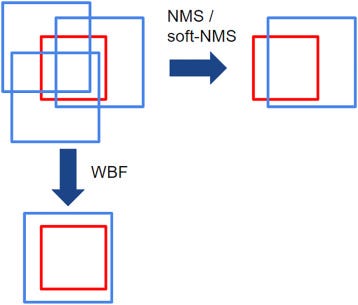
- Both NMS and Soft-NMS filters the boxes by discarding boxes with low confidence scores, but WBF uses information from all the boxes.
- WBF can boost the results where all the ensembled models predict inaccurate boxes, by taking an average of them. See the fig below for a better understanding.
Weighted Boxes Fusion Algorithm:
Inputs:
- List of box predictions from each model, each box is 4 numbers. It has 3 dimensions (models_number, model_preds, 4)
- List of scores for each model
- List of labels for each model
- List of weights for each model. Default: weight == 1 for each model (If more weightage should be given to a particular model, increase its weight to 2 or 3, etc.,)
- IOU threshold (To check overlap)
- Confidence threshold (to discard boxes of low confidence score)
- Confidence type: Max, Avg (how to calculate confidence for averaged boxes)
Outputs:
- List of final boxes
- List of final confidence scores
- List of final labels
Algorithm:
Create a dictionary of labels and corresponding boxes from all the models like shown below and Sort each list in dict by score.
Boxes = {label_1:B_1,label_1:B_2,...label_n:B_n},
where B=[[score1, x1,y1,x2,y2],[score2, x1,y1,x2,y2],...]
Now the below algorithm is explained for each label in the dictionary, B1, B2.
- As we know from above, B_n is a sorted list of boxes for label_n based on confidence scores.
- Declare empty lists L and F for boxes clusters and fused boxes, respectively. Each position in the list L can contain a set of boxes (or single box), which form a cluster; each position in F contains only one box, which is the fused box from the corresponding cluster in L.
- Iterate through the boxes in B (b¹,b²,b³,..)and find the matching box in F. The match is found if the IOU of box b¹ with the box in F is greater than the threshold. Here b¹ is a single box, whereas F can have multiple boxes. So IOU calculation is done with every box in F and finalizes the index (pos)at which it got the highest IOU with b¹.
- If the match is not found i.e., if no box in F has IOU greater than the threshold with b¹, then append the box b¹ to F and L as new entries and proceed to b².
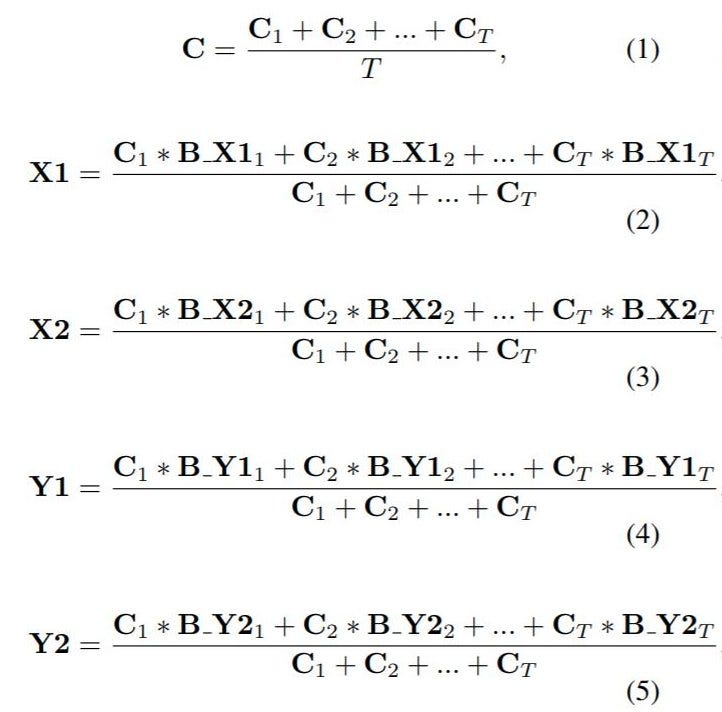
- If the match is found, then take the index (pos) of the matched box in F and add the box b¹ to L at that index. Recalculate the box coordinates and confidence score in F[pos], using all T boxes accumulated in cluster L[pos] with the following fusion formulas — (1),(2),(3),(4),(5).
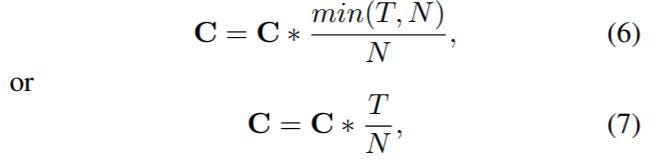
- After all boxes in B are processed, re-scale confidence scores in F using the below formula — (6),(7). Rescaling the scores is necessary to give weightage to more prominent boxes — if the number of boxes in the cluster is low it could mean that only a small number of models actually predict it and we need to decrease confidence for such case.
Code module:
Below is the sample code module, find_matching_box() and get_weighted_box() are not shown here to keep it simple.
find_matching_box(): Performs step-3 in the algorithm
get_weighted_box(): Performs step-5 & 6 in the algorithm
overall_boxes = []
for label in Boxes:
    boxes = filtered_boxes[label]
    new_boxes = []
    weighted_boxes = []
    # Clusterize boxes
    for j in range(0, len(boxes)):
        index, best_iou = find_matching_box(weighted_boxes,\
                                            boxes[j], iou_thr)
        if index != -1:     #No match found
            new_boxes[index].append(boxes[j])
            weighted_boxes[index] = get_weighted_box(
                                             new_boxes[index],
                                             conf_type)
        else:
            new_boxes.append([boxes[j].copy()])
            weighted_boxes.append(boxes[j].copy())
    # Rescale confidence based on number of models and boxes
    for i in range(len(new_boxes)):
        weighted_boxes[i][1] = weighted_boxes[i][1] *
                               len(new_boxes[i]) / weights.sum()
    overall_boxes.append(weighted_boxes)
Applications:
WBF have applications in 2 major scenarios:
- Ensemble models —predictions from different models on the same data
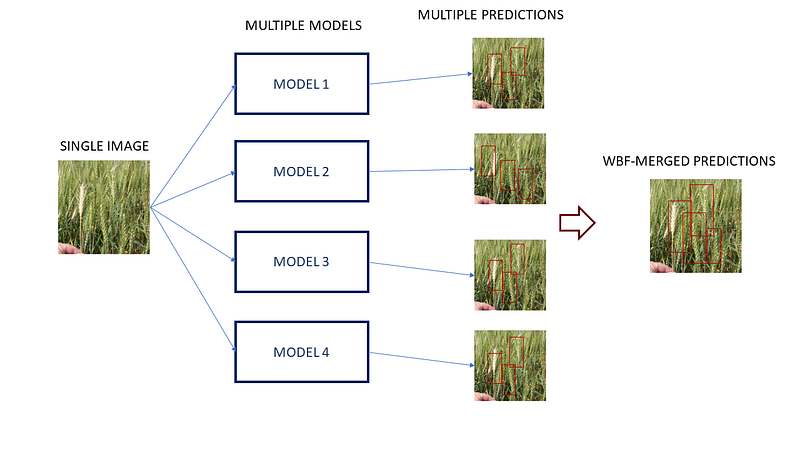
- Predictions from Single model with Augmented data
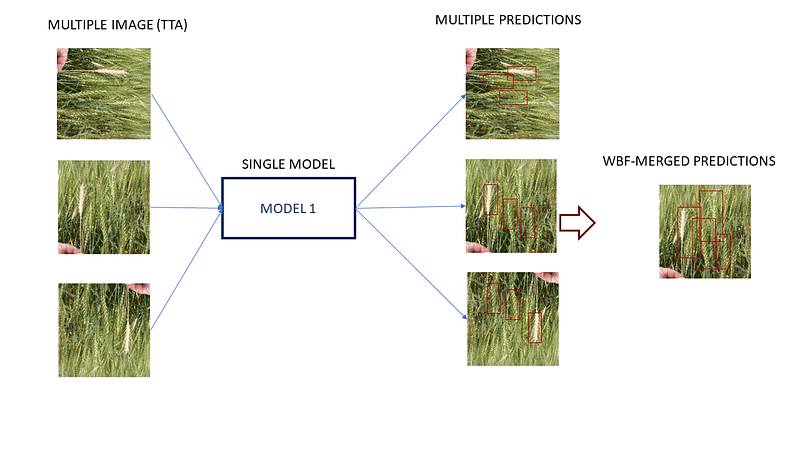
WBF gives better results than NMS & Soft-NMS in both cases.
- WBF can also be used in the ensemble of manual labels from experts in medical applications.
WBF — an alternative to NMS?:
Sadly WBF gives inferior results on the single model use-case compared to NMS. Here are the results from the ablation study conducted by the authors:
Model: RetinaNet detector with the ResNet152 backbone trained on the Open Images dataset.
Results:
- NMS with default IoU threshold = 0.5 — mAP: 0.4902
- WBF with optimal parameters — mAP: 0.4532 (IoU threshold = 0.43, score threshold = 0.21)
That’s all for now, Hope you got something out of it. Below are the references to check out. Thank you.
References:
Join my weekly newsletter to get the latest updates and recent advances in AI along with curated stories from the medium on Machine Learning.


