Weekly Prompt: Character vs Environment
How does the world, the walls, and the wind, batter your hero?

Welcome to the third weekly challenge for August, where the theme is Rings of Conflict.
As we said in the Monthly Theme announcement, this month focuses on the interactions between the many forms of conflict. Each week we’ll look at a Ring of Conflict as they interact and affect your stories.
There’s a quote I’ve heard on writing podcasts — more than once. And every time it’s doled out like it clearly explains just how to go about writing a story.
But for me, at least, it made sense on the surface, but when I got down to writing, I still didn’t get it.
“In the first act, get your hero up a tree; in the second act, throw stones at him, and in the third act, get him down safely.”
George Abbott, the veteran director-playwright
The problem was, I never knew where to get the stones from and how to make them seem relevant or sensible within my story. So many of the problems or obstacles I’d used in past novels felt contrived. Placed there simply to guide puppets through a play.
While exploring and assembling these prompts, it became much clearer that thinking of stories as layers of interacting conflict gives one more than enough stones to knock any hero out of their tree.
So, this week you get to add the environmental conflict
Perhaps your band of plucky heroes have ventured out of their city, fleeing their conflict with another character. A guardian turned villain. Or perhaps a spurned lover. Or some other power-hungry antagonist.
Maybe that society has churned them out, branding them as outcasts, no longer part of “Us” relegated to the much-maligned “Them.”
Exiled to deal with the world at large. Or trapped and forced to deal with a world within walls. Every environment has boundaries, and every story has a scale relevant to its narrative.
Challenge Requirements
Your story must:
- Optionally: Take inspiration from any ONE of the generators below and use that to add yet another layer of conflict to your story.
- Your story must consider the environment as a source of conflict.
- Be minimum 100 words long and maximum 1000, excluding the title, subtitle, and post-story bio/links. (We use Medium’s own word count feature.)
- Be fictional, even if it includes factual information or concerns.
- Use “Blizzard” as one of your five tags.
Considering Environmental Conflict
I often find the novel I’m reading somehow ties into the prompts I end up writing.
This week, I’m reading Branden Sanderson’s, Alloy of Law. In the current chapter, two characters are trying to puzzle out a kidnapping. Marasi, a brilliant young student, is questioning the effectiveness of lawmen (to her potential love interest — a grizzled lawman), at which point she raises an interesting theory.
It’s called the Broken Window Theory; I’ve heard about it before when it was applied successfully to New York City in the ‘90s.
The broken windows theory states that any visible signs of crime and civil disorder, such as broken windows (hence, the name of the theory) vandalism, loitering, public drinking, jaywalking, and transportation fare evasion, create an urban environment that promotes even more crime and disorder (Wilson & Kelling, 1982).26 Jul 2021
So by cleaning areas up, fixing windows, picking up litter and improving the overall aesthetic, a government could reduce crime more cost-effectively than by increasing the number of lawmen.
See what cool things you can put into your books. You just need a student character to fall in love with the hero and impress him with her smarts.
Book nerdery aside, this raises an important point about how people are the products of their environments. A rundown post-apocalyptic setting can shape Mad Max sort of mayhem. A haunted mansion can affect sanity and drive insane behaviour. Milieu maketh man.
So if you want to create problems, criminality, and disorder, you know what you need to describe. And how you can use the environment to shape the people.
N. K. Jemison does this to great effect in her Broken Earth series (a triple Hugo winning series), where earthquakes and eruptions constantly threaten society, and a few powerful people control this environment. Thus elevating these few into both the elite strata and the lowest of lows. Due to the double-edge sword of their power.
More Book Nerdery: This is a great example, probably the only one I’ve ever seen, where an author successfully used Second Point of View. The gist is that where you live or find yourself, your environment shapes your behaviour. That's very useful for a writer. Knowing basic psychology and how it impacts the fictional minds we carry around in our heads lends that much more realism to our stories. Informing how they’re driven or how they resist. It's obvious with the weather but far more subtle with broken windows.
What happened to Nature?
One final point of clarification, I prefer the definition of Character versus Environment instead of saying Character versus Nature.
Environment encompasses nature and other places where the walls bear down on you, unnatural places that no less shape your actions than a blizzard or a jungle or battling the wilds and their beasts.
A City can be an environment. I’d argue that Gotham is one, being both society and environment, breeding a particular kind of villain and, in turn, a very distinctive kind of hero. The Hive Cities of Warhammer 40K are definitely another example of an artificial ecosystem. Far more than simple society.
Read on for examples of environments you could use.
So what will it be?
Now that I’ve gotten that self-serving definition in place. Which environment will you choose to impact your hero?
Somewhere dark and dank
Will you throw your Fantasy heroes into a claustrophobic dungeon? Or an old ruin on a distant planet. There are many ways for there to be a dungeon in your story and for your hero’s poor soul to be tormented there.
I’m definitely going to try to work one of these into the third part of my contemporary vampire story. Fighting against the established order is going to get you thrown in the dungeon.
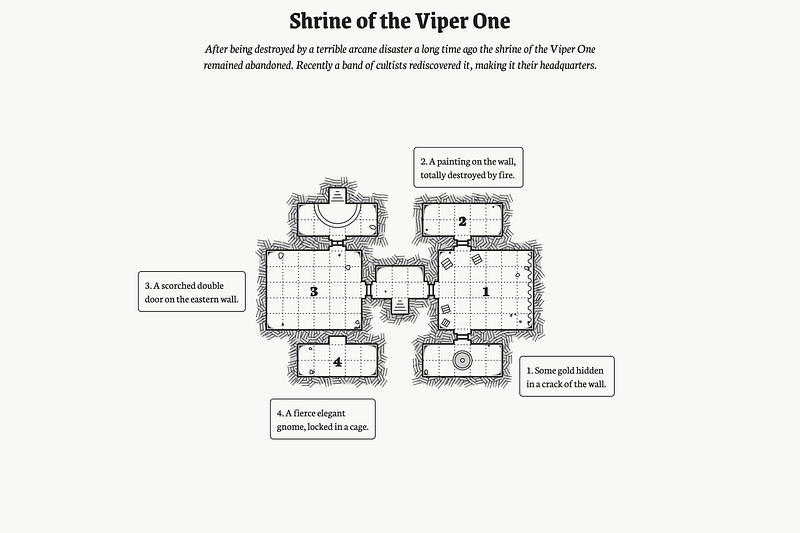
*As always, use as much as you want of this; it’s for the fun of divergent thinking and the sparks of inspiration that come from adding odd things into your brain and stirring it about.
But perhaps you want to cast your hero into the wilderness
Send them to the Barrens! Let them deal with exile and fend for themselves! Well then, here’s a map for you to find a place to have them toil and struggle.
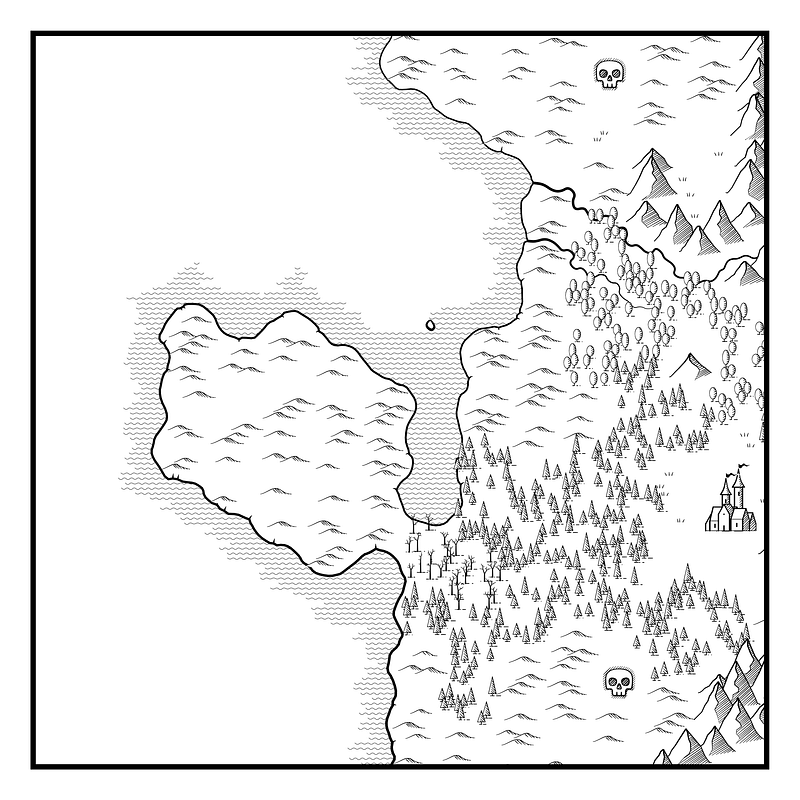
Generate your own map below — the map legend has some fun name ideas. Toggle it by pressing L (if yours is off when you start).
Or will it be planet-sized trouble
Perhaps your vision is grander, or just racier and spacier. Generate your hero, or his plucky back of space pirates, their own planet. Take inspiration from the little blurb and see if you can work any of that into the next part of your story. This one might test you, but that’s part of the fun.
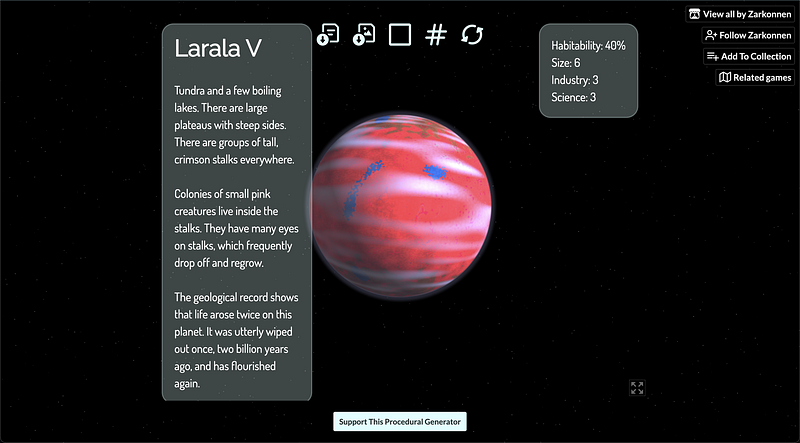
Here’s another pretty planter builder, but there’s no handy blurb for ideas.
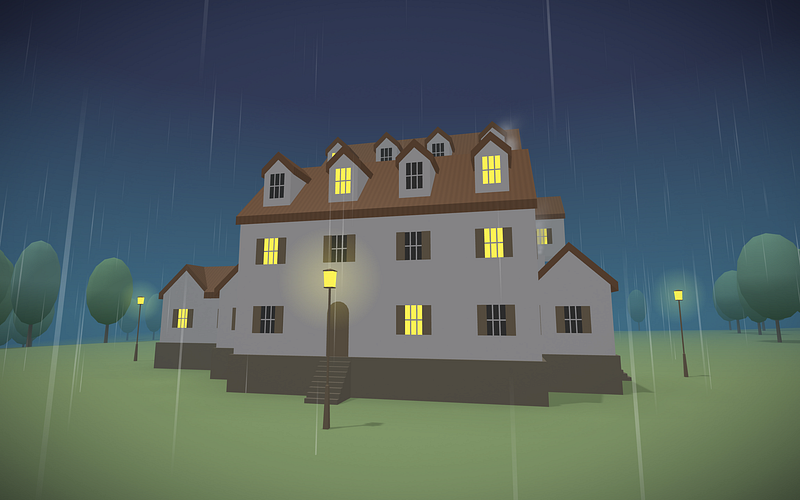
Or will you keep all the fighting under one roof?
You might think this one is a cheat, but a pretty good film was once set in a single room. Truth be told, I haven’t seen it, but my wife said it was pretty good. (See Room and no spoilers for Zane).
Whichever one you choose, consider how the environment can come to bear on your story, how it could add its own flavour of struggle and strife.
“Just for the record, the weather today is calm and sunny, but the air is full of bullshit.” ― Chuck Palahniuk, Diary
Links to Amazon are affiliate links at the pub will get a microfiction sized commission if you buy anything. ❤️