
Wednesday Wisdom: Election Day
Something Like The Truth, Vol. 1, Issue#3 —an Authenticity Chronicle proposal
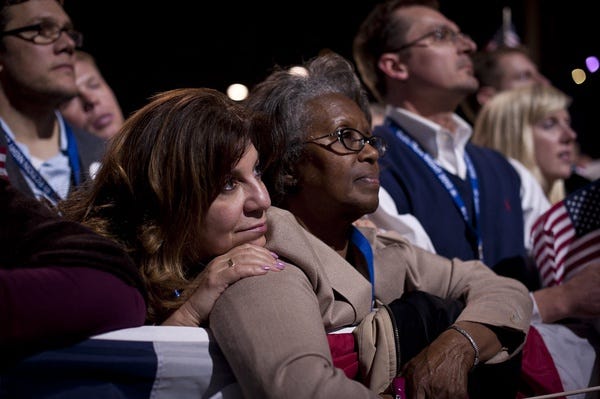
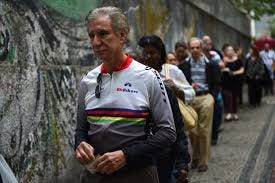
Election Day, upon us in less than a week, is a chaotic jumble of slogans, traffic, desperate TV spots, pundits with statistics, pundits ignoring reality, desperate sleep-deprived candidates — and in 2020 includes paramilitary groups threatening, or threatening to defend against, violence. Election Day is also the orderly filing out of buses of senior citizen groups, the imposed quiet and lack of visual clutter near polling places, the hushed and reverent backroom handling of ballots, and the simple image of a written-out vote slipped into a box monitored by local leaders or village elders.
In a third-world country’s first election a few years back, I decried the corruption, the fraud, the hypocrisy of staging an “event” and calling it a democratic process, but then I watched Election Day: the elders slowly moving from bus to voting table or booth, the folding of the slip of paper, the hand tremor making the thin slot in the ballot box a challenge, the small but mighty victory of steadying one’s hand to complete the vote …….. staged or not, a shallow image perhaps, but it was a moving and important collective effort that in my cynicism I could not deny — you have to start somewhere.
SACRED ELECTION DAY
Election Day should be a celebration — here in the U.S. we need to make it a national holiday.
The arguments against it are weak:
- It won’t pass Congress — they said that about national health care, a much harder sell.
- Some people still won’t get to the polls — but we have Uber, Lyft, taxis, vans for senior centers, unused school buses —and there are companies lined up now to give their employees the day off, but that Election Day participation would be a private solution, not a federal one. Give everyone a holiday and call on the generous companies to sponsor transportation if they want to contribute.
- Retail stores are open and those employees will be disadvantaged — we can utilize limited mail-in ballots (more on that later), relocate polling places, find half-day work solutions ….. this does not seem insurmountable.
There is a backlash against the build-it-and-they-will-come sentiment that I have come across in many endeavors in recent years. It seems that the magical qualities of place and synergy and the human spirit are a threat to the planners and the detail hounds and the data experts, and it is easy to disparage the ethereal qualities of intuition and inner knowledge, so the careful planners tend to win in most cases. But Election Day should be “built,” and it will become the celebration it should be.
ROGUES IN POWER
I realize my position about the joy and elevated spirit we would experience won’t work for many, so I’ll define some practical factors favoring this proposal.
1. In the mail-ballot world of 2020, an Election Day holiday may seem an idea whose time has passed. But look at the chaos the current system is causing— nationally, with the incumbent in charge of the postal service, anticipation of mail-ballot fraud becomes the justification for not accepting a result, and the dispersed arrival of paper to locations creating security gaps and the potential for mayhem and worse. We can go back to mail-in ballots for military personnel and other special circumstances and give democracy the visible national gala it deserves. If it has trouble passing Congress, maybe there’s a rider we can add to the bill — I’m sure favorable members of Congress can think of something. Don’t they have a lot of practice with that sort of thing?
We need to be smart about the details. All the assurances in the world won’t stop a crafty candidate or their supporters from casting doubt on mail security. The incumbent’s ability to control the Postal Service and limit ballot distribution and return is a blatant power move not worthy of a country that has a pretty good record of fair elections. The holiday concept returns mail ballots to those with great need. And we get a collective ritual that could play a part in healing some wounds. Sorry, I’m getting ethereal again but I believe in this.
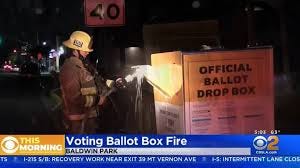
2. We’ve left open the opportunity for schemers to create rogue ballot boxes. In California we have folks taking advantage of a law that allows people to turn in the ballot of a friend or relative. Members of churches, clubs, and other groups have hundreds of friends, and so a ballot box is set up for convenience to be submitted by one of the friends.
That is the largest problem we are facing right now. Election officials have ordered this activity to cease, demanded to know the locations of the boxes and the names of the voters who submitted ballots. The organizers of the rogue box system have refused to comply, and expect to turn in their boxes and ballots on Election Day, having run a parallel system outside of the authority of the Secretary of State and election officials.
And if the boxes are refused, has it been set up that this could be the basis for challenging the election results?
3. All best practices in large activity management are ignored here. Too many days, too many places, too much paper, too many people involved, too much conflict of interest — high potential for tampering, theft, loss, hijacking, side deals, electioneering ……. given the complexity and high stakes nature of elections, and the passions that arise in what amounts to a competition between belief systems that are fundamental to an individual’s way of life and way of seeing the world ……. who would design a system like we have now, with the State Attorney General on TV threatening to prosecute violators, unknown shadow-electors “harvesting” votes favorable to their cause, paper flying all over the State in wildfire season, ready-made excuses and justification for Election Day losers to challenge the outcomes?
This is simply not the way to go about a fair and honest election. And we’ve done it to ourselves. I appreciate the convenience of the mail-in ballot but a holiday would be even better. We could have Election Day parties like we have Super Bowl parties. Maybe with this much focus on the election, we could come to a common understanding of the Electoral College.
THE ELEPHANT IN THE ROOM
7. The Electoral College is a way to slot votes into regional scores, instead of a straight “most votes win” rule.
I am going to start out with sports analogies here. In tennis, four points wins a game, and winning six games awards a “set.” If the six-game “set”winner won those six games in close battles, and the other player in winning only four games won those by a wide margin, it is possible that the loser of a set would actually have won more points. Win two or three sets depending on the tournament and it is “set and match.” The winner can win less games and points than the opponent but has grouped their points together in keeping with the rules of the game.
In boxing it’s even more controversial. Winning a close round is scored 10–9, yet a decisive advantage in which no one is knocked down is still scored 10–9. A knockdown is scored 10–8, and in the rarest of cases a 10–8 score is awarded without a knockdown, if the advantage is overwhelmingly to one fighter — but in many cases that kind of advantage causes the referee to stop the fight. Many fights with supposedly obvious outcomes result in surprising decisions — sometimes due to poor judging but often due to the round-by-round scoring. The more powerful and impactful blows seem to have come from one fighter, but the small margins in other rounds count equally, and the crafty, workmanlike technician often wins on points in outcomes that baffle and infuriate audiences.
There are reasons these sports designed their scoring like this, having to do with the style of play they were encouraging, and the tendency for the smaller increments to control runaway dominance and keep matches closer and audiences more engaged. I mention this to show that forms of this mathematical system have been used in places beyond the Electoral College.
The Electoral College treats each State like a “game” and the final electoral vote tally like a “set and match.” It was created at a time when states were almost nation-states and not bound to central authority. Their internal vote was to be unified and presented as a bloc that enhanced their influence. To further elevate states’ importance, while population was the basis for their initial electoral vote allocation, two more votes were added to each individual state to further strengthen the role of smaller states.
With 103 votes (50 states x 2 votes+ 3 DC votes) added on above the 435 votes based on population, there’s a 23% boost; of the 538 Electoral Votes in total, the disproportionate bloc is 19%.
Today, Wyoming has 600,000 people and 3 electoral Votes, for a ratio of 1EV::200,000 people. California, at 40 million people and 55 votes, clocks in with a ratio of 1EV::727,000 people. Electorally, an individual Wyomingite’s vote value is 3.6 times more than a Californian’s. The national average EV per population ratio is most closely attained in Missouri and Indiana in the 1EV::612,000 range.
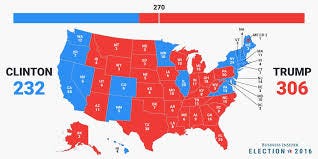
Twice in 4 elections a candidate with the popular vote plurality lost in the Electoral College.Was the 103 add-on votes the problem? Looking at the 2016 election, Trump won 31 states, Clinton 19+DC. Subtract 62 EVs from Trump’s 304 and he has 242 EVs; eliminate 41 EVs from Clinton’s 227 and she totals 186: closer, but nowhere near a victory.
In 2000, Bush vs. Gore, we see the effect of the 23% boost: the tally of 271–266 in Bush’s favor dissipates quickly: Bush carried 30 states, and the 60 extra EVs that came with them brings his total down to 211; Gore loses 43 EVs for his 20 states + DC, and his final total would be 223 — a close but clear winner.
The 2016 election was so surprising, so unpredictable, and revealed such a split in this country that it is difficult to trust any sweeping statements or take polls seriously. We are a far cry from watching a villager proudly, almost reverently, cast their paper ballot in a wooden box as an armed guard stands stoically nearby, at once oppressor and protector. In our world of complex numerical systems, and the strategies employed to master that system and produce a winning candidate, we can still cling to the one-person/one-vote concept, but barely — each person may have one vote, but its value can be far different in the larger scheme than someone else’s vote ……. but these are just the fever-dreams of statisticians and political science majors; something much more elemental is taking place out in the real world, where numbers are not foremost in people’s minds.
POST-ELECTION REALITY
On November 9, 2016, the day after Donald Trump was elected president of the United States, I was in San Francisco riding in an Uber at about 7pm. The driver was a young, impassioned, articulate, dread-locked black activist — I knew this because he spent the first 15 minutes of the ride on the telephone with a friend, I assumed, with whom he was sharing commiserations over the new president, and imagining all the things that could go wrong in a Donald Trump regime. The driver’s name was Ted.
At 7pm it was already fully dark and the night was rainy as well; the streets were slick and the metal grooves that held the cables for the famous cable cars made the ride even more slippery. The activist was driving a bit erratically: nothing dangerous but his concentration was off. He was still mumbling when he got off the phone, but soon quieted. We drove in silence for a while and I commented:
‘Crazy election, huh? And to think she had over 2 million more popular votes.’
He sprung on me quickly. I was in the back seat and he directed his response sometimes to me, sometimes to the front windshield.
‘I ain’t even trippin’ off that,’ he said, talking fast. ‘Have you seen that electoral map? Have you seen how much land is shaded in red? This looks like a red country to me. The whole middle of the country actually wants him as president. They don’t want you, they sure as hell don’t want me, they want him.’ He paused here, shook his head, his long locks flying around in disbelief. We were at a stop light, and he turned to address me directly. ‘Now I get the Electoral College,’ he conceded. ‘It’s the land. It’s like the land is voting and he dominates the land. It’s not one person one vote, it’s one acre one vote. And that’s a lot of red acreage in the middle of the country. A bloodbath of red.’
I didn’t go into my ideas about Election Day as a holiday. Ted was in no mood to celebrate. We came to a red light and he was able to turn around to address me. ‘I’m at peace with it, though,’ he said, his eyes wide and sincere, like man who had won that peace by conquering his share of inner pain. ‘At least I understand it now. Check out the map. It’s undeniable.’ We had reached my destination and I exited into the rainy evening. ‘I will check it out,’ I told Ted. ‘That’s a unique viewpoint.’
He was correct: the middle of America was a broad red brush stroke. The acreage had spoken. Ted’s brutally honest lens that forced him to see beyond his own party’s claim of popular vote supremacy was admirable, and he had a point.
In six days we’ll see what Election 2020 brings, and maybe there will be a new lens through which to view the election, and what it reveals to us in the third decade of the millennium about our earnest, fractured country may be yet another disturbing, complex truth.


