avatarStacey Schneider

Free AI web copilot to create summaries, insights and extended knowledge, download it at here

3893

Abstract

id="bff9">Literally, the idea for Web 3.0 existed for 15 years. It was well established. It was referenced often.</p><p id="ff5d">But, I guess Bitcoin was the shiny penny that made everyone forget Web 3.0 was so much more than blockchain.</p><h1 id="3ecf">Reviewing The Vision for the Web</h1><p id="ca4c">For all intents and purposes, the web we surf today was born 40 years ago, in January of 1983. It was an extension of previous efforts going back another 20 years, but functionally this is where the modern internet started.</p><p id="17c8">It has evolved in three big phases.</p><h2 id="ca7c">Web 1.0 — The Static Web, The Read-Only Web, The Publisher Web</h2><p id="8517">A static web with no search engines and few users interact. In Web 1.0 the information is read-only, and users can not even comment. The information on web pages is accessed by HTML, URL, and HTTP technology. This version was a one-way highway with very limited information and utility.</p><h2 id="e3d2">Web 2.0 — The Social Web, The Read-Write Web, The Reader Web</h2><p id="b72d">By 2005 Web 1.0 evolved into Web 2.0, also known as read-write or the social web, it was defined by users contributing content with posts, comments, and reactions on platforms like MySpace, Facebook, and YouTube. Web 2.0 created a more interactive web using the technologies like JavaScript, HTML5, and CSS3.</p><h2 id="5d9c">Web 3.0 — The Semantic Web, The Read-Write-Trust Web, The Dynamic Web, The Personalized Web, The Intelligent Web</h2><p id="9bd7">We are on the cusp of transitioning to Web 3.0, known most popularly as the semantic web, where information is machine-readable and computers use it to perform tasks on our behalf, in an inclusive and secure way. Web 3.0 requires advancements in blockchain, artificial intelligence, interoperability standards, decentralization, and, of course, ubiquitous access to the internet for every human.</p><figure id="2d45"><img src="https://cdn-images-1.readmedium.com/v2/resize:fit:800/1*BEpG4Bw13oFTkV7HF0JW9g.png"><figcaption>Key characteristics of the vision for Web 3.0. | 📸: <a href="https://medium.com/@sparkystacey">Stacey Schneider</a>.</figcaption></figure><h1 id="706e">Web3 Is Really Just Part of the Web 3.0 Vision</h1><p id="68c2">Even Wikipedia describes the definition of Web3 as “hazy”.</p><figure id="2023"><img src="https://cdn-images-1.readmedium.com/v2/resize:fit:800/1*k47YCfYpojzST4vpnhMmPQ.png"><figcaption>Wikipedia cites how the definition of Web3 is considered hazy. | Source: <a href="https://en.wikipedia.org/wiki/Web3">Wikipedia</a></figcaption></figure><p id="6726">I’d go as far as to say it's <i>lazy</i>.</p><p id="2a5c">The concept for Web3 is really a narrowing of the whole vision for Web 3.0, focusing on using blockchain to rewrite the data privacy paradigm for the web.</p><p id="ea10">To understand the progressive vision for the internet, its important to remind ourselves of how it is broken, and what we are trying to achieve.</p><h2 id="fbea">A short history of the Web by Stacey</h2><p id="c2c1">You see, when our forefathers first built the internet in the 60s, they took shortcuts. Scarcity or immaturity of technologies, speed to market, and sheer pragmatism meant those smart men and women made some big compromises early on.</p><p id="2f51">It was unavoidable.</p><p id="28ba">We built the internet to serve only one purpose—to establish connectivity. In the process, we failed to protect user privacy or data security and have been scrambling to compensate ever since.</p><p id="6928">Over the years, these weaknesses created a haven for bad actors and hampered the general utility and security of the web. According to the FBI, <a href="https://www.securityweek.com/cybercrime-losses-exceeded-10-billion-in-2022-fbi/#:~:text=The%20FBI%20received%20more%20than,revealed%20in%20its%20latest%20report.">cybercrime losses exceeded

Options

10 billion</a> in 2022.</p><p id="fd58">However, when you think about it, the real cost to businesses is how much time and money they spend securing data in an inherently insecure environment. For companies like JP Morgan Chase, these costs reach over 600 million a year.</p><p id="27c5">What’s more, 70% of data is created by individuals, yet 80% of data is managed by companies — and regular people around the world are really unhappy with their success record.</p><p id="3ec3">This is why we all want to modernize internet communications to be secure by default.</p><h2 id="0a40">Enter blockchain.</h2><p id="3b6c">As the protocols for blockchain matured, they started to disrupt our Web 2.0 world. Novel blockchain architectures promised to put full control of data privacy in the hands of its author, while at the same time, users were repeatedly being victimized by cybercrime.</p><p id="62b2">It was the first piece of the Web 3.0 puzzle to get real traction. It was thrilling too, because regular users finally felt like they had the power over what should have been theirs in the first place.</p><p id="1b2c">You see, traditional messaging systems are <b><i>receiver-based</i></b>, in that the recipient gets to decide how long messages live and how they are shared. A blockchain-based system can change this to be <b><i>sender-based</i></b> where the sender decides how long a message can persist or be shared during addressing.</p><p id="67c2">If you dig deeper into the tech and concepts like smart contracts coupled with cryptography, you have a complete set of safeguards designed to create confidence that private messages aren’t floating around uncontrolled or longer than you want them to. Ever.</p><p id="f299">This is huge. Its ramifications are impressive—not only can it protect your private data, but it also has several mission-critical applications, from secure battlefield communications to even replacing the entire backbone of the internet.</p><p id="08cd">Really big ideas, but only part of the picture.</p><p id="1e35">The big picture is an intelligent web that dynamically generates your user experience while protecting your data, and being open and fair to all.</p><p id="8d95">That means a whole lot more than blockchain.</p><h1 id="5d43">So, can we stop with Web3 already?</h1><figure id="727e"><img src="https://cdn-images-1.readmedium.com/v2/resize:fit:800/1*CUAFgsORnYJHtzAa4rSJLA.png"><figcaption>Please join me in stopping the confusing practice of Web3 and Web 3.0 | 📸: <a href="https://medium.com/@sparkystacey">Stacey Schneider</a>.</figcaption></figure><p id="0bdb">I realize I’m just one person. I don’t reasonably think I can change the whole internet, and topple the branding of Web3 on my own.</p><p id="9959">But, I can be really annoyed, and hopefully get you annoyed too. As a community, technologists are usually intelligent. As scientists, we are usually precise.</p><p id="5718">But this oversight shows we can be dumb. Or maybe we are just tired of correcting people.</p><p id="da93">But really—who thought we wouldn’t confuse the market more by renaming one of Web 3.0’s components Web3? And why are we accepting it? Why hasn’t it died yet?</p><p id="ec9b">Please join me in never using the term Web3 again. It's just blockchain, or decentralization. It doesn’t need another term, and it certainly doesn’t need to cloud our vision of where we are headed.</p><p id="e829"><i>That’s all for now — hope you enjoyed it!</i></p><p id="b07b"><i>If you did, please <a href="https://sparkystacey.medium.com/membership">consider becoming a Medium member</a> if you appreciate reading stories like this and want to help me as a writer. It costs $5 per month and gives you <a href="https://sparkystacey.medium.com/membership">unlimited access to Medium content</a>. I’ll get a little commission if you sign up via my link.</i></p></article></body>

Web3 and Web 3.0 Are Different, And It's Dumb

Blockchain takes all the glory, but there are 5 characteristics and a whole vision for Web 3 that we seem to have forgotten.
Web3 is only part of the story, and is a ridiculously confusing name for one of the components of Web 3.0. | 📸: Stacey Schneider.

I started working on the infrastructure and vision for the Internet in the 90s.

By the early 2000s, I was attending annual meetings of the World Wide Web Consortium (W3C). I helped establish Unicode so the whole world could talk in the same place. I helped invent C# in a secret basement project so Java and .NET could co-exist. I have supported dozens of big-name infrastructure projects along the way, including co-founding a blockchain company called Provide.

I’m even named on the (now expired) patent for how the whole world selects their language preferences on web applications.

Yes, my huge genius idea was a lookup table essentially. Not technologically exciting at all, but I was working on the globalization of the internet so early that no one had thought of this yet.

I am not trying to belabor or over-inflate my early accomplishments. I was one of many helping. The Internet is a massive project.

I am, however, trying to underscore that I’ve been working on the vision for the internet for my whole career—and I’ve had a pretty good seat at the party. I’ve watched it all evolve closely.

So, its pissing me off that everyone seems to think Web3 is just about blockchain.

Almost every day, my news feed mentions Web3—and every day I get more and more steamed.

The moniker was hijacked and warped.

Screenshot of the Web3 definition from Wikipedia.

Wikipedia shares that the term “Web3” was coined in 2014 and only gained popularity in 2021. And, it only focuses on the benefits of decentralization and blockchain technologies.

Somehow, around this inflection point, everyone seems to have forgotten Tim Berners-Lee crafted the idea for Web 3.0 in 1999.

I have a dream for the Web [in which computers] become capable of analyzing all the data on the Web — the content, links, and transactions between people and computers. A “Semantic Web”, which makes this possible, has yet to emerge, but when it does, the day-to-day mechanisms of trade, bureaucracy and our daily lives will be handled by machines talking to machines. The “intelligent agents” people have touted for ages will finally materialize.

— Tim Berners-Lee, inventor of the World Wide Web

Literally, the idea for Web 3.0 existed for 15 years. It was well established. It was referenced often.

But, I guess Bitcoin was the shiny penny that made everyone forget Web 3.0 was so much more than blockchain.

Reviewing The Vision for the Web

For all intents and purposes, the web we surf today was born 40 years ago, in January of 1983. It was an extension of previous efforts going back another 20 years, but functionally this is where the modern internet started.

It has evolved in three big phases.

Web 1.0 — The Static Web, The Read-Only Web, The Publisher Web

A static web with no search engines and few users interact. In Web 1.0 the information is read-only, and users can not even comment. The information on web pages is accessed by HTML, URL, and HTTP technology. This version was a one-way highway with very limited information and utility.

Web 2.0 — The Social Web, The Read-Write Web, The Reader Web

By 2005 Web 1.0 evolved into Web 2.0, also known as read-write or the social web, it was defined by users contributing content with posts, comments, and reactions on platforms like MySpace, Facebook, and YouTube. Web 2.0 created a more interactive web using the technologies like JavaScript, HTML5, and CSS3.

Web 3.0 — The Semantic Web, The Read-Write-Trust Web, The Dynamic Web, The Personalized Web, The Intelligent Web

We are on the cusp of transitioning to Web 3.0, known most popularly as the semantic web, where information is machine-readable and computers use it to perform tasks on our behalf, in an inclusive and secure way. Web 3.0 requires advancements in blockchain, artificial intelligence, interoperability standards, decentralization, and, of course, ubiquitous access to the internet for every human.
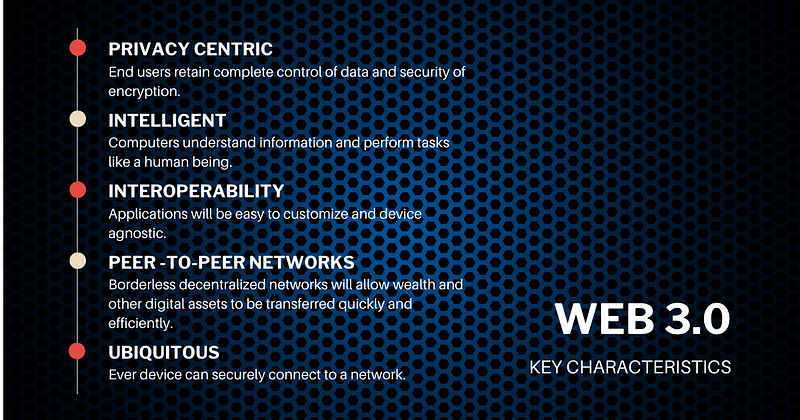
Key characteristics of the vision for Web 3.0. | 📸: Stacey Schneider.

Web3 Is Really Just Part of the Web 3.0 Vision

Even Wikipedia describes the definition of Web3 as “hazy”.
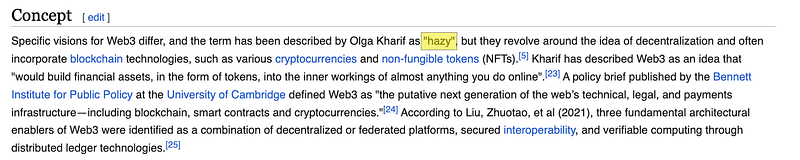
Wikipedia cites how the definition of Web3 is considered hazy. | Source: Wikipedia

I’d go as far as to say it's lazy.

The concept for Web3 is really a narrowing of the whole vision for Web 3.0, focusing on using blockchain to rewrite the data privacy paradigm for the web.

To understand the progressive vision for the internet, its important to remind ourselves of how it is broken, and what we are trying to achieve.

A short history of the Web by Stacey

You see, when our forefathers first built the internet in the 60s, they took shortcuts. Scarcity or immaturity of technologies, speed to market, and sheer pragmatism meant those smart men and women made some big compromises early on.

It was unavoidable.

We built the internet to serve only one purpose—to establish connectivity. In the process, we failed to protect user privacy or data security and have been scrambling to compensate ever since.

Over the years, these weaknesses created a haven for bad actors and hampered the general utility and security of the web. According to the FBI, cybercrime losses exceeded $10 billion in 2022.

However, when you think about it, the real cost to businesses is how much time and money they spend securing data in an inherently insecure environment. For companies like JP Morgan Chase, these costs reach over $600 million a year.

What’s more, 70% of data is created by individuals, yet 80% of data is managed by companies — and regular people around the world are really unhappy with their success record.

This is why we all want to modernize internet communications to be secure by default.

Enter blockchain.

As the protocols for blockchain matured, they started to disrupt our Web 2.0 world. Novel blockchain architectures promised to put full control of data privacy in the hands of its author, while at the same time, users were repeatedly being victimized by cybercrime.

It was the first piece of the Web 3.0 puzzle to get real traction. It was thrilling too, because regular users finally felt like they had the power over what should have been theirs in the first place.

You see, traditional messaging systems are receiver-based, in that the recipient gets to decide how long messages live and how they are shared. A blockchain-based system can change this to be sender-based where the sender decides how long a message can persist or be shared during addressing.

If you dig deeper into the tech and concepts like smart contracts coupled with cryptography, you have a complete set of safeguards designed to create confidence that private messages aren’t floating around uncontrolled or longer than you want them to. Ever.

This is huge. Its ramifications are impressive—not only can it protect your private data, but it also has several mission-critical applications, from secure battlefield communications to even replacing the entire backbone of the internet.

Really big ideas, but only part of the picture.

The big picture is an intelligent web that dynamically generates your user experience while protecting your data, and being open and fair to all.

That means a whole lot more than blockchain.

So, can we stop with Web3 already?
Please join me in stopping the confusing practice of Web3 and Web 3.0 | 📸: Stacey Schneider.

I realize I’m just one person. I don’t reasonably think I can change the whole internet, and topple the branding of Web3 on my own.

But, I can be really annoyed, and hopefully get you annoyed too. As a community, technologists are usually intelligent. As scientists, we are usually precise.

But this oversight shows we can be dumb. Or maybe we are just tired of correcting people.

But really—who thought we wouldn’t confuse the market more by renaming one of Web 3.0’s components Web3? And why are we accepting it? Why hasn’t it died yet?

Please join me in never using the term Web3 again. It's just blockchain, or decentralization. It doesn’t need another term, and it certainly doesn’t need to cloud our vision of where we are headed.

That’s all for now — hope you enjoyed it!

If you did, please consider becoming a Medium member if you appreciate reading stories like this and want to help me as a writer. It costs $5 per month and gives you unlimited access to Medium content. I’ll get a little commission if you sign up via my link.

Technology
Artificial Intelligence
Blockchain
Web3
Web Development
Recommended from ReadMedium