
Wearing Pants, Practicing Medicine, and Earning Medals as a Woman in the 1800's
Mary Edwards Walker was a gender-bending trailblazer
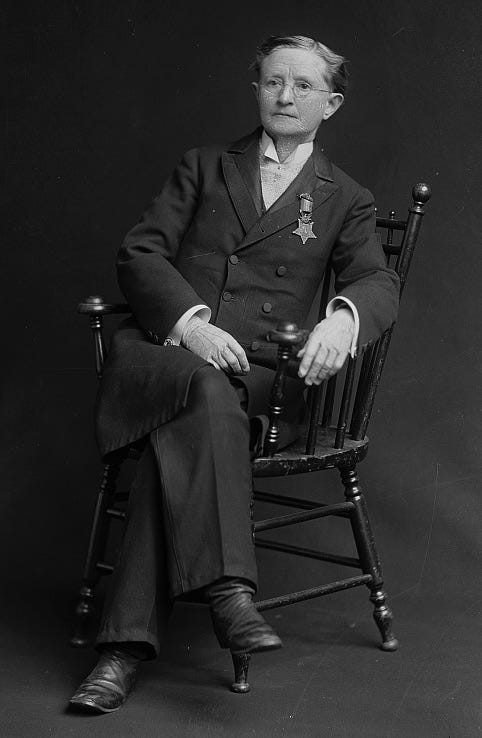
Wearing a top hat and a suit was so unusual for a woman in the late 19th -early 20th century you might get arrested. Being a decorated military surgeon was even more surprising. Mary Edwards Walker did both. She was a non-conformist in a time when bucking convention was treated harshly.
Abolitionists and free thinkers
Walker’s parents were abolitionists and free thinkers. If their daughter wanted to wear trousers and shirts rather than the fussy dresses of her peers, fine. And Walker did. Bloomers beat corsets any day for running around and doing farm chores.
Educating girls for anything beyond the domestic pursuits of raising children and keeping house was considered a waste by most people of the time, but Walker’s parents started their own school which educated all genders equally.
Not a lot of careers were open to women in the 1850’s so Walker and her sisters went into one of the few that was; teaching. She didn’t stay there long though before doing the practically unheard of and heading to medical school.
Getting married to a fellow student right after graduation was one of the more conventional moves Walker made in her life but even here she did it her way.
No flowing wedding dress with a long train for Walker. She wore a short skirt over trousers which was her norm. She also took the word “obey” out of the vows and did not change her name. To call these actions scandalous and unusual for the time is a major understatement.
Walker and her husband opened a medical practice together but it was tough going. Many people weren’t prepared to accept a female doctor. After four years the practice and the marriage folded.
Some people might have faded into the background after such a setback. Not Walker. She headed to the now long-defunct, Bowen Collegiate Institute in Iowa. She didn’t last long there, unfortunately. She joined the all-male debate team and refused to resign so the school suspended her.
When civil war broke out in 1861, Walker immediately headed to Washington DC to join the union army. After all, surgeons were going to be desperately needed and she was a trained and certified doctor. The Army wouldn’t commission her due to her gender.
Did this stop Walker? Nope. She started serving as an unpaid volunteer surgeon. In 1862 she was finally given a commission as “Contract Acting Assistant Surgeon (civilian).” She worked near the front lines, often crossing the line to treat injured civilians on the other side.
Captured and taken prisoner
It was on one of these trips she was captured by the confederates and taken prisoner as a spy. This report from the Richmond Sentinel in April 1864 gives a picture of the kind of attitudes Walker battled all her life.
The female Yankee surgeon captured by our pickets a short time since, in the neighborhood of the army of Tennessee, was received in this city yesterday evening, and sent to the Castle in charge of a detective.
Her appearance on the street in full male costume, with the exception of a gipsey hat, created quite an excitement amongst the idle negroes and boys who followed and surrounded her. She gave her name as Dr. Mary E. Walker, and declared that she had been captured on neutral ground.
She was dressed in black pants and black or dark talma or paletot. She was consigned to the female ward of Castle Thunder, there being no accommodations at the Libby for prisoners of her sex. We must not omit to add that she is ugly and skinny, and apparently above thirty years of age.
Castle Thunder was notorious for disease, overcrowding, and torture. It was even investigated for its violence by the Confederate Congress who eventually decided they had more pressing battles to fight and would let the abuse continue.
Even while in prison Walker refused to wear traditional feminine garments and instead wore the outfit she had created as a military doctor, a mid-length skirt over trousers and a buttoned coat. After four months at Castle Thunder she was released in a prisoner exchange, and she immediately went back to work as a military surgeon.
Her time in prison led to a disability pension for muscular atrophy awarded after the war. In 1865, she was awarded the Medal of Honor for Meritorious Service. She is the only woman to ever receive this honor.
In 1917, two years before her death, Congress stripped her of her Medal of Honor arguing it was reserved for military members only and Walker was technically a civilian. Walker ignored this slight, refused to return the medal, and continued to wear it proudly for the rest of her life.
60 years later, her right to do so was reinstated by Congress who recognized her service as being civilian in name only due to the prejudices of the time.
Fighting for women's rights
Walker spent the rest of her life fighting for rights for women. Even here she was a free thinker often going against the prevailing trends of the movement.
She firmly believed the Constitution already granted women the right to vote and regularly attempted to do so. No amendment was necessary according to Walker, simply a recognition by Congress of rights already present. She continued to hold this position even when the suffragette movement fought for an amendment.
When feminists dropped the bloomer trend of a short skirt over trousers due to the ridicule it received on all sides, Walker went to full trousers and suit coat complete with matching top hat rather than revert to traditional feminine clothing like most other woman reformers of the day.
Walker considered dress reform and women’s rights to be closely linked. Grace Wagner, of Syracuse University, notes in “Durable and Elegant”: Mary Edwards Walker and Dress Reform:
She did not see how equality between the sexes could be achieved if women were not able to easily move and thus perform the same, or similar, work as men.
Wanger shares several original documents from the Syracuse University Archives to back up this claim.
Walker dedicated her book, Hit, to her parents first and then to fellow dress reformers:
“TO THE PRACTICAL DRESS REFORMERS,
The truest friends of humanity, who have done more for the universal elevation of woman in the past dozen years, than all others combined. You, who have lived the precepts and principles that others have only talked — who have been so consistent in your ideas of the equality of the sexes, by dressing in a manner to fit you for the duties of a noble and useful life. You, who have written and spoken, and been living martyrs to the all-important principles involved in a thoroughly hygienic dress, and thus given to the world and indisputable proof of your unflinching integrity. To You, in a word, who are the greatest philanthropists of the age, this second Dedication is made.”
Walker rejected the label of her style of dress as “men’s clothing”.
“Dr. Mary Walker may be eccentric, but she is no fool. On election day, she offered her vote in Oswego; and it was refused on account of her sex. A bystander remarked that, if Mary was allowed to vote, ‘they might as well dress up all their women-folks in men’s clothes, and bring them down and vote them.’ To which Mary indignantly replied: ‘I don’t wear men’s clothes, I wear my own clothes.’ Exit the masculine voter.”
Vineland Independent, 1880
Arrested for impersonating a man
She was arrested more than once for impersonating a man, but despite this remained adamant in her choice of clothing. She testified before Congress wearing her suit leading some in the press to suggest she had been granted a special license by Congress which allowed her to dress as a man.
This rumor was false given that a woman wearing trousers wasn’t illegal, but that didn’t stop it from spreading. A story too good to resist was just as popular centuries ago as today.
The National Park Service biography of Walker shares the story of the time a group of tailors was assembled in the same Washington D.C. hotel where Walker happened to be staying.
We will have with us tonight the flower and the cream of the custom cutters of the world. It will be a great occasion. We can make it even greater than we had expected it to be. There is now in this hotel Dr. Mary Walker, the only woman ever given permission by Congress to appear on the streets or in the House at any time or at any place in the garb and habiliments of mere man. Why should it not be a great thing to have the custom cutters, the clothiers of man, addressed by the only woman who has this remarkable privilege?
The organizers thought this was a fine plan and she was introduced as a “novelty”. She was also mistakenly introduced as noted feminist pioneer Susan B. Anthony who was not only not present, and not Mary Walker, but had been dead several years.
Despite facing roadblocks and ridicule at every turn, Mary Edwards Walker fought her entire life to do, be, and dress as exactly who she wanted to be.
The Whitman Walker medical clinic in Washington D.C. named after poet Walt Whitman and Dr. Walker notes:
Dr. Walker’s commitment to care and community in the face of gender and sex discrimination align with our work at Whitman-Walker. Rooted in saving lives and fighting stigma, Whitman-Walker learned to care for people with compassion and dignity when resources were scarce, and fear and bias were plentiful. Dr. Walker’s dedication to never be defined by set expectations of her gender set her ahead of her time.
I’ll conclude with Walker’s own words as recounted in the NIH series, The Changing Face of Medicine:
“I am the original new woman…Why, before Lucy Stone, Mrs. Bloomer, Elizabeth Cady Stanton and Susan B. Anthony were — before they were, I am. In the early ‘40’s, when they began their work in dress reform, I was already wearing pants…I have made it possible for the bicycle girl to wear the abbreviated skirt, and I have prepared the way for the girl in knickerbockers.”
Thank you, Dr. Walker, for your service!
Read all of my history stories here. Join Medium to read not just my stories but all the other fantastic content lurking around every corner. Use this link and I’ll get a small commission when you sign up.


